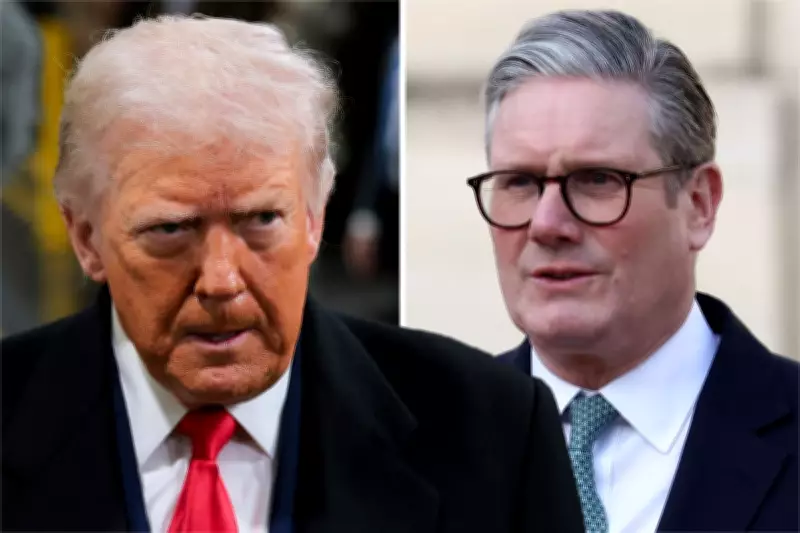
President Donald Trump has expressed being "very disappointed" by Prime Minister Keir Starmer's hesitation in permitting the use of British military bases for operations against Iran. In a striking rebuttal, Simon Walters contends that this sentiment is profoundly mutual, with millions across Britain sharing a deep disappointment directed squarely at the American leader.
A Near-Impossible Position for Starmer
Regardless of individual opinions on Starmer, observers recognise the prime minister was placed in an extraordinarily difficult situation. Trump's request for UK backing in his initial assault on Iran forced Starmer into a delicate balancing act. The subsequent shift in position, aimed at safeguarding British citizens vulnerable to retaliatory strikes in the Gulf region, was a necessary and pragmatic decision.
Historical Hypocrisy and Factual Errors
Trump's criticism arrives amidst a backdrop of hypocrisy, following his imposition of severe tariffs on UK imports due to displeasure over a US Supreme Court ruling. More fundamentally, the president's grasp of history appears flawed. His assertion to The Daily Telegraph that Starmer's actions were unprecedented in UK-US relations ignores critical historical context.

The United States itself declined to support Britain during the Second World War until the attack on Pearl Harbor in 1941 forced its hand. Furthermore, Labour Prime Minister Harold Wilson famously resisted American pressure to commit British troops to the Vietnam War during the 1960s. Wilson's stance, supported by the British electorate, has been vindicated by historical analysis.
Cataloguing British Disappointment
The true source of disappointment lies not with Starmer, but with President Trump's conduct. A detailed examination reveals a pattern of concerning actions and oversights.

- Failure to Learn from Iraq: Ignoring the catastrophic lessons of the bungled US intervention in Iraq, which led to prolonged regional disaster.
- Lack of Consultation: Not bothering to consult the United Kingdom, a loyal ally, before launching attacks on Iran.
- Constitutional Bypass: Omitting to seek approval from the US Congress for military action, contravening American constitutional norms.
- Human Cost Blindness: Failing to foresee the likely deaths of numerous innocent civilians, including Iranians, Americans, and Britons.
- Stark Contradiction: Displaying glaring hypocrisy compared to his past accusations that President Obama would start a war with Iran for political gain.
- Major Policy Reversal: Executing a far more significant U-turn than Starmer by establishing a "board of peace" only to initiate a major conflict weeks later.
- Nobel Peace Prize Mockery: Making a mockery of any claim to deserving the Nobel Peace Prize through aggressive military action.
- Selective Morality: Demonstrating breathtaking double standards by targeting Iran's leadership while offering comfort to Russia's Vladimir Putin.
- Strategic Vacuum: Providing no coherent plan for how the war concludes or how it advances Iranian aspirations for freedom.
- Regional Destabilisation Risk: Risking plunging Iran into the kind of devastating turmoil that engulfed Iraq in 2003, with effects still felt globally.
- Nuclear Proliferation Incentive: Encouraging rogue states to believe acquiring nuclear weapons, like North Korea, is their only defence against random US attack.
- Alliance Contempt: Showing total disregard for NATO allies and the United Nations framework.
- Global Perception Damage: Reinforcing a global view of the US as a bully that flouts international rules on a whim for self-interest.
- Domestic Diversion Suspicion: Allowing critics to allege he is using war to distract from failing economic policies, looming midterm election defeats, and potential exposure in the Epstein scandal.
In summary, the wave of disappointment Trump attributes to Keir Starmer's Iran policy is overwhelmingly reciprocated. The British perspective, grounded in historical precedent and a detailed critique of Trump's actions, paints a picture of a presidency whose approach to foreign policy and alliance management has generated profound concern and disillusionment.