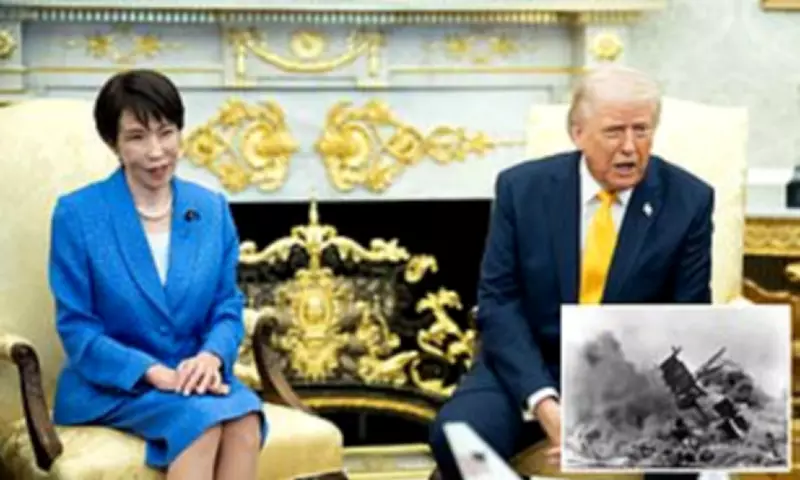
In a startling exchange that has drawn international attention, former President Donald Trump delivered a controversial response when pressed about his undisclosed Iran war strategies during a high-stakes Oval Office meeting with Japanese Prime Minister Sanae Takaichi on Thursday. The discussion, which centred on global security and military cooperation, took an unexpected turn as Trump invoked a painful historical memory.
A Surprising and Controversial Remark
When asked why he had not shared his Iran war plans with allied nations, Trump offered a blunt explanation. 'You don't want to signal too much ... we wanted surprise,' he stated, before adding a provocative comparison. 'Who knows better about surprise than Japan?' Trump continued, 'Why didn't you tell me about Pearl Harbor!'
This reference to the Japanese attack on the US naval base at Pearl Harbor in December 1941, which precipitated America's entry into World War II, was met with visible unease. Prime Minister Takaichi was observed pursing her lips and crossing her hands as Trump made these comments, a clear sign of discomfort during what was otherwise a cordial diplomatic engagement.

Political Allies and Mutual Praise
Earlier in the meeting, the atmosphere had been notably warmer. Prime Minister Takaichi, speaking through a translator, praised Trump extensively, highlighting the severe security environment in the Middle East. 'But even against the backdrop, I firmly believe that it is only you, Donald, who can achieve peace across the world,' she asserted.
The two leaders share a strong political bond as conservatives and allies. Trump proudly endorsed Takaichi's anticipated 2025 run for prime minister, noting her close association with his late friend, former Japanese Prime Minister Shinzo Abe, whom he described as her mentor.
Strained Relations with NATO Allies
The conversation swiftly shifted to broader alliance dynamics, particularly concerning the Strait of Hormuz. Trump has repeatedly called on allies to assist in patrolling this critical waterway amid escalating tensions with Iran. He expressed appreciation for Japan's support, stating, 'We've had tremendous support and relationship with Japan on everything and I believe that based on statements that were given to us yesterday, the day before yesterday, having to do with Japan, they are really stepping up to the plate.'
However, his tone turned critical when discussing NATO. 'Unlike NATO,' Trump added sharply, voicing frustration over the alliance's reluctance to volunteer for the Strait of Hormuz effort. He elaborated, 'In the case of NATO, they don't want to help us defend the Strait, and they're the ones that need it. But now they're getting much nicer, because they're seeing my attitude. But it's, as far as I'm concerned, it's too late.'
Growing Anger and Congressional Reactions
Trump's irritation with NATO has been escalating, as noted by Senator Lindsey Graham, a prominent Iran war hawk and one of Trump's key Congressional allies. Graham revealed on social media earlier this week that he had never witnessed Trump angrier than over this perceived snub. 'I have never heard him so angry in my life,' Graham disclosed, underscoring the depth of Trump's frustration.
Despite his calls for allied assistance, Trump downplayed the necessity of external support. 'We don't need much. We don't need anything honestly from Japan or anyone else. But I think it's appropriate that people step up,' he remarked, suggesting that the US military is largely self-sufficient but expects cooperation as a matter of principle.
This meeting highlights the complex interplay of diplomacy, historical sensitivities, and military strategy, with Trump's candid remarks sparking debate over alliance management and international relations in a volatile global landscape.