The British government has called on Iran's leadership to exercise restraint as the death toll from ongoing anti-regime protests continues to climb sharply. Demonstrations that began in late December over economic grievances have evolved into the most serious challenge to Supreme Leader Ayatollah Ali Khamenei's rule in years.
London Protests and Diplomatic Tensions
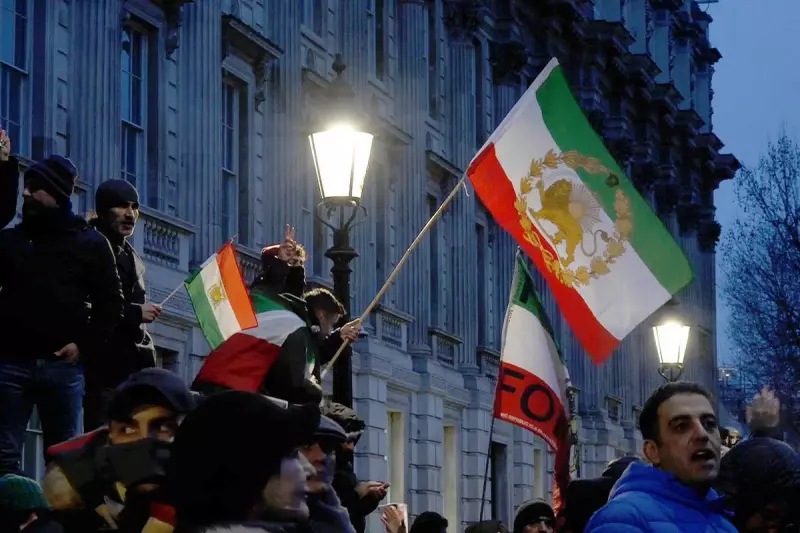
In a show of solidarity, protesters in London have targeted the Iranian embassy for two consecutive days. On Monday 12 January, a demonstrator toppled the flagpole outside the building in Knightsbridge. This followed an incident on Saturday where a protester scaled the embassy's front to replace the Iranian flag with the pre-Islamic revolution lion and sun standard.
The Foreign Office has responded to reports from Tehran that the UK's ambassador, Hugo Shorter, was summoned over the flag incident. Official sources have insisted that Ambassador Shorter merely "had a meeting" at the Iranian Foreign Ministry, rejecting the characterisation of a formal summons.
UK Government Stance and Calls for IRGC Proscription
Transport Secretary Heidi Alexander, speaking on behalf of the government, emphasised the priority was to "stem the violence" occurring within Iran. She told Sky News's Sunday Morning With Trevor Phillips that the UK has always viewed Iran as a hostile state posing security threats in the Middle East and beyond, and as a repressive regime towards its own population.
Meanwhile, demonstrators gathered outside Downing Street to demand that the Islamic Revolutionary Guard Corps (IRGC) be proscribed as a terrorist organisation. This call has garnered support from senior parliamentary figures including Labour peer Lord Spellar and former Conservative leader Sir Iain Duncan Smith.
Ms Alexander noted that proscription decisions, which would be made by Home Secretary Shabana Mahmood, undergo a "very thorough process" and are kept under constant review.
International Reactions and Escalating Crisis
Foreign Secretary Yvette Cooper praised the bravery of Iranian protesters, particularly young women, stating that "it should not require courage just to make your voice heard." She underscored that free speech and peaceful assembly are fundamental rights that should never come with the threat of violence.
The protest movement, which ignited on 28 December initially over economic issues, has been met with a severe crackdown. Despite internet and telephone blackouts imposed by authorities, footage from Tehran and other cities has circulated on social media.
According to the US-based Human Rights Activists News Agency, the confirmed death toll has risen to at least 544 people – comprising 496 protesters and 48 members of the security forces. More than 10,000 individuals have been detained during the two weeks of unrest.
Internationally, the situation remains volatile. US President Donald Trump claimed on Sunday night that "Iran wants to negotiate" following his threats of action, while not ruling out a potential response. Iran has warned it will target US troops and Israel if military action is taken.
In the UK, Conservative leader Kemi Badenoch suggested it would be appropriate for the US to help remove Iran's leadership, indicating potential support for RAF involvement as part of a broad international coalition, similar to recent strikes in Syria. She stressed the need to avoid escalation while working towards a stable Iran.