

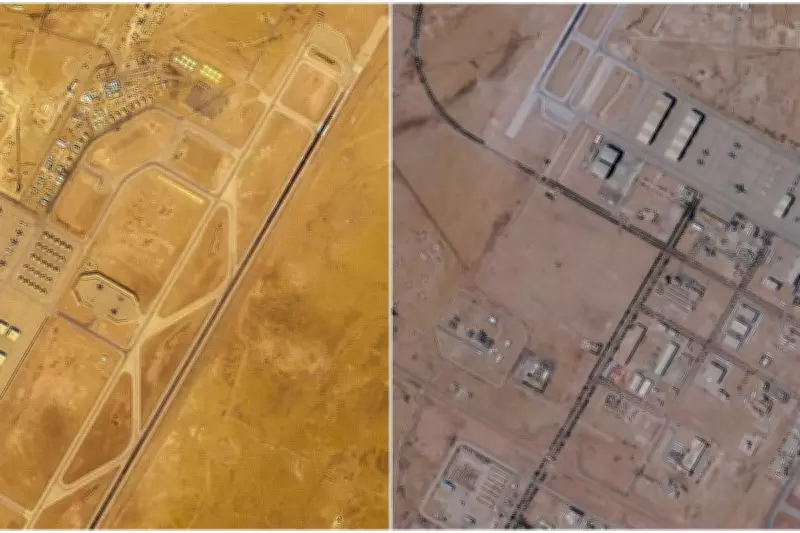
Recent satellite imagery has unveiled a notable escalation in military activity at a key Saudi Arabian airbase, highlighting growing tensions between the United States and Iran. The images, captured over a critical four-day span in February, document a substantial increase in the presence of US military support aircraft at Prince Sultan Airbase.
Detailed Analysis of Aircraft Movements
The data reveals that the number of aircraft stationed at the base jumped from 27 on 17 February to 43 by 21 February, before experiencing a slight reduction to 38 by 25 February. This fluctuation underscores a rapid deployment phase, with the build-up primarily involving advanced support craft such as KC-135 Stratotankers and E-3 Sentry AWACS aircraft. These assets are crucial for aerial refuelling and surveillance operations, indicating preparations for potential extended missions in the region.
Context of Regional and Diplomatic Tensions
This military reinforcement coincided with a broader increase in US forces across the Middle East, as Washington ramps up its posture amid ongoing friction with Iran. Notably, Saudi Arabia had previously communicated to Iran that it would not allow its airspace or territory to be utilised for military strikes against Tehran, adding a layer of diplomatic complexity to the situation.

Simultaneously, indirect negotiations between the United States and Iran regarding Iran's nuclear programme were underway. The timing of the aircraft surge aligns with a stark warning issued by US President Donald Trump to Iran on 19 February, delivered during a high-profile address. This confluence of events suggests a coordinated strategy by the US to bolster its military capabilities while engaging in delicate diplomatic talks.
Implications for Regional Security
The presence of these aircraft at Prince Sultan Airbase, a strategically located facility, signals a heightened state of alert and readiness. Analysts interpret this move as a demonstration of US commitment to regional allies and a deterrent against Iranian actions. The slight decrease in aircraft numbers by late February may indicate a rotational adjustment or a response to evolving diplomatic cues, but the overall trend points to sustained military preparedness.
As tensions simmer, the satellite imagery serves as a tangible indicator of the volatile dynamics at play, with potential ramifications for international security and stability in the Middle East.






