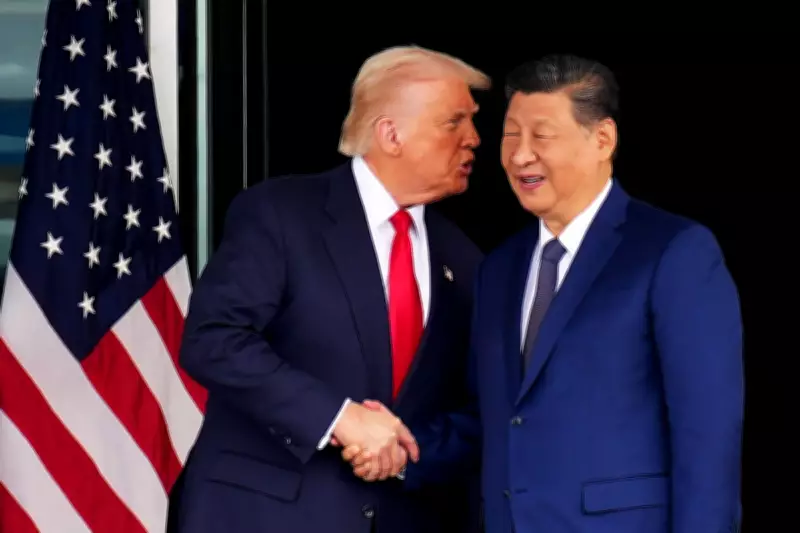
In a significant diplomatic recalibration, the United States has moderated its assessment of China's immediate threat to Taiwan, just ahead of a planned summit between former President Donald Trump and Chinese leader Xi Jinping. The 2026 Annual Threat Assessment from the US Intelligence Community, released this week, explicitly states that Chinese leaders do not currently plan to execute an invasion of Taiwan in 2027, nor do they have a fixed timeline for achieving unification.
Intelligence Report Marks a Notable Shift
The report, compiled by the Director of National Intelligence, represents a clear departure from earlier warnings. It acknowledges China's preference to achieve unification without force, despite its threats to use military means if necessary. "China, despite its threat to use force to compel unification if necessary and to counter what it sees as a US attempt to use Taiwan to undermine China's rise, prefers to achieve unification without the use of force, if possible," the document reads.
This new stance walks back the 2023 intelligence report, which quoted Xi Jinping as instructing his military to "be ready by 2027" for a potential invasion. The shift comes amid heightened tensions, with China consistently asserting sovereignty over Taiwan and Taiwan firmly rejecting those claims, maintaining that only its 23 million people can decide the island's future.

Context of the Trump-Xi Summit
The timing of this assessment is crucial, as the US prepares for a summit between Trump and Xi in Beijing. However, the meeting's status remains uncertain due to the ongoing US-Israeli war against Iran, which has embroiled the Middle East in conflict. Trump recently requested a delay of about a month for his visit, citing the war, with the White House confirming the postponement.
Experts suggest the softened intelligence language may be aimed at easing tensions ahead of the diplomatic engagement, though the report still highlights China's military advancements. It reiterates that the People's Liberation Army is making "steady but uneven" progress on capabilities to capture Taiwan, indicating ongoing preparedness.
Previous Warnings and Current Military Activity
Just last year, US Defense Secretary Pete Hegseth warned allies in the Indo-Pacific that China's invasion of Taiwan appeared "imminent," emphasizing that Beijing was "actively training" daily and rehearsing for potential conflict. "We are not going to sugarcoat it – the threat China poses is real. And it could be imminent," Hegseth stated at the Shangri-La Dialogue.
Similarly, the Pentagon reported late last year that China was preparing to win a fight for Taiwan by 2027 and refining options for a "brute force" takeover if needed. Chinese military activity in the Taiwan Strait has reinforced this perception, though recent observations show a sudden dip in military flights around the island.
Expert Analysis on Military Movements
K Tristan Tang, a Taipei-based non-resident fellow at the National Bureau of Asian Research, suggests the weeklong reduction in flights might indicate a shift in China's military training and modernization. "Mr Xi's military appears to be exploring a new model for joint training between its air force and navy and possibly its ground forces," Tang explained. Such exploratory activities could be conducted away from Taiwan to avoid international monitoring, accounting for the decreased aerial presence.
Satellite imagery from January 2026 has captured Chinese fishing boats in the region, hinting at ongoing maritime operations. Despite the lull in flights, experts caution that China's military posture remains a persistent concern.
Taiwan's Response and Regional Implications
In response to the US intelligence assessment, Taiwan's de facto embassy in Washington issued a statement emphasizing continued vigilance. "China has never abandoned the use of force against Taiwan and its continued military intimidation and gray-zone operations pose serious threats not only to Taiwan but also to regional peace and stability," the statement read. Taipei pledged to monitor China's activities closely, underscoring the island's commitment to self-defense.

This development occurs against a backdrop of Trump's historical downplaying of Chinese military risks during his presidency, adding a layer of political nuance to the current diplomatic maneuvers. As the US and China navigate this delicate period, the revised threat assessment could influence not only bilateral relations but also the stability of the entire Indo-Pacific region.