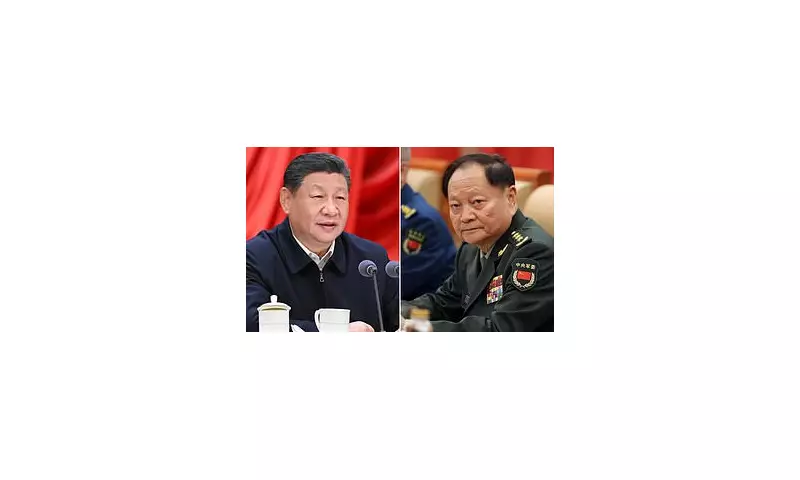
China's highest-ranking military official, General Zhang Youxia, has been dramatically purged by President Xi Jinping following explosive allegations of leaking nuclear secrets to the United States. The removal, which occurred last week, forms part of a sweeping anti-corruption campaign that has punished over 200,000 officials since Xi assumed power in 2012.
Allegations of Betrayal and Beijing Gunfight
Sources claim that General Zhang, once considered President Xi's most trusted confidant, allegedly handed over essential information regarding China's nuclear weapons capabilities to American intelligence. The Central Military Commission launched an investigation into Zhang on Saturday, citing vague "violations of discipline and state law" as the official reason for his dismissal.
However, insiders have revealed far more serious allegations. According to reports, Zhang is accused of undermining Communist Party unity through "political cliques," abusing his authority, and accepting bribes for official acts. These included allegedly facilitating the promotion of former Defense Minister Li Shangfu, who was himself removed for corruption in 2023.

Wild Speculation and Information Vacuum
Associate Professor Chong Ja Ian from the National University of Singapore commented on the swirling speculation surrounding the 75-year-old general's downfall. "Everything from leaking nuclear secrets to the United States to plotting a coup and factional infighting," he told the BBC. "There are even rumours of a gunfight in Beijing."
Professor Chong noted that the wild speculation highlights two critical points: President Xi remains unassailable in his position, and significant limits to information in Beijing fuel uncertainty that breeds such rumours.
Nuclear Secrets Breach Investigation
Much of the evidence against General Zhang reportedly came from Gu Jun, former manager of the China National Nuclear Corp, the state-owned corporation overseeing China's civil and military nuclear programs. At a closed-door meeting on Saturday, authorities allegedly revealed that their investigation into Gu linked Zhang directly to a nuclear data breach, though specific details of the infringement were not disclosed.
The PLA Daily newspaper stated that Zhang's removal demonstrates the Communist Party's "zero tolerance" approach to "punishing corruption… no matter who it is or how high their position."
Military Leadership in Disarray
Experts suggest that General Zhang's removal, along with that of another ruling member of the People's Liberation Army, Liu Zhenli, could leave China's military leadership in significant disarray. Lyle Morris, a senior fellow at the Asia Society Policy Institute, described President Xi's actions as a "complete cleaning of the house... the biggest purge in Chinese history since 1949."
Morris told The Telegraph: "There is no way they could pull off the Taiwan contingency with no senior leaders in charge." This reference to potential military action against Taiwan highlights concerns about how the purge might affect China's strategic capabilities.
Impact on Taiwan Contingency Plans
General Zhang was considered central to modernisation efforts within the Chinese armed forces, serving as senior vice-chairman of the Central Military Commission. His removal, particularly given his reportedly more cautious stance on Taiwan compared to President Xi's more bullish approach, is likely to delay any potential attempt to seize Taiwan by force.
The Central Military Commission has now been reduced to its smallest size in history, with just two members remaining: President Xi himself and Zhang Shengmin, the military's anti-corruption watchdog who was promoted to CMC vice-chair in October.
Historical Context and Future Implications
This latest purge follows the expulsion of other senior military figures, including the other vice chair of the commission, He Weidong, last October, and two former defence ministers in 2024 over corruption charges. Christopher K Johnson, a former CIA analyst specialising in elite Chinese politics, noted that while Beijing can produce impressive hi-tech weaponry, the country's weakness lies in its lack of "software" capable of conducting large-scale military manoeuvres.

Despite the apparent turmoil, Morris added that the removals actually suggest President Xi has "a lot of support in the party and is fully in charge." This assertion comes amid rumours that circulated in Beijing last year about a power struggle between Zhang and Xi, particularly regarding differing views on China's prospects for successfully seizing Taiwan.
The absence of Generals Zhang and Liu from a televised party seminar on Tuesday fuelled further speculation about their fate, with one source telling the South China Morning Post that General Zhang had been accused of corruption, including failing to control his own family members.