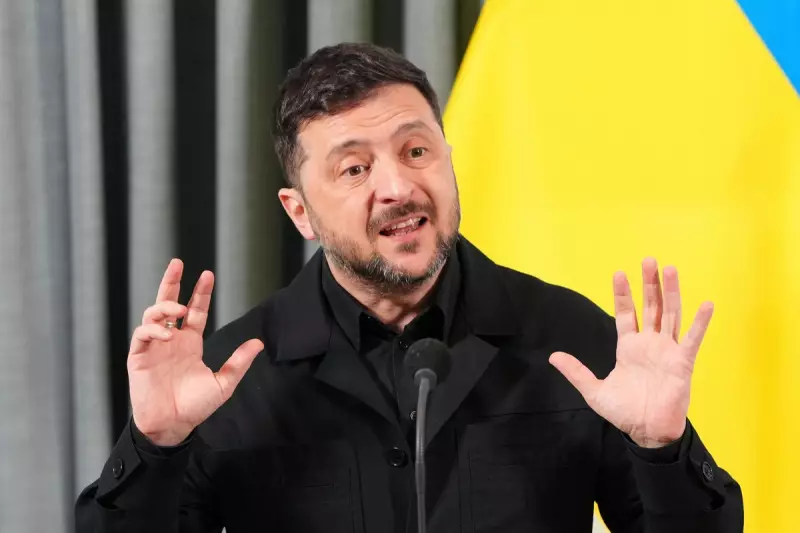
Ukrainian President Volodymyr Zelensky has announced that revised peace plans, brokered by the United States, could be formally presented to Russia within a matter of days. The development follows what he described as successful talks in Berlin, where he secured crucial NATO-style security assurances from European allies and Washington.
Diplomatic Moves and Moscow's Immediate Rejection
Speaking on Tuesday during a visit to the Netherlands, President Zelensky indicated that American envoys were preparing to deliver the outcomes of this week's negotiations to the Kremlin. However, the potential for a breakthrough was immediately dampened by Moscow's firm opposition to core elements of any prospective deal.
Deputy Russian Foreign Minister Sergei Ryabkov reiterated that Moscow would not relinquish captured Ukrainian territory to end the conflict. He also stated Russia would reject any proposal involving NATO peacekeepers being stationed in a post-war Ukraine, a key component of the security guarantees discussed for Kyiv.
Zelensky, addressing the Dutch parliament in The Hague, insisted that peace must not “become a reward for Russia’s aggression.” He warned against over-reliance on diplomacy alone, pointing to the severe situation on the ground as winter takes hold.
Winter Warfare and Critical Infrastructure Under Fire
As diplomatic efforts continued, Russia launched a new wave of heavy bombardment across Ukraine, targeting energy infrastructure. The attacks left hundreds of thousands of civilians without power amid freezing temperatures.
Ukraine's deputy energy minister reported early on Tuesday that the entire Donetsk region had been cut off following a Russian strike. In Odesa, nearly 290,000 people were left without electricity, even after utility workers managed to restore power to 330,000 homes.
Maxim Timchenko, head of Ukraine’s largest energy provider, told the BBC that Russian strikes were now so frequent that repair crews simply did not have time to recover between attacks. Zelensky accused Russia of cynically targeting energy networks to weaponise the winter cold against ordinary Ukrainian citizens.
Allied Support and the Path Ahead
In response to the escalating attacks on infrastructure, the United Kingdom on Tuesday unveiled a new £600 million package for air defence systems to support Ukraine through the winter. Defence Minister John Healey said the investment represented “critical help to Ukrainians as they defend their towns, cities and energy infrastructure from Russia's barbaric attacks.”
Returning from Berlin, Prime Minister Sir Keir Starmer described the talks as productive but cautioned that the path to peace for Ukraine was “not an entirely straight line.” He informed his cabinet of progress on Ukraine’s request for clear, long-term security guarantees, with European allies working on plans for a multinational force to be stationed in Ukraine after the war.
Concurrently, European officials moved to establish an International Claims Commission, to be based in the Netherlands. This body would be tasked with ensuring Ukraine receives compensation for damages from Russian attacks and alleged war crimes. Early discussions have focused on using frozen Russian sovereign assets, supplemented by contributions from EU member states, to fund any damages awarded.
However, the plan to unlock approximately €210 billion (£184bn) in frozen Russian assets faces opposition from some EU nations fearful of legal repercussions and Russian reprisals. Four EU diplomats told Politico that new assurances had not yet swayed Belgium, where most of the assets are held.
Zelensky emphasised that such a financial package was vital for Ukraine's strength and could help offset reductions in support from other partners. Meanwhile, leaders from the EU's eastern flank, including Poland and the Baltic states, met in Helsinki to call for greater EU focus on regional defence, citing the long-term threat posed by Russia. Polish Prime Minister Donald Tusk highlighted discussions on spending billions to construct an “anti-drone wall” along eastern Europe's border.