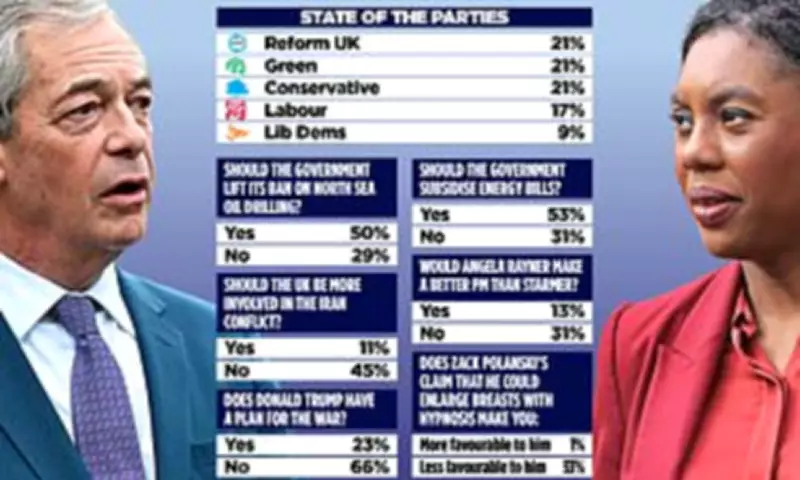
A dramatic new poll has revealed that Kemi Badenoch has successfully overhauled Nigel Farage's previous polling advantage, creating a historic three-way tie between the Conservatives, Reform UK and the Green Party. The survey, conducted by former Conservative deputy chairman Lord Ashcroft, places all three parties at exactly 21 percent support each, marking the first time in nearly a year that Reform has not held a clear lead.
Uncharted Political Territory
Labour finds itself languishing in fourth place with just 17 percent, a position that will undoubtedly concern Sir Keir Starmer's team. The findings come at a critical juncture, with local elections scheduled for next month, and are likely to cheer Ms Badenoch, who has faced persistent speculation about her future as Tory leader following internal party mutterings.
Conversely, the results will rattle nerves within Mr Farage's Reform UK ranks, indicating a significant loss of momentum at a crucial time. Polling expert Sir John Curtice, professor of politics at the University of Strathclyde, described the situation as 'uncharted territory' for British politics, highlighting the unprecedented complexity of voting patterns and the increasing likelihood that no single party will command a majority at the next general election.

Coalition Calculations and Right-Wing Rifts
The poll's implications extend far beyond simple numbers. It is expected to intensify calls for the Conservatives and Reform UK to 'unite the Right' through a pre-election alliance. Should they fail to do so, and if Labour, the Greens under Zack Polanski, and Sir Ed Davey's Liberal Democrats were to form what some term a 'coalition of chaos', this leftist alliance could theoretically command 47 percent of the vote, potentially enough to form a government despite Labour's current low standing.
Despite the concerning figures, one Labour source remained bullish, telling reporters: 'We are just four points off the lead.' This optimism underscores the volatile and fragmented nature of the current political landscape.
Ashcroft's Unique Methodology
Lord Ashcroft's polling method differs significantly from standard approaches. Rather than asking about a hypothetical election tomorrow, he queries voters on their likelihood of supporting each party whenever the next election occurs. This methodology famously and correctly predicted the Leave victory in the 2016 Brexit referendum, when many other pollsters were forecasting a win for Remain.
The decline in Reform's support is corroborated by other polls, showing a drop from highs of 35 percent in September to a current average of around 26 percent. Senior Tory figures have been quick to mock former colleagues like Robert Jenrick and Nadhim Zahawi, who defected to Reform, suggesting they left too soon for what they deride as a 'one-man band'.
Internal Challenges and External Threats
Mr Farage's position is further complicated by internal missteps and external competition. He recently sacked his housing spokesman, Simon Dudley, after Dudley's controversial comments about the Grenfell Tower fire. Furthermore, his support base on the Right faces a new threat from his arch-critic, ex-Reform MP Rupert Lowe, who has established the Restore Britain party.
Mr Lowe claims Restore Britain is already the nation's fourth-largest party with 123,000 members, surpassing the Conservatives' reported 113,000. This development adds another layer of complexity to the already crowded right-wing political space.
Leadership Resolve and Public Sentiment
For her part, Ms Badenoch has firmly dismissed any suggestion she would step down after the local elections. 'It is absurd to suggest I would be replaced,' she stated on Friday. 'I am going to fight on. I don't know of any party leader who has decided that, following a local election result, they would throw in the towel. What kind of person would I be if I just gave up?'
The Ashcroft poll also explored broader public concerns, revealing significant disquiet about international conflicts. Only 11 percent of voters believe the UK should take a more active role in America's war with Iran, while 45 percent oppose greater involvement. Two-thirds of respondents doubt Donald Trump has a coherent plan for the conflict.

Consolation for Labour and Personal Politics
There is some consolation for Sir Keir Starmer within the data. Only 13 percent of voters think his former deputy, Angela Rayner, would make a better Prime Minister than him. However, the poll also highlights personal controversies affecting other leaders.
Green co-leader Zack Polanski appears partially damaged by past claims of being able to increase women's breast size through hypnosis. Just one percent of voters say this makes them view him more favourably, compared to 33 percent who view him less favourably as a result.
This comprehensive poll paints a picture of a British electorate in flux, with traditional party loyalties breaking down and new alliances potentially forming. As the country approaches crucial local elections, the only certainty appears to be continued political uncertainty and fragmentation across the spectrum.