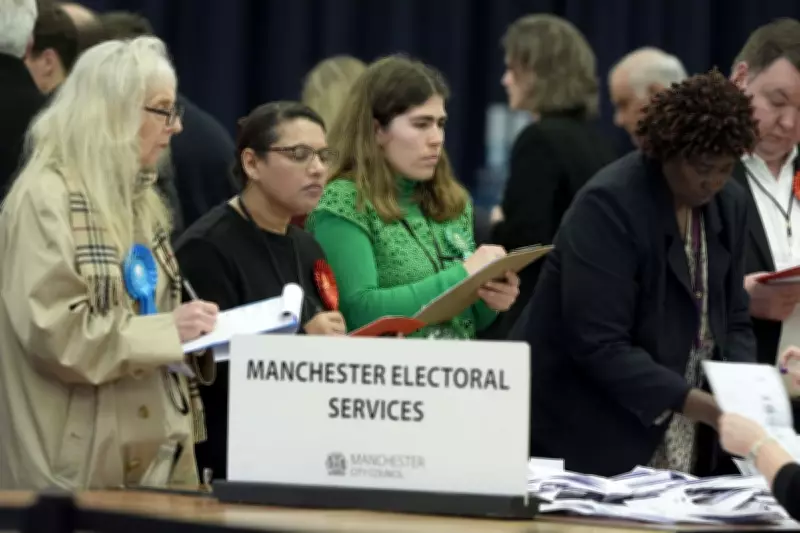
Family Voting Allegations Cast Shadow Over Gorton and Denton By-Election
Serious concerns have emerged regarding potential electoral malpractice during the crucial Gorton and Denton parliamentary by-election in Greater Manchester. An election monitoring group has reported witnessing illegal "family voting" practices across a majority of polling stations, sparking a heated dispute about the integrity of the democratic process.
Observer Group Reports Record Levels of Irregularities
Democracy Volunteers, an independent election observation organization, issued a startling statement after polls closed on Thursday night. The group claimed to have witnessed family voting – where multiple voters use a single polling booth and potentially influence each other's choices – in an unprecedented 68% of polling stations visited.
"Based on our assessment of today's observations, we have seen the highest levels of family voting at any election in our 10-year history of observing elections in the UK," the organization declared in their statement.

The group reported attending 22 of the constituency's 45 polling stations, spending between 30 to 45 minutes at each location. Their observers witnessed family voting in 15 of these 22 stations, with a particularly concerning nine cases occurring at a single polling location.
From their sample of 545 observed voters, Democracy Volunteers documented 32 instances of family voting, affecting approximately 12% of those observed. This contrasts sharply with their findings from the recent Runcorn and Helsby by-election, where they reported family voting in just 12% of polling stations affecting only 1% of voters.
Council Response and Political Fallout
The acting returning officer for the by-election strongly contested the allegations, stating that no issues had been reported by polling station staff during voting hours. A spokesperson expressed disappointment that Democracy Volunteers waited until after polls closed to raise their concerns.
"Polling station staff are trained to look out for any evidence of undue influence on voters," the spokesperson emphasized. "No such issues have been reported today. If Democracy Volunteers were so concerned about alleged issues they could and should have raised them with us during polling hours so that immediate action could be taken."
Reform UK leader Nigel Farage seized upon the allegations, suggesting they raised "questions about the integrity of the democratic process in predominantly Muslim areas." His intervention threatened to overshadow the vote counting process as tensions mounted.
High-Stakes Political Contest
The Gorton and Denton by-election represents a significant test for Prime Minister Sir Keir Starmer's leadership, coming at a time when Labour's popularity has been declining. The contest was triggered by former Labour MP Andrew Gwynne standing down for health reasons.
Labour had won the constituency comfortably in 2024 with over half the vote, but pre-election polling suggested a tight three-way battle between Labour candidate Angeliki Stogia, Reform UK's Matt Goodwin, and the Green Party's Hannah Spencer.
Labour's political lead for the contest, Andrew Western, acknowledged the challenging nature of by-elections for incumbent governments while defending their campaign's positive local focus. "The politics of anger and easy answers offered by Reform and the Greens won't deliver the change communities want to see on the cost of living, or on fixing our NHS," he stated.
Strategic Implications and Voter Confusion
Political analysts highlighted the broader implications of the by-election outcome, regardless of the family voting controversy. Luke Tryl, executive director of research consultancy More in Common, noted that the result would have "huge consequences going forward for narratives" even if decided by a handful of votes.
Both Labour and the Greens positioned themselves as the primary anti-Reform option, creating confusion for tactical voters. Tryl observed that their competing campaigns "left voters more confused" with conflicting claims about which party could best keep Reform UK at bay.

The Green Party expressed confidence that their vote had "held up well" throughout the campaign, with a party source suggesting they had given Labour "the scare of their lives in what not so long ago was considered one of their safest seats in the country."
The final result, expected on Friday morning, is anticipated to influence May's local and devolved elections while shaping the political landscape ahead of the next general election. A Labour victory would provide breathing space for Starmer's leadership, while defeat could reignite speculation about challenges to his position.