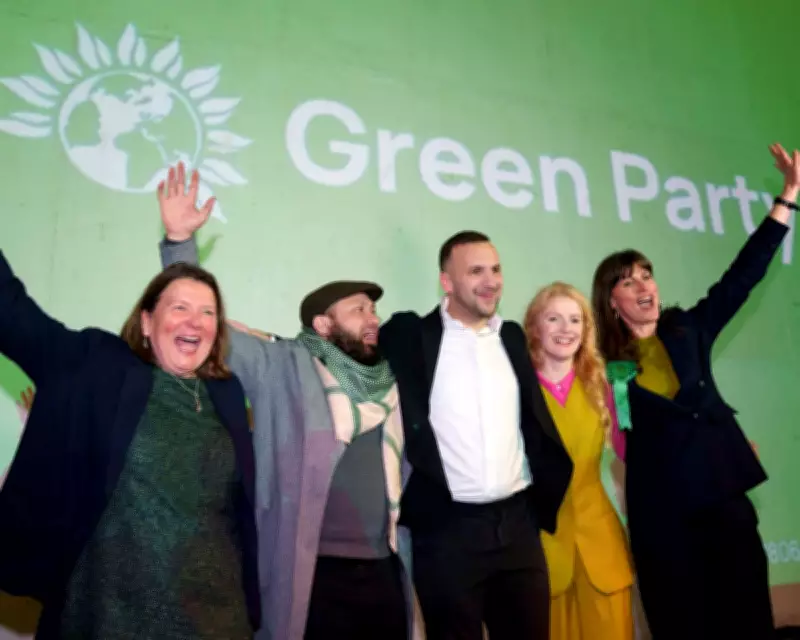
Green Party Celebrates Historic Byelection Victory in Gorton and Denton
In a stunning political upset, the Green Party has achieved a landmark win in the Gorton and Denton byelection, dealing a significant blow to Labour and the leadership of Keir Starmer. Hannah Spencer, a local plumber and Green Party councillor, was elected as the party's first MP in northern England, overturning Labour's 13,000-vote majority from the 2024 general election. The tightly contested race saw Reform UK finish second and Labour come third, marking a dramatic shift in the political landscape of Greater Manchester.
The Green Surge Continues with Convincing Win
The Green Party didn't just sneak a win in Gorton and Denton; they secured it convincingly, capturing almost 41% of the vote. This figure is four times larger than their previous best byelection result, and they achieved a comfortable 4,400 majority. The party's first-ever victory in a Westminster byelection saw its vote share increase by 27.5%, which is five times greater than any byelection performance since 2010.
Reform UK placed a fairly distant second with 10,578 votes, while Labour languished in third with 9,364 votes. This result comes amid growing support for the Greens, whose membership has surged from about 70,000 to over 180,000 since Zack Polanski became leader in September last year. Party sources anticipate membership will soon hit 200,000.

According to Politico's poll of polls, the Greens are now polling at 16% nationally, just two points behind both the Conservatives and Labour, who are tied at 18%. This represents significant progress, as in September, the Greens trailed Reform by 21 percentage points, with Reform currently at 26%.
The choice of candidate was pivotal. Hannah Spencer, a working-class plumber and lifelong Greater Manchester resident, proved to be a disarming force, effectively connecting with ordinary voters. In her victory speech, she focused on wealth distribution and giving working-class people a voice, stating, "Life has changed. Instead of working for a nice life, we're working to line the pockets of billionaires. We are being bled dry." Notably, her speech included only a brief mention of traditional green issues like clean air, alongside priorities such as good schools and thriving high streets, suggesting a repositioning towards a general left-wing populist party.
Has Reform UK's Momentum Stalled?
Reform UK has contested four byelections this parliament, winning only one narrowly in Runcorn. In Gorton and Denton, candidate Matt Goodwin, known for his extreme views, led in the predominantly white working-class Denton area but struggled with the constituency's 44% minority ethnic population due to the party's anti-immigration message.
Despite this, some commentators viewed second place as a good result for Reform UK, as the swing they experienced aligns with national trends. Goodwin claimed to have "embarrassed Labour" in one of their strongest seats, asserting, "I think if we can do this here, we can do this pretty much anywhere." Pollsters More in Common noted that if Reform made similar progress uniformly across the country in a general election, they could secure 229 seats.
Labour Faces Deepening Troubles
Labour, which won Gorton and Denton with over 50% of the vote in the 2024 general election, fell to a distant third place. This result reignites questions about Keir Starmer's leadership and criticism from the left that he hasn't done enough to impress the progressive base, especially after a similar loss in Caerphilly last year.
Starmer acknowledged the disappointment, saying, "It's a very disappointing result. Incumbent governments quite often get results like that midterm. But I do understand that voters are frustrated." The decision to block Andy Burnham from running for the seat has also come under scrutiny, with campaigners suggesting Burnham could have won it.
Luke Tryl of More in Common warned that the loss sends a message to voters about future contests, potentially collapsing Labour's argument that the threat of Reform would unite the progressive vote. The result highlights Labour's challenges in areas with high proportions of graduates, students, and Muslims, with support collapsing among white working-class voters and ethnic minorities.

The Tories' Electoral Nadir Deepens
The Conservatives performed disastrously, securing just 706 votes and losing their £500 deposit after polling only 1.9% of the vote, down 6% from the general election. This marks only the second time since 1962 that the party has lost its deposit in a vote by polling under 5%. Tory leader Kemi Badenoch defended their candidate, Charlotte Cadden, as the "only one sensible candidate standing," but the result underscores the party's struggles.
Other candidates fared poorly as well: the Liberal Democrats' Jackie Pearcey got 653 votes and lost her deposit, while The Official Monster Raving Looney Party's Sir Oink-a-lot polled 159 votes, beating Advance UK's Nick Buckley by four votes.
The Collapse of Two-Party Politics
For the Conservatives, this was the worst byelection result in their history. For Labour, coming third in their 50th safest seat, held for nearly 100 years, represents a historic setback. The result saw the sixth-largest Labour majority overturned since World War II, with activists noting a shift among Muslim voters, many citing Starmer's position on Gaza as a key reason for moving away from the party.
With the Greens and Reform taking a combined 68% of the vote, and Labour and the Tories taking only 27%, the duopoly that has long dominated postwar British politics appears weaker than ever. As Professor John Curtice of Strathclyde University noted, "The Green party's historic success in the Gorton and Denton byelection means the future of British politics is now even more uncertain than it was already."