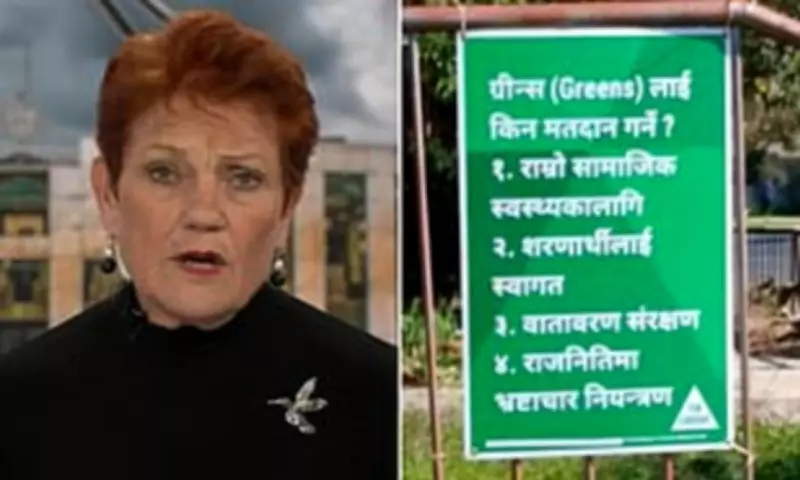
Pauline Hanson, the leader of One Nation, has launched a fierce criticism against the Greens political party for their decision to display campaign signage in Punjabi ahead of the upcoming federal by-election in the New South Wales seat of Farrer. Hanson insists that English should unequivocally remain the primary language used in Australian electoral communications, asserting that this approach is fundamental to national cohesion.
Language Debate Ignites Ahead of Crucial Vote
"What's interesting in this by-election are the corflute signs that are popping up across the electorate," Hanson wrote in a detailed Facebook post on Thursday. She specifically highlighted that "The Greens have erected the following signs, appealing to the Indian community in Punjabi." The One Nation leader contends that "The Greens ignore the vital need to use English for those who want to call Australia home."
English Proficiency Deemed Critical for Democratic Engagement
Hanson elaborated on her position, arguing that proficiency in English is especially crucial during election campaigns. She stated, "English is critical for economic, social and practical survival, especially during elections where debate and policies help voters form a view on who is best suited to lead a community or region." She believes the Greens' decision to use Punjabi undermines the unifying role of English as Australia's national language.

The Greens' signs promote their candidate, Richard Hendrie, encouraging voters to 'Vote 1' and outlining key party priorities. One Punjabi sign articulates the Greens' support for social justice, opposition to discrimination, and advocacy for better education, healthcare, environmental protection, and cost-of-living relief. Another sign emphasises the party's stance on social wellbeing, refugee protection, environmental action, and ending political corruption.
Demographic Context and Electoral Background
However, data from the 2021 Census reveals that Punjabi speakers constitute only 1.2 per cent of the population in the Farrer electorate. This vast rural electorate spans south-western NSW, encompassing regional centres such as Albury, Griffith, Leeton, and Deniliquin. It has been a conservative stronghold since its establishment in 1949.
The by-election was triggered by the resignation of long-serving former Opposition Leader Sussan Ley, who held the seat for 25 years after first being elected in 2001. Early voting commences next Tuesday, with the official polling day scheduled for May 9.
Broader Political Attacks and Campaign Dynamics
Hanson also used the opportunity to criticise the Greens' wider political agenda. "Remember the Greens stand for open borders, mass migration and further division in this country," she declared. The by-election is shaping up as a highly competitive contest, with One Nation's candidate David Farley and independent Michelle Milthorpe among the frontrunners.
Recent YouGov polling indicates One Nation remains ahead of the Coalition nationally, with the party level with Labor on a 27 per cent primary vote. Liberal sources suggest their candidate, Albury councillor Raissa Butkowski, is an outside chance. The Liberal Party is attempting to regain ground by highlighting controversies surrounding One Nation, including the fallout from the employment and subsequent sacking of convicted rapist Sean Black following public backlash.
Implications for Multicultural Political Communication
This incident raises significant questions about political campaigning in Australia's multicultural society. Should political parties utilise languages other than English to effectively reach and engage diverse communities within their electorates? Hanson's strong stance positions English as a non-negotiable element of electoral discourse, while the Greens' approach reflects a strategy to connect with specific demographic groups through their native language.
The debate underscores deeper tensions regarding integration, national identity, and the methods deemed appropriate for political persuasion in a country with a rich immigrant heritage. The outcome of the Farrer by-election may offer insights into how these cultural and linguistic strategies resonate with voters in a traditionally conservative regional seat.