California Democrats Strongly Prefer Newsom to Harris for 2028 Presidential Nomination
In a striking development for the Democratic Party's future, a new poll indicates that California Democrats overwhelmingly favour Governor Gavin Newsom over former Vice President Kamala Harris as their top choice for the 2028 presidential nomination. The survey, conducted by the Los Angeles Times and the UC Berkeley Institute of Governmental Studies, reveals a significant preference gap between the two prominent Californian politicians.
Poll Results Highlight Newsom's Dominance in Home State
According to the poll, twenty-eight percent of respondents selected Newsom as their preferred candidate, while only nine percent chose Harris. This three-to-one advantage underscores Newsom's strong positioning within his home state's Democratic base. Mark DiCamillo, director of the Berkeley IGS Poll, described the outcome as "quite a positive result for Newsom" and noted that he has "separated himself from the rest of the pack."
The findings are particularly concerning for Harris, who not only trails Newsom substantially but also falls behind two out-of-state figures. Representative Alexandria Ocasio-Cortez garnered fourteen percent support, tying with Harris at nine percent alongside former Transportation Secretary Pete Buttigieg. This places Harris in a competitive position with national Democrats rather than establishing her as the clear home-state favourite.

Parallel Political Paths and Potential Future Clash
Despite sharing similar political backgrounds and San Francisco Bay Area roots, Harris and Newsom have never directly competed in an election. Their careers have followed remarkably parallel trajectories: Harris advanced from San Francisco district attorney to state attorney general and then U.S. senator, while Newsom progressed from the San Francisco board of supervisors to mayor, lieutenant governor, and ultimately governor.
Ironically, the March poll showed that neither politician received strong support in the highly liberal Bay Area compared to other regions of California. This regional nuance adds complexity to their political standing within the state.
Diverging Post-2024 Strategies and Public Profiles
Since the 2024 election cycle, Newsom has actively cultivated a higher public profile than Harris. He has positioned himself as one of Donald Trump's most vocal Democratic critics, adopting a confrontational social media style reminiscent of the former president. Newsom has further elevated his visibility through launching a podcast and publishing a new memoir.
In contrast, Harris has maintained a quieter public presence, though she released her own memoir in 2025 titled 107 Days, which details the chaotic 2024 Democratic ticket shake-up that saw her replace President Joe Biden before ultimately losing to Donald Trump.
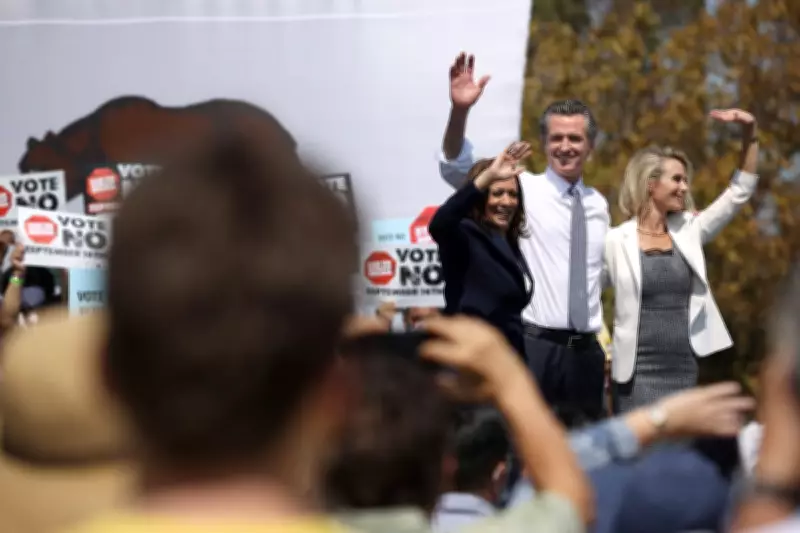
The two politicians have campaigned together in the past, with Harris assisting Newsom during his recall fight and Newsom supporting the Biden administration. However, their political detente may be approaching its end. Last month, Newsom remarked that "fate will determine" whether the California heavyweights finally face each other at the ballot box in 2028, adding "You can only control what you can control" in a CNN interview.
Republican Landscape and General Election Projections
On the Republican side, a similar dynamic between allies could unfold in 2028, with Vice President JD Vance and Secretary of State Marco Rubio emerging as frontrunners and Donald Trump Jr. ranking third. For the general election, the prediction site Kalshi shows Newsom and Vance in a statistical dead heat, each with a twenty percent chance of victory, while Rubio trails slightly at seventeen percent.
This poll data provides crucial early insights into the evolving political landscape as both parties begin to shape their strategies for the 2028 presidential election, with California's Democratic preferences potentially influencing national nomination dynamics.