The political landscape of New York City, and by extension the United States, has been fundamentally reshaped by the improbable victory of Zohran Mamdani as mayor. His election, a triumph for the progressive wing, has not only stunned the political establishment but has also laid bare a deepening and potentially irreconcilable fissure within the Democratic Party.
The Tabloid Frenzy and the Manufactured Menace
In the fevered run-up to the election, the New York Post embarked on a campaign of hysterical brilliance, casting the Ugandan-born Muslim progressive as a figure of existential threat. The paper's narrative lurched wildly, struggling to pin down the nature of the danger Mamdani supposedly represented.
Initially, the focus was on a putative alliance with Antifa, framed as a left-wing street militia infiltrating the Democratic Party. This swiftly gave way to a more sensationalist line, linking Mamdani to Imam Sirah Wahhaj, whom the Post labelled an unindicted co-conspirator in the 1993 World Trade Center bombing. The implication was of a jihadist threat, a narrative that sat uneasily with the earlier anti-fascist framing.
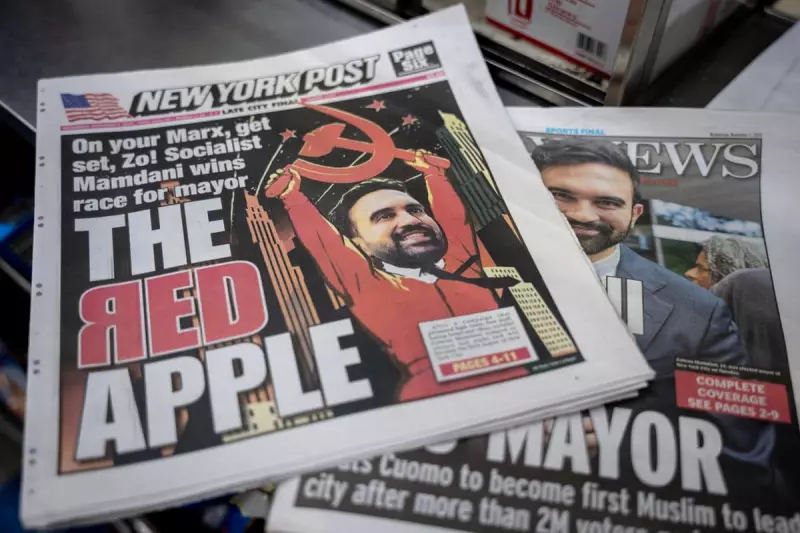
The paper finally settled on a more familiar bogeyman for its conservative readership: communism. Front pages screamed "Keep the Commie Out!" and, following his victory, "On your Marx, get set, Zo!" The imagery was blunt, depicting a red-clad Mamdani brandishing a hammer and sickle. This media storm, however inaccurate, proved commercially successful, with copies selling out across the city.
The Real Battle: Machine Politics Versus People Power
Beyond the tabloid madness, a genuine and significant political struggle was underway. The Democratic Party machine, both nationally and in New York, mobilised to prevent what it saw as a radical takeover of its essential machinery. Key figures like Senate Minority Leader Charles Schumer and House Minority Leader Hakeem Jeffries—who effectively boss the party in Brooklyn—were notably tepid in their support.
Schumer offered no endorsement, while Jeffries gave a last-minute, lacklustre one, widely seen as a move to ward off a future primary challenge from Mamdani's camp. The resistance stemmed from a fundamental dislike of popular insurgencies. Mamdani's campaign, promising a rent freeze in an astronomically expensive city, doubled voter turnout to at least 42%, delivering him a slim absolute majority with over a million votes.
This surge in participation directly threatened the top-down system of patronage, candidate selection, and graft that defines machine politics. His social democratic platform, far from revolutionary expropriation, merely proposed reining in prices and slightly higher taxes on the wealthy—policies not dissimilar to those of Franklin D. Roosevelt.
The Fault Line: Brooklyn Versus Queens
The crucial political civil war is not the national Trump versus Democrat showdown, but a localised conflict within the Democratic Party itself. It pits Mamdani and figures like Alexandria Ocasio-Cortez against the party's old guard: Schumer, Governor JB Pritzker, and California's Gavin Newsom.
The geographic fault line for this struggle runs through New York City. On one side is the Brooklyn machine—the organisation that produced former mayor Eric Adams—which suffered a significant defeat. On the other is a large section of Queens, where Mamdani moved in 2018 and built his winning coalition. This new, undesignated border between boroughs now marks the frontline in the battle for the soul of the party.
The conflict was crystallised by the federal arrest of deposed Venezuelan president Nicolás Maduro in Brooklyn. While Schumer and Jeffries offered muted, critical responses, Mamdani issued a short, unequivocal protest and revealed he had called the President directly. This act ended his brief truce with the Post, which promptly returned to attacking him as a friend of dictators.
Ultimately, Mamdani's victory represents a seismic shock to a sclerotic political system. It demonstrates that a candidate mobilising voters around material issues like housing can overcome both a hostile media ecosystem and a resistant party establishment. For anyone not a professional politician, the rattling of the Brooklyn machine's cage is a significant and promising development in American politics.