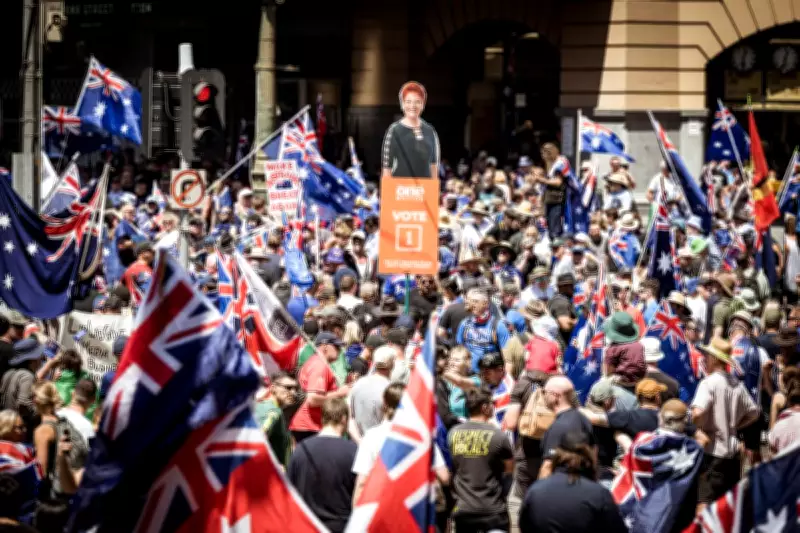
Political analysts across Australia are observing a significant transformation in the electoral landscape, with Pauline Hanson's One Nation party emerging from the extreme fringes to become a more acceptable choice for a growing number of voters. This shift is largely driven by widespread disillusionment with the country's major political parties, according to experts who have been tracking the trend.
A Narrative of Rising Acceptance
In the lead-up to last year's federal election, a narrative began to circulate within political circles suggesting that the Coalition's struggling campaign might receive a crucial boost from One Nation's increasing popularity. The theory posited that preferences from Hanson's supporters could assist the Liberals in challenging Labor in key working-class constituencies located in outer suburbs and regional areas.
"Aunty Pauline is now acceptable," remarked a Liberal insider in a statement to the Australian Financial Review, indicating a perception that Hanson and her right-wing platform had gained a new level of palatability among the electorate. This perspective framed One Nation as a potential electoral asset for the Coalition during a period of political uncertainty.

However, this anticipated scenario failed to materialise on polling day, as Opposition Leader Peter Dutton's suburban-focused strategy encountered significant setbacks. Despite this, the narrative surrounding One Nation's influence has persisted and evolved in the months following the election.
Polling Reveals a Dramatic Shift
The latest Guardian Essential poll has revealed startling figures, placing One Nation's primary vote at 22%. This represents a threefold increase compared to their performance at the 2025 election and brings them within just three percentage points of the Coalition. This surge indicates a substantial realignment in Australian political preferences.
Peter Lewis, a director at Essential Media, interprets this growing support for One Nation primarily as an expression of profound dissatisfaction with the established parties, especially the Liberals and Nationals. He cautions that with the next federal election not scheduled until 2028, these figures should be viewed as indicators of discontent rather than definitive voting intentions. Nevertheless, Lewis emphasises the significance of the trend.
"The rise in support for One Nation is not trivial," Lewis stated. "It reflects shifts occurring elsewhere in the UK, Europe, and of course in the US where populist movements are repudiating the mainstream parties' failures to harness global capitalism."
The Drivers of Discontent
Kos Samaras, a former Labor strategist who now works as a pollster with the Redbridge Group, provides further insight into the motivations behind this voter migration. He suggests that One Nation is increasingly becoming a political haven for individuals whose voting behaviour is now dominated by cultural issues rather than economic management.
"Over time, particularly over the last decade, they have started to experience financial stress and a decline of living standards," Samaras explained, referring to this cohort of voters. "They have now given up on the Coalition, which was the party they used to support because they thought they managed the economy better for them. They are now just voting on cultural grievances and One Nation is absolutely the vehicle for that."
A detailed analysis of the Essential poll data confirms that the rise of One Nation is predominantly, though not exclusively, fuelled by former Coalition voters moving further to the right. The survey found that 23% of respondents who voted for the Coalition in 2025 now intend to support One Nation. In comparison, 8% of previous Labor voters have switched their allegiance to Hanson—a smaller, yet still notable, shift.
Challenging Political Complacency
John Roskam, former executive director of the right-wing thinktank the Institute of Public Affairs, argues that the Liberal Party has maintained a dangerous level of complacency regarding the threat of losing votes to its right flank. As a long-standing Liberal member who maintains connections with state and federal MPs, Roskam offers a critical internal perspective.

"The Liberal party has been pretty complacent about those challenges because they've convinced themselves that Liberal voters couldn't bear to vote for One Nation," Roskam said. "It's now pretty clear they can."
Redefining the One Nation Voter
While One Nation's core support continues to be concentrated outside capital cities among non-university educated individuals with middle-to-low incomes, recent polling challenges simplistic stereotypes. The party is now polling higher than the Coalition with female voters (23% to 21%) and performs considerably better among the 35-54 age demographic (26% to 19%).
This increase in support has occurred without any notable moderation of Hanson's policy positions or public stances, as demonstrated by her controversial burqa stunt in the Senate last November. The party's political messaging remains sharply focused on two primary grievances: ending what it terms "mass migration" and abandoning both the net zero target and the Paris Climate Agreement.
Barnaby Joyce, the former Nationals leader who defected to One Nation in December, attributes the party's appeal to the "clarity" of its positions, which he believes resonates with disenfranchised voters. He contrasts this with the perceived ambiguity of the major parties.
"We're very much more succinct, deliberate and on some issues more binary, which some people don't agree with," Joyce remarked. "After [the] Bondi [massacre] people have said: 'that's it, we've had it'. We don't want you to try and make everyone feel happy. We want you to fix the problem."
Electoral Ambitions and Realities
Following a Newspoll in January that showed One Nation ahead of the Coalition on primary votes for the first time, Hanson publicly declared her ambition to transform the party into a viable alternative government. Currently, One Nation holds just a single seat in the chamber where government is formed—Joyce's regional New South Wales seat of New England—making this goal appear extraordinarily ambitious.
Psephologist Kevin Bonham suggests that reports speculating One Nation could win over 30 seats based on current polling are "not realistic," primarily due to the party's historical difficulties in securing preferences. However, he agrees with election analyst Antony Green's assessment that if national support remains above 20%, it could translate to over 35% in specific rural and regional areas, placing Hanson's candidates in serious contention.
Bonham identifies several seats that could be in play, including LNP-held constituencies in Queensland such as Wright, Flynn, Capricornia, Hinkler, Wide Bay, and Dawson, along with Labor-held Blair outside Brisbane. Labor seats like Hunter and Paterson in New South Wales coal country are also considered potential targets. Winning a cluster of these seats could significantly weaken the Nationals' presence in the lower house, illustrating the substantial threat One Nation poses to the traditional conservative parties.
Internal Dynamics and Future Announcements
The spectre of One Nation's rise has already influenced internal Coalition politics, being cited as a factor in the Nationals' opposition to Labor's proposed hate speech laws—a disagreement that contributed to the political crisis which ultimately ended the Coalition partnership.
Colin Boyce, the Flynn MP who is challenging David Littleproud for the Nationals leadership, recently warned that a split from the Liberals would leave the party vulnerable to a "right-flank onslaught" from One Nation. While Boyce dismissed speculation about his own defection, he hinted that other MPs might soon cross the floor to join Hanson and Joyce.
James Ashby, Hanson's chief-of-staff, confirmed that One Nation has been actively recruiting and is preparing a "significant announcement" ahead of parliament's return. "It will shock people just how significant this announcement will be," Ashby told Sky News, though Hanson's office declined to provide further details when contacted.
Historically, One Nation has been plagued by internal disunity and organisational challenges in Canberra, which have hindered its ability to consolidate support beyond the far-right fringe. Whether the current surge in popularity will lead to similar chaos or fundamentally reshape the Australian political landscape remains one of the most pressing questions in the nation's contemporary politics.