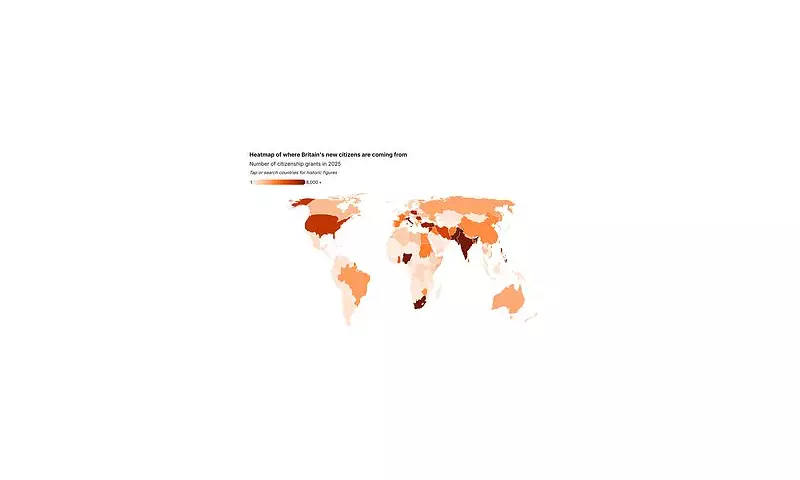
Campaigners have launched a scathing attack on the UK's citizenship system, branding it a 'soft touch' that is devaluing the British passport. The criticism follows the release of official figures showing record numbers of people being granted citizenship, with the process embroiled in scandal over the case of an Egyptian dissident with a history of extremist views.
Record Numbers and a Growing Backlash
Home Office statistics reveal that in the year ending September 2025, migrants from over 200 countries were approved as British citizens. This included individuals from nations as diverse as Nepal, North Korea, and Fiji. The numbers from just three countries—India, Pakistan, and Nigeria—exceeded 55,000, a figure campaigners say is enough to populate towns the size of Horsham, Dunstable, and Clacton.
Under the current Labour government, grant numbers have reached unprecedented levels. The figures hit 269,000 in 2024 and 241,000 for the year ending September 2025. This represents a dramatic increase from the early 1960s, when as few as 15,000 applications were approved annually. The current annual intake is now sufficient to fill cities like Newcastle, Brighton, or Plymouth.
Robert Bates, of the Centre for Migration Control, told the Daily Mail: 'The whole world seems to be getting in on Britain's soft touch pathway to citizenship. This has caused the value of a British passport to be cheapened and awarded to those who are, quite frankly, not British.'
The Alaa Abd El-Fattah Scandal
The debate over citizenship has been supercharged by the controversy surrounding Alaa Abd El-Fattah. The 44-year-old Egyptian activist was granted British citizenship in 2021 while imprisoned in Egypt, based on his mother being born in the UK. He was freed after a long campaign and arrived in London on Boxing Day, where he was welcomed by Prime Minister Sir Keir Starmer.
This welcome provoked immediate outrage after critics unearthed a series of historical online posts by El-Fattah. In 2010, he called for 'the killing of all Zionists, including civilians'. He also described the British as 'dogs and monkeys' and voiced hatred for white people, boasting he was 'proud of being racist against whites'.
El-Fattah's case is particularly contentious because he obtained citizenship via a little-known route based on his mother's birthright. Following a landmark European Court of Human Rights (ECHR) case involving an American murderer, this route exempted him from the usual 'good character' test required for most naturalisation applicants.
Tory leader Kemi Badenoch acknowledged it was a mistake to grant him citizenship, stating the decision was 'rubber-stamped' by officials without being escalated to the then home secretary, Priti Patel. Shadow Justice Secretary Robert Jenrick said: 'It beggars belief that Starmer still "welcomes" this anti-British, anti-white, anti-Semitic extremist to our country.'
System Under Strain and Calls for Reform
The surge in citizenship grants is largely a consequence of high net migration in previous years, as the naturalisation process typically becomes available after five years of lawful residence. Once granted, citizens gain the right to live and work without immigration controls, obtain a British passport, and vote in all elections.
However, Home Office inspectors have previously warned that citizenship has been handed to thousands of illegal immigrants and foreign criminals without proper checks. One uncovered case involved staff approving an application from an asylum-seeker who had admitted to a fatal stabbing in his home country.
Campaigner Robert Bates argues for a radical overhaul: 'The standard naturalisation time needs to be increased to eighteen years. Even then a passport should only be provided once a far more stringent set of criteria are met that demonstrate complete assimilation into British culture.' He also called for the UK to withdraw from the ECHR to regain control over citizenship decisions.
In response to the mounting pressure, Home Secretary Shabana Mahmood has announced the biggest overhaul of the settlement model in 50 years. The plans include doubling the minimum qualifying period for settled status from five to ten years of lawful residence. Migrants are expected to be in work and contributing, with illegal migrants potentially waiting 30 years and benefit claimants up to 20 years for settlement.
A Home Office spokesperson stated: 'These numbers are due to the unacceptably high levels of net migration in recent years... becoming a British citizen is a privilege, not a right. Our reforms are based on contribution, integration and respect for our laws.' As the political storm continues, the value and integrity of British citizenship remain firmly in the spotlight.