In the biting cold of a Minneapolis morning, where temperatures hovered just below freezing, the weight of a 30-pound press-labelled body armour began to feel almost intolerable. This marked the second day of The Daily Mail's embed with Immigration and Customs Enforcement officers from the department's bustling Minneapolis hub, coming weeks after two Americans were killed by federal officers.
The Gruelling Reality of ICE Operations
The back seat of a blacked-out Nissan functioned as an impromptu clubhouse, where two ICE officials—an agent and a public affairs officer—exchanged war stories about Operation Metro Surge. Their 12-hour shifts frequently extended to 14 or even 16 hours, with the simple act of going out on a government-funded per diem becoming a chore due to activists poised to confront any agent. These officers, hailing from Texas and Arizona, spoke candidly of missing their families back home.
Withdrawal of Federal Agents Announced
Border Czar Tom Homan, acutely aware of how public outrage in Minneapolis has amplified the dangers faced by agents and hindered already painstaking operations, addressed the press. At a Wednesday conference in the city, he announced that 700 federal immigration agents would be withdrawn from the frigid urban centre and sent home, describing the situation as not a 'perfect operation.' This reduction will lower the number of federal officials to around 2,000, a significant drop from the peak deployment of approximately 3,000 agents.
Anti-ICE protests, spanning from Minnesota to the Grammy's stage, have intensified calls for the agency to reduce its deployments or dissolve entirely. Meanwhile, in the deadly cold, a truck hummed as it pumped heat into a cramped cab on an ice-packed street, with a Laotian man subject to removal orders presumably starting his day just a block and a half away.
A Detailed Look at Early Morning Raids
The Daily Mail embarked on two early morning ICE operations from February 2 to 3, involving teams of eight to 10 agents spread across multiple vehicles. Between two three-hour patrols on Monday and Tuesday, only two arrests were made. One operation saw agents wait 90 minutes with no movement at a residence, prompting a shift to another nearby target expected to be at work soon.
Idling behind a Hispanic and Asian food market, the team grew eager to make an arrest with the press observing. As another hour passed without action, the mood turned restless, highlighting the slow-moving, tedious watch-and-wait game often absent from news footage and headlines.
Online Backlash and Operational Challenges
A viral video circulating online depicted agents with guns drawn surrounding a car in a southside neighbourhood, with one agent barking at a camera-wielding onlooker to stand back. This footage garnered tens of thousands of views, fuelling the disdain from agitators that agents say has made their jobs more perilous. They stress that their targets often include rapists, kidnappers, and violent criminals, yet memorials for Renee Good and Alex Pretti, shot by federal officers, continue to grow as people pay respects.
Back in the Nissan, a radio call finally signalled a breakthrough: another target was running errands. A follow-up indicated a Honduran national, wanted for criminal trespassing, was headed to a restaurant. The vehicle whipped around, igniting a high-speed dash that transformed a seemingly fruitless ride-along into an adrenaline-fuelled pursuit.
The Arrest: A Study in Contrast
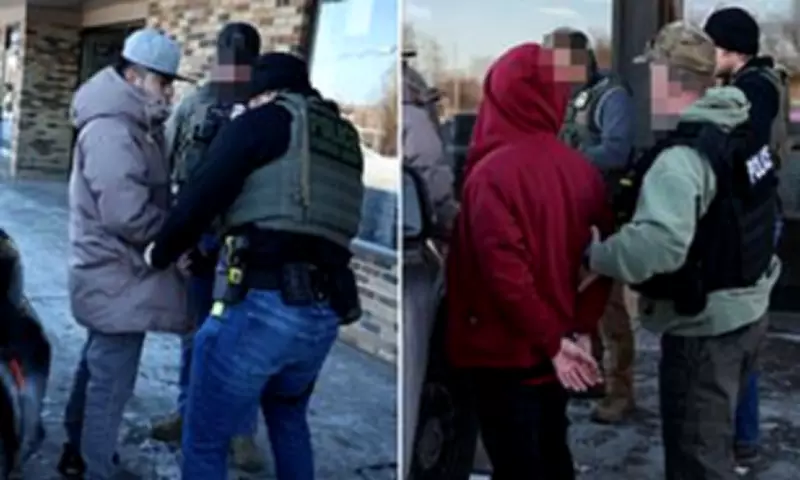
The Nissan sped into a strip mall so rapidly that everyone grabbed their assist handles. After a sharp turn, the subject appeared on foot, attempting to enter a taco shop with a friend. The driver activated the unmarked car's lights as the two men frantically tried the locked front door before turning to face the agents.
Other agents in their vehicles arrived instantly, with one blocking the men's car. An agent speaking Spanish requested identification; one produced a Honduran passport, while the other handed over documents. The Honduran man had a prior criminal history for trespassing and was wanted for illegal entry, already flagged for immigration proceedings. His companion, in the country on a worker authorisation issued by the Biden administration, would also face removal proceedings.
A Surprisingly Cordial Process
The loud, frantic drive culminated in a blur of speed and adrenaline, but the arrest itself was peaceful and professional. Within five minutes of The Daily Mail's arrival, the men were loaded into another unmarked vehicle after answering basic questions and emptying their pockets of phones, vapes, papers, wallets, and keys. Their belongings were bagged, and they were transported to the Whipple Federal Building for processing.
This brief, cordial arrest starkly contrasted with viral ICE videos, featuring no crying, screaming, or attempts to flee. The most upset individual was a woman in her early-to-mid twenties who emerged from a coffee shop to film the interaction, keeping her distance but clearly displeased—unlike other operations in the city, she did not insert herself into the action, much to the relief of the half-dozen agents involved.
The Aftermath and Broader Implications
The ride back to the federal building carried a decidedly more upbeat tone. Staking out targets with criminal histories and removal orders can take days or weeks until agents identify the optimal time and place for arrest. Investigators meticulously determine where these migrants live, work, and spend time, building a pattern of life to ensure safety. If a target deviates from this pattern, that information is logged for future reference.
The agents expressed gratitude that the men pulled into a strip mall off the main street, avoiding potential harassment had they remained on the main drag. It took half a dozen ICE and Homeland Security Investigations agents in six vehicles all morning to make two arrests—a success by their standards, as operations are consistently foiled, especially amid anti-ICE protests that have descended on the city and heightened dangers.
Ultimately, the agents were most content to return to the federal building safely, one day closer to rotating out of Minnesota and reuniting with their families, underscoring the personal sacrifices embedded in these high-stakes enforcement efforts.