Minnesota's Grassroots Resistance: How Communities Unite Against Trump's ICE Deportation Surge
In the heart of Minneapolis, a profound civic mobilisation is unfolding as tens of thousands of residents rally to counter the severe mass deportation tactics enacted under Donald Trump's administration. This movement, arguably the most widespread effort of its kind in the United States, has seen ordinary citizens transform into frontline observers, mutual aid providers, and vocal protesters, all united by a singular mission: to defend their immigrant neighbours from Immigration and Customs Enforcement (ICE) agents.
A Network Reawakened: From George Floyd to ICE Patrols
The infrastructure for this resistance is not new. It is built upon a longstanding culture of civic engagement, robust workers' unions, and a sprawling ecosystem of community-led advocacy groups, particularly those championing the rights of Latino and Somali residents. Crucially, neighbourhood networks that first banded together after the police killing of George Floyd in 2020 have been reignited and expanded. The federal government's aggressive onslaught has effectively drafted a significant portion of Minneapolis into direct action, bringing an abrupt end to normal daily life for many.
Residents like Cory, a south Minneapolis local, exemplify this shift. He never expected to spend hours each day driving after immigration agents, documenting their movements on video. "I'm not the type of person to do this," he admitted. Despite the palpable dangers—highlighted by the killings of two observers, Alex Pretti and Renee Nicole Good, by federal agents in January—Cory felt compelled to act. "We learned growing up about a lot of horrible things people have done in history. And there's a lot of asking yourself, 'What would I have done if I was in that time period?'" he reflected. "I found myself asking that a lot—like, what is our obligation to stop things, like these horrible racist attacks on people and frankly what feels like an ethnic cleansing project?"
The Mechanics of a Community Defence
The resistance takes many practical forms across the Twin Cities and beyond. Volunteers patrol in their cars, meticulously documenting ICE agents. Others provide safe rides for individuals who fear driving, stand guard outside schools during drop-offs and dismissals to protect children and parents, and deliver essential groceries and supplies to families too terrified of detention to leave their homes. Crowdfunding initiatives have sprung up to offer legal aid and cover rent for those affected.
Organisations such as the Immigrant Defense Network and the Minnesota Immigrant Rights Action Committee have been coordinating since Trump's return to office, conducting trainings on how to safely document ICE and know one's rights. A network of hotlines has been operational for months, gathering intelligence from residents and issuing alerts when ICE is spotted in an area. Tactics borrowed from other cities facing similar federal surges include the use of whistles and car horns to rapidly signal ICE's presence.
Will Stancil, a local attorney with a significant online following who has been tracking ICE for weeks, described the peculiar atmosphere. "It feels like we're being invaded," he said. "The invaders want to destroy the city, but we want to protect the city. And I think that posture has made it much easier for us to keep the peace." This sentiment is echoed by Minneapolis Police Chief Brian O'Hara, who told CBS News that after Pretti's killing, he feared the city would descend into chaos, crediting the collective restraint of citizens and police for preventing a total breakdown.
Broad-Based Coalition: Unions, Faith Groups, and Economic Pressure
The anti-ICE movement in Minnesota is notably broad and deep. For every individual visible in videos documenting agents—footage now circulating globally—there are hundreds more working behind the scenes. This includes city council members and state lawmakers engaging in rapid response, following ICE to document operations or appearing at deportation scenes.
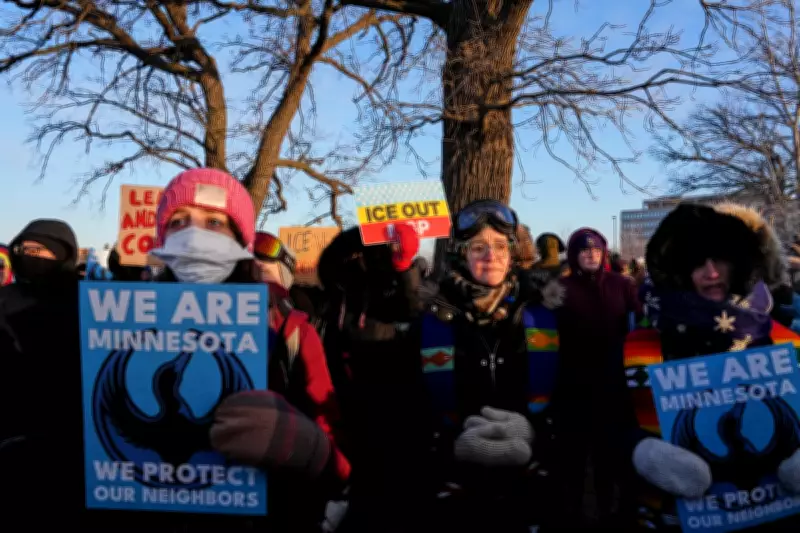
Significant collective actions have amplified the message. A coalition including the Minnesota AFL-CIO union and the multi-faith group Isaiah orchestrated an economic blackout and a large rally on 23 January, held in subzero temperatures. This action attracted national support, with people across the country calling out of work and abstaining from spending. A survey commissioned by involved groups indicated that 23% of nearly 2,000 likely voters had participated in some form, whether by not shopping, working, attending school, or closing their businesses.
Christa Sarrack, president of Unite Here Local 17, which represents around 6,000 hospitality workers, noted the unique ease of organising in this climate. "This is probably the easiest organising we've ever been able to do," she said. "I think it is because people just want to reach out and they want to do something so that they can feel like they're actually being a part of a solution to this." Her union has seen 16 members detained at the airport alone, despite possessing legal work permits, and is providing mutual aid to about 200 members.
The Human Cost and the Spirit of 'Neighborism'
The human impact of the ICE surge is pervasive and deeply personal. For most residents, this is no longer an abstract issue. They now know someone—directly, or through school or work networks—who has been taken by ICE, detained for protesting, or whose business has been forced to close. The deployment of approximately 3,000 agents in a relatively compact urban area means virtually everyone has felt the repercussions.
This reality has galvanised what some commentators have termed "neighborism." It draws on Minnesota's famed social contract, often encapsulated by the concept of "Minnesota nice"—a cultural norm where helping your neighbour, like shovelling them out of a snowbank, is simply the right thing to do. "And now we're in this moment of, we're pushing everyone's cars out at once, and we'll keep doing it, and more people will keep joining in this fight," said Dylan Alverson, owner of Modern Times, who has switched his business to a free or donation-based model to deprive the government of taxable income until the federal surge ends.
Mutual aid networks have shifted into overdrive to address hidden hunger, as fear keeps people from visiting food shelves. Kirstie Kimball, a food writer and fundraiser, helped move 3,000 pounds of food in just two and a half days through local business Moona Moono before stepping back due to a breast cancer diagnosis. She has since focused on fundraising, noting how everyday people are reprioritising spending. "We might see someone be like, 'Hey, instead of going out to eat this week or getting a coffee, I'm going to spend whatever that dollar amount is for me on mutual aid.'"
Frontline Compassion and a Nation's Watchful Eye
At the Whipple federal building, where ICE has established a base, volunteers like Natalie Ehret of the newly formed Haven Watch maintain a near-constant presence. Stationed in a minivan, they provide coats, phones, and a compassionate welcome to those released from detention—including both protesters and immigrants. Ehret estimates she has helped dozens in the past two weeks, including children as young as two and six years old released with their mother. "It's nearly impossible to not walk away changed from those stories," she said.
The protests at Whipple have drawn individuals from across the nation, like Esther from Florida, who used vacation time to join the demonstrations. "This city is literally being slaughtered for political sport," she asserted. Even in more politically mixed rural areas like Nicollet county, residents are not staying silent. Nicole Helget confronted agents parked in her community, questioning them directly about warrants. She emphasised that the bravest leadership comes from within the targeted communities themselves, even if they cannot always be on the frontlines due to vulnerability.
As the situation continues, there is a palpable fear that Trump could escalate further, potentially by invoking the Insurrection Act. The stakes, as Kirstie Kimball noted, are extraordinarily high. "It's hard to be like, they will keep killing us, and we must remain peaceful," she said. "But we also know that the conditions that we're organising under require us to be exceptionally careful... we're not just fighting for the soul of Minnesota, we're fighting for the soul of the rest of the country."
For Cory and countless others, the commitment remains steadfast. "I don't think we can take our foot off the gas until we know our neighbours are safe," he stated, defining safety by the freedom of his Latino and Somali neighbours to live without fear. The movement's endurance, he hopes, will not waver, ensuring that more lives are not lost before the nation continues to care.