

Ohio Church Packed as Faith Leaders Rally to Extend Haitian Protected Status
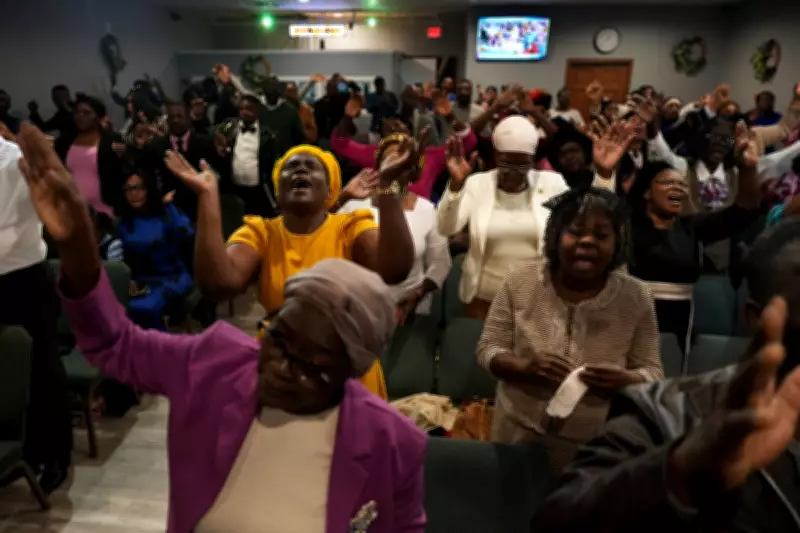
Faith leaders and hundreds of supporters have gathered at a church in Springfield, Ohio, to support Haitian migrants fearing the end of their Temporary Protected Status in the United States. The event on Monday at St. John Missionary Baptist Church called for an extension of TPS, which is set to expire on Tuesday.
Overcapacity Crowd Shows Solidarity
In a church crowded to overcapacity, two dozen faith leaders and their audience of hundreds sang and prayed together in unity as a sign of support for Haitian migrants. Religious leaders representing congregations from across the United States attended the event, demanding an extension of the Temporary Protected Status that has allowed thousands of Haitian migrants to legally arrive in Springfield in recent years, fleeing unrest and gang violence in their homeland.
So many people turned up for the church event that a fire marshal had to ask 150 to leave because the building had exceeded its 700-person capacity. Hundreds joined a choir clapping and singing: "You got to put one foot in front of the other and lead with love."

Legal Hopes and Community Fears
The TPS designation for Haiti is set to expire Tuesday, and those gathered were hoping that a federal judge might intervene and issue a pause. Guerline Jozef, executive director of the Haitian Bridge Alliance, told the packed church: "We believe in the legal system of this country of ours, we still believe. We believe that through the legal ways, the judge hopefully will rule in favor of current TPS holders today that will allow them to stay while we continue to fight."
She added: "We have been called for such a time as this to protect those who have nowhere else to go. They cannot go back to Haiti."
The uncertainty over TPS has deepened worries for an already embattled Haitian community in Springfield. Viles Dorsainvil, leader of Springfield’s Haitian Community Help and Support Center, said: "As we are getting close to the end of the TPS, it has intensified the fear, the anxiety, the panic."
Federal Crackdown and Historical Context
The Department of Homeland Security announced last June that it would terminate TPS for about 500,000 Haitians who were already in the U.S., including some who had lived in the country for more than a decade. DHS said conditions in the island nation had improved enough to allow their safe return.
DHS spokesperson Tricia McLaughlin said in a statement: "It was never intended to be a de facto asylum program, yet that’s how previous administrations have used it for decades. The Trump administration is restoring integrity to our immigration system to keep our homeland and its people safe." She noted there were no new enforcement operations to announce.
A federal judge in Washington is expected to rule any day on a request to pause the TPS termination for Haitians while a lawsuit challenging it proceeds. TPS allows people already in the U.S. to stay and work legally if their homelands are deemed unsafe. Immigrants from 17 countries, including Haiti, Afghanistan, Sudan and Lebanon, had the protective status before President Donald Trump's second term started.
Community Impact and Sunday Services
Some of Springfield’s estimated 15,000 Haitians also sought comfort and divine intervention in their churches on Sunday. At the First Haitian Evangelical Church of Springfield, its pastor estimated that half of the congregants who regularly attend Sunday service stayed home.
Rev. Reginald Silencieux said: "They don’t know the future; they are very scared." Flanked by the flags of Haiti and the United States, he advised his congregation to stay home as much as possible in case of immigration raids. He also offered a prayer for Trump and the Haitian community and reminded congregants to keep their faith in God: "The president is our president. He can take decisions. But he is limited. God is unlimited."

After the service, Jerome Bazard, a member of the church, said ending TPS for Haitians would wreak havoc on his community: "They can’t go to Haiti because it’s not safe. Without the TPS, they can’t work. And if they can’t work, they can’t eat, they can’t pay bills. You’re killing the people."
Wider Consequences and Local Support
Many of the children in the Springfield Haitian community are U.S. citizens who have parents in the country illegally. If they are detained, Dorsainvil said some parents have signed caregiver affidavits that designate a legal guardian in hopes of keeping their kids out of foster care. He added: "They’re not sending their kids to school."
Volunteers from nearby towns and from out of state have been calling the Haitian community center offering to deliver food for those afraid to leave home, Dorsainvil said. Others have been stockpiling groceries in case immigration officers do flood the community. Some, he said, have been receiving desperate calls from family members abroad asking them to leave: "They keep telling them that Springfield is not a safe place now for them to stay."
The event also observed a moment of silence for people who have died in federal immigration detention and for Alex Pretti and Renee Good, who were shot and killed by federal officers in Minneapolis. Some of the speakers evoked biblical passages while appealing for empathic treatment of migrants.





