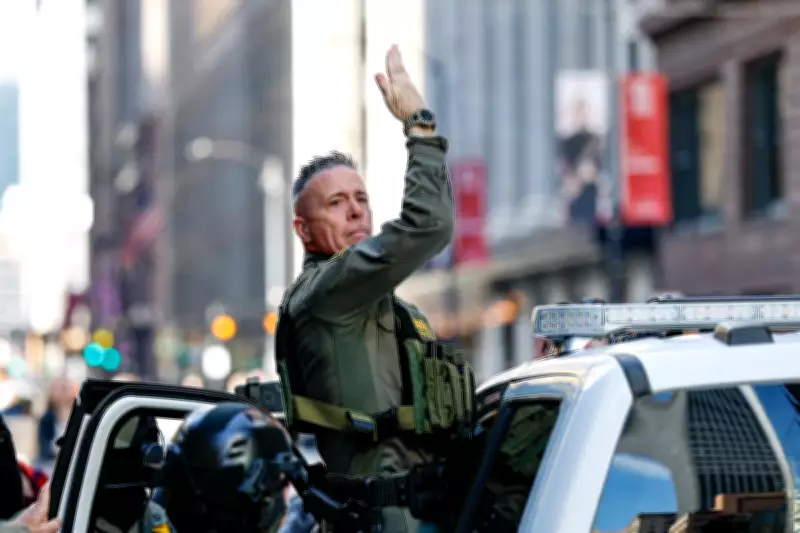
Former Trump Commander Rejected ICE Directives for Targeted Chicago Operations
Emails obtained by NBC News reveal that Gregory Bovino, the former "commander-at-large" for Donald Trump's immigration operations in Democratic-led cities, actively "declined" orders from Immigration and Customs Enforcement leadership to conduct targeted arrests during raids in Chicago.
Internal Conflict Over Enforcement Strategy
According to the correspondence, Todd Lyons, the acting director of ICE, instructed Bovino to focus specifically on "targeted operations" in Chicago. This approach would have limited arrests to individuals already identified by federal authorities for immigration violations and other legal breaches.
Bovino explicitly rejected this directive in a September email to Homeland Security officials, stating: "Mr. Lyons seemed intent that CBP conduct targeted operations for at least two weeks before transitioning to full scale immigration enforcement. I declined his suggestion. We ended the conversation shortly thereafter."

Chain of Command Controversy
The emails indicate Bovino claimed to report not to ICE leadership but to Corey Lewandowski, an unpaid special government employee working closely with Homeland Security Secretary Kristi Noem. This assertion appears to contradict Noem's recent public statements that officers are performing "targeted enforcement" in every situation.
Homeland Security has not responded to requests for comment regarding these conflicting accounts of command structure and operational authority.
Aftermath of Minneapolis Shooting
The revelations come amid significant operational changes following the fatal shooting of Alex Pretti in Minneapolis by border patrol officers under Bovino's command. This incident, occurring just two weeks after an ICE agent fatally shot Renee Good in the same city, prompted bipartisan political pressure and growing public outrage.
In response, President Trump deployed White House border czar Tom Homan to Minnesota, effectively cutting Secretary Noem out of the chain of command. Bovino has since been returned to his previous post at CBP's southern California branch near the U.S.-Mexico border.
Pattern of Aggressive Tactics
Under Bovino's leadership, the Department of Homeland Security deployed thousands of masked border patrol agents into multiple Democratic-led cities including Los Angeles, New Orleans, and Charlotte, North Carolina. These operations have faced numerous allegations of indiscriminate, large-scale arrests and aggressive tactics.
Federal lawsuits from protesters and press groups describe officers "gassing residents in different neighborhoods each day" during what they termed a "tour of Chicago neighborhoods." District Judge Sara Ellis commented in November that "the use of force shocks the conscience" and emphasized the public interest in governmental conduct that follows established rules and policies.
Legal Context and Supreme Court Rulings
The operations occurred against a complex legal backdrop. In September, the Supreme Court's conservative majority granted federal agents permission to stop and detain individuals based on perceived ethnicity, spoken language, or occupation—a decision critics argue has fueled racial profiling.
Justice Brett Kavanaugh, who authored the ruling, later added clarification in December footnotes, noting that officers "must not make interior immigration stops or arrests based on race or ethnicity." However, this clarification came after Bovino's Chicago operations had concluded.
Defiance and Defense
Despite numerous allegations of violent tactics—including accusations of officers ripping people from cars in front of their children, using chemical weapons at point-blank range, and turning neighborhoods into "war zones" filled with tear gas—Bovino testified that his officers' behavior was "more than exemplary."

This testimony came after plaintiffs accused border patrol officers of violating protective orders against using riot weapons against demonstrators, highlighting the ongoing tension between enforcement practices and civil liberties concerns in immigration operations.