Civil Rights Pioneer Jesse Jackson Passes Away at 84
The Reverend Jesse Jackson, the towering civil rights leader whose thunderous oratory and moral vision reshaped American politics, has died at the age of 84. His family announced his peaceful passing, though no specific cause was disclosed. Jackson had been hospitalised in recent months while being monitored for progressive supranuclear palsy, a neurodegenerative condition.
From Southern Segregation to National Prominence
Born Jesse Louis Burns in 1941 in Greenville, South Carolina, Jackson entered a world rigidly defined by Jim Crow segregation. His early experiences with racial injustice shaped his lifelong activism. As a boy, he walked past a white elementary school each day to attend a segregated Black school five miles away, an experience that sharpened his sense of inequality.
In 1960, he led a peaceful "read-in" at Greenville's segregated library, resulting in his first arrest for disorderly conduct. This marked the beginning of decades of civil disobedience and activism that would define his career.

The King Connection and Civil Rights Leadership
Jackson's life became forever intertwined with the civil rights movement when he joined Martin Luther King Jr.'s Southern Christian Leadership Conference. King appointed him head of Operation Breadbasket, the economic arm of the organisation that used boycotts and negotiations to pressure companies to hire Black workers and support Black-owned businesses.
The night of King's assassination in 1968 remains central to Jackson's legacy. He was present at the Lorraine Motel when King was shot, and his subsequent television appearances wearing a blood-stained turtleneck became iconic images of the tragedy. Jackson later explained his actions as resulting from trauma, though some biographers have suggested ambition also played a role.
Building the Rainbow Coalition
In 1971, Jackson broke with the SCLC leadership and founded Operation PUSH (People United to Save Humanity, later People United to Serve Humanity). The organisation targeted discriminatory corporate practices through boycotts of major companies including Coca-Cola, Burger King and Revlon, often securing concessions and contracts for Black businesses.
His most significant political innovation came in 1984 with the formation of the National Rainbow Coalition, which broadened his message to embrace women, the poor, and members of the LGBTQ+ community. This coalition later merged with PUSH to create the Rainbow PUSH Coalition, reflecting Jackson's conviction that political power required a broad alliance of marginalised groups.
Presidential Campaigns and Political Impact
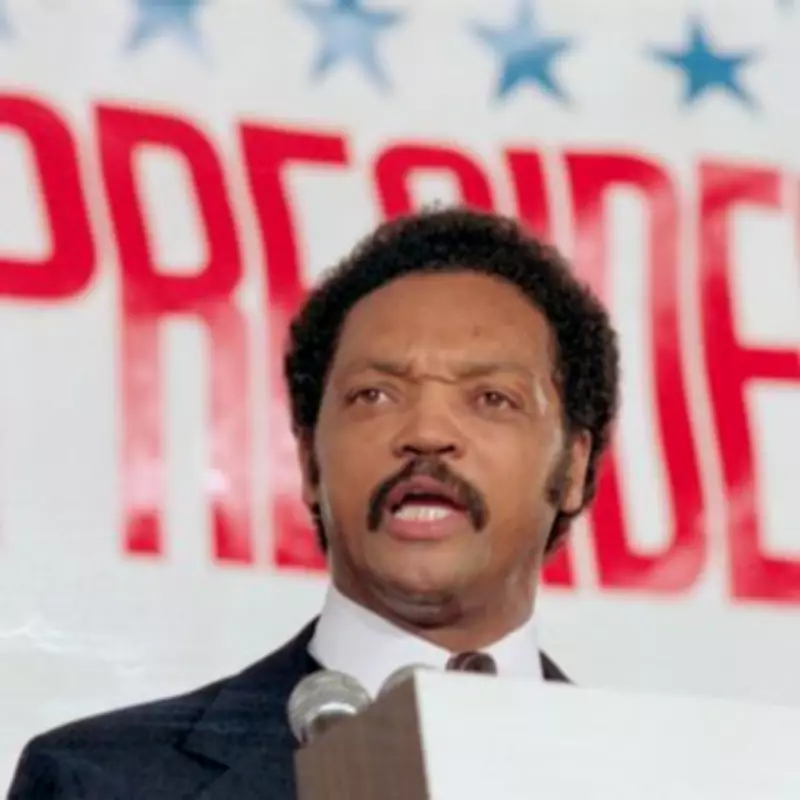
Jackson mounted two serious campaigns for the Democratic presidential nomination in 1984 and 1988. Though he never secured the nomination, his campaigns transformed expectations of what Black candidates could achieve nationally and helped lay the groundwork for future progressive leaders including Barack Obama, Alexandria Ocasio-Cortez and Bernie Sanders.
His 1988 convention speech became one of the defining political addresses of the era, concluding with his famous refrain: "Keep hope alive. Keep hope alive. Keep hope alive." The speech encapsulated his message of resilience and possibility for America's marginalised communities.
International Influence and Later Years
Jackson's influence extended beyond American borders. He visited the United Kingdom on numerous occasions, addressing church congregations and anti-apartheid rallies, meeting Labour politicians, and drawing parallels between racial injustice in the United States and inequalities in Britain. He became a prominent voice in the international struggle against apartheid in South Africa.
In 2000, President Bill Clinton awarded Jackson the Presidential Medal of Freedom, America's highest civilian honour, in recognition of his decades of work advancing opportunities for people of colour.
Complex Legacy and Personal Challenges
Jackson's career was not without controversy. He faced criticism over his association with Nation of Islam leader Louis Farrakhan and apologised for derogatory remarks about New York's Jewish community. In 2001, he acknowledged fathering a child out of wedlock, and his son, former congressman Jesse Jackson Jr., was convicted of campaign fraud in 2013.

Health challenges marked his later years. In 2017, Jackson disclosed he had Parkinson's disease, which gradually limited his mobility and speech. After contracting COVID-19 in 2021, he spent weeks in rehabilitation before being diagnosed with progressive supranuclear palsy last year.
Enduring Impact on American Politics
Despite the controversies and health struggles, Jackson remained active in political discourse, supporting Black Lives Matter protests and commenting on the political shifts that followed Donald Trump's election. He continued to advocate for multiracial coalitions of conscience, warning against the dangers of ethnic nationalism.
Jackson's legacy is complex but undeniable: a preacher's voice carried into the political arena, a belief that America could be remade by a coalition of the poor and excluded, and a rallying cry that still echoes through American politics. As he once declared: "I was born in the slum, but the slum was not born in me. And it wasn't born in you, and you can make it."
His death marks the passing of one of the last major figures from the civil rights era, a man who bridged the struggle led by Martin Luther King Jr. and the political ascent of Barack Obama, forever changing what was possible for Black political leadership in America.