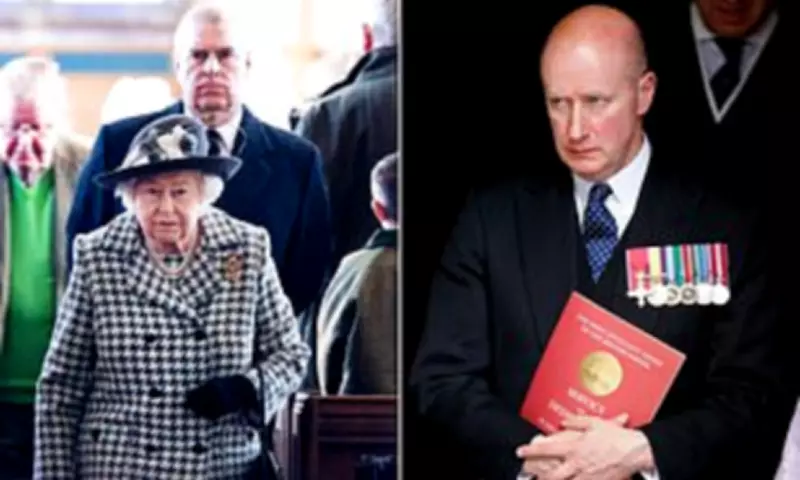
Queen's Trusted Adviser Removed After Raising Concerns Over Andrew's Business Affairs
Whitehall sources have made the startling claim that one of Queen Elizabeth II's closest confidants was ousted from Buckingham Palace at the insistence of Prince Andrew, after he warned the monarch that her son's business activities posed a significant risk to the reputation of the Royal Family.
The Decade-Long Service and Sudden Departure of Sir Christopher Geidt
Sir Christopher Geidt, who served as the late Queen's private secretary for ten years until his forced departure in 2017, was once described as one of the few individuals in the royal circle 'willing to say boo to a goose'. His exit followed an intense power struggle within the royal household, but new revelations suggest Prince Andrew played a direct role in his removal.
By 2019, Lord Geidt had been elevated to the House of Lords as Baron Geidt and appointed as a Permanent Lord-in-waiting, a peer holding office in the royal household. During this period, highly placed informants contacted him with urgent warnings about Andrew's business dealings with Russian oligarchs.
One source disclosed: 'He said that he would pass on the information to his old colleagues at the Palace, but that he had long been aware of these issues and he had attempted to raise them before. "But the Queen just doesn't want to know." It seems clear that Andrew played a role in his departure in 2017.'
A Pattern of Suppressed Intelligence and Royal Protection
This revelation represents the latest indication that damaging intelligence regarding Prince Andrew may have been suppressed by the royal household for years, largely due to the Queen's deep affection for her second son. The disclosure follows last week's report by The Mail on Sunday, which revealed that King Charles III was warned as early as 2019 that the Royal Family's name was being 'abused' through Andrew's business associations.
A whistleblower sent an email to Charles, then the Prince of Wales, alerting him to the former Duke of York's secret financial connections with controversial millionaire financier David Rowland, who was allegedly exploiting his royal links. The email explicitly warned of 'David Rowland's abuse of the Royal Family'.
Historical Context: Early Warnings and Euphemistic Conversations
Sir Craig Oliver, who served as director of communications for Prime Minister David Cameron, has recalled a 2011 meeting with a senior adviser to the Queen, understood to be Lord Geidt. This meeting occurred after questions emerged about Andrew's role as a UK trade envoy, following the publication of a photograph showing him with 17-year-old Virginia Giuffre.
Sir Craig noted that 'the bulk of the conversation with the adviser was about Prince Andrew, who was starting to appear in the media for spending more time on louche holidays than he was executing his official duties as UK trade envoy'.
He added: 'The Palace official's sentences were littered with euphemisms that were – in their own way – devastating. He said that we could all agree that the Duke of York's public role had not been a "smooth ride". On one level there had been the "fluff" of him helping to sell bits of Britain, but we all knew he was "not biddable".'
The adviser contrasted Andrew's 'patchy' performance with the 'superb' work of the Duke of Kent, noting that Andrew tended to 'rub the fur the wrong way'. After this 'gentle demolition', the official suggested it might be time to announce that, after 'ten good years', Prince Andrew should leave the role.
Reflecting on this exchange, Sir Craig observed: 'Looking back on this I see the seeds of the full crisis we are now witnessing. For "dignity" read, "don't rock the boat".'
A source close to Lord Geidt has declined to comment on these latest allegations, maintaining the traditional discretion of royal insiders even as these troubling revelations continue to surface.