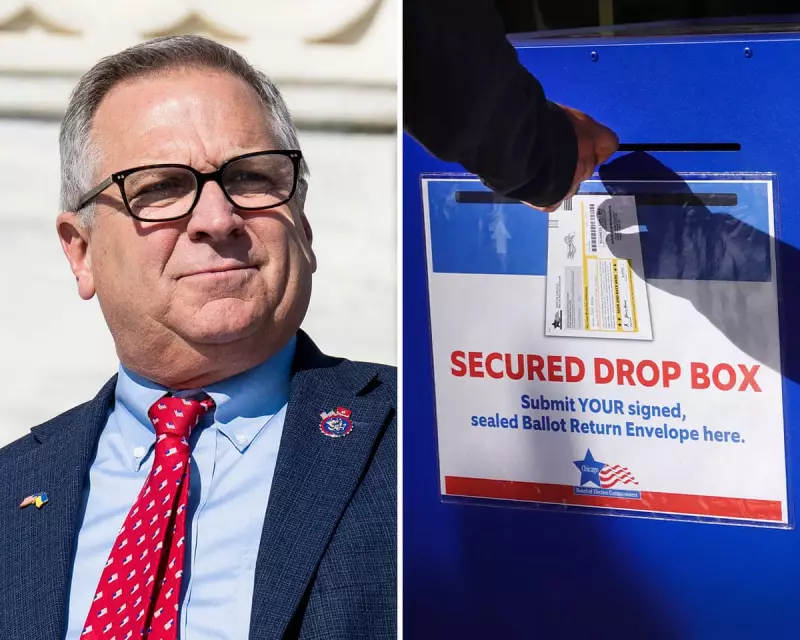
In a significant ruling with potential ramifications for US electoral processes, the United States Supreme Court has revived a legal challenge brought by a Republican congressman against an Illinois state law governing the counting of mail-in ballots.
A Pathway to Challenge Post-Election Day Counting
The court's 7-2 decision, handed down on Wednesday, allows Congressman Mike Bost to proceed with his lawsuit. Bost, a conservative Republican from Illinois now serving his fifth term, argues that the state's law permitting the counting of mail-in ballots for up to two weeks after election day is unconstitutional. His central claim is that this provision effectively extends the election period beyond the single day designated by law.
The Illinois statute in question allows election officials to count ballots received after election day, provided they are postmarked on or before that date. This practice is not unique to Illinois; sixteen states, along with Guam, Puerto Rico, the Virgin Islands, and Washington DC, have similar rules for accepting late-arriving mailed ballots.

Standing and the "Candidate-Plaintiff"
The Supreme Court's decision did not rule on the constitutional merits of the Illinois law itself. Instead, it focused on the procedural question of whether a political candidate like Bost has the legal standing, or right, to bring such a challenge in the first place. Lower courts had dismissed Bost's suit, finding he had not suffered a concrete injury.
Writing for the majority, Chief Justice John Roberts asserted that candidates possess a direct interest in the rules governing the elections in which they compete. "Candidates have a concrete and particularized interest in the rules that govern the counting of votes in their elections," Roberts wrote. He argued this interest extends to "the integrity of the election – and the democratic process." Bost's legal team had contended that the cost of maintaining a campaign operation past election day, in case of a late count, constituted a financial injury granting him standing.
The ruling, however, drew a sharp dissent from the court's liberal justices. Justice Ketanji Brown Jackson, joined by Justice Sonia Sotomayor, warned that creating a special rule for candidate-plaintiffs "complicates and destabilizes both our standing law and America's electoral processes." Jackson argued that political candidates should be held to the same standard as any other litigant in proving a direct injury.
Broader Context of Mail-In Voting Battles
This case arrives amidst a highly charged national debate over mail-in voting, which expanded significantly during the Covid-19 pandemic. Former President Donald Trump and his allies have repeatedly sought to challenge the legitimacy of mail-in ballots and the rules surrounding them. Trump himself issued an executive order in March aimed at states counting ballots received after election day, though it was swiftly challenged in court by civil rights groups.
Conservatives aligned with Trump viewed Bost's lawsuit as a strategic avenue to continue these broader attacks on postal voting methods. The Brennan Center for Justice, the American Civil Liberties Union, and the League of Women Voters are among the organisations that have actively opposed such measures, defending expanded voting access.
The Supreme Court's decision to reinstate the lawsuit means the case will now return to lower courts for further proceedings on its substantive claims. The ultimate outcome could influence not only Illinois law but also set a precedent for how election rules are challenged across the United States in future contests.