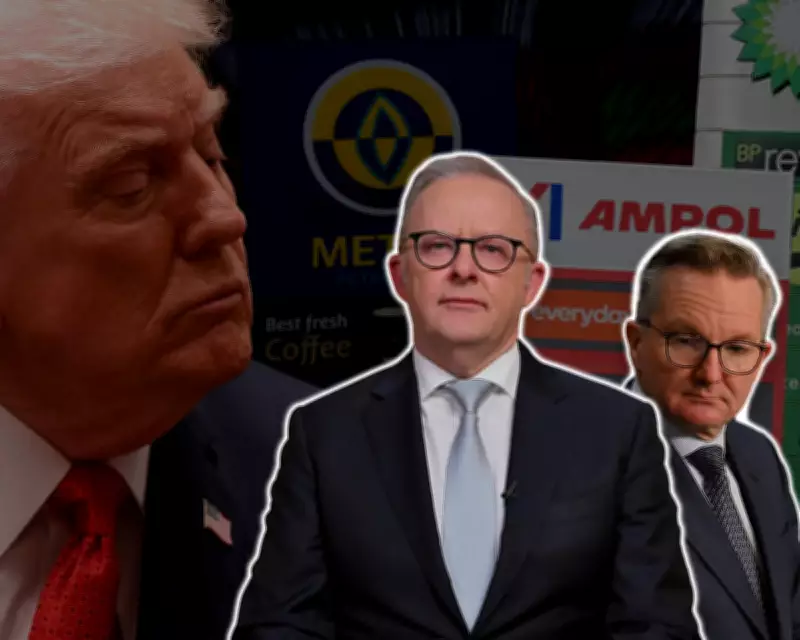
Albanese Confronts Global Energy Shock Amid Trump's Iran War Fallout
The Australian Prime Minister, Anthony Albanese, and Energy Minister, Chris Bowen, are grappling with the severe economic repercussions stemming from the Middle East crisis, while simultaneously increasing their government's distance from the actions of former US President Donald Trump. This unfolding scenario has thrust Australia into a period of significant uncertainty, testing leadership and policy responses.
A New Reality Dawns for Australian Leadership
On Saturday, 28 February, Anthony Albanese was engaged in a charity tennis event at Coogee Beach Tennis Club in Sydney's eastern suburbs, a brief respite from the relentless pressures of governing. However, that evening marked a pivotal moment as the US and Israel launched initial strikes on Iran, igniting a conflict that triggered a historic global energy shock. This event has ushered in a new era of unpredictability for Australia and the international community.
The Australian government was not consulted prior to Donald Trump's authorization of Operation Epic Fury but swiftly endorsed it, citing the necessity to prevent Iran from acquiring nuclear weapons and threatening global security through militant proxies. As Trump's objectives in the Middle East became increasingly ambiguous and petrol prices surged domestically, this conflict emerged as the second major test of Albanese's leadership in recent months, following the Bondi beach antisemitic terror attack.

Economic Turmoil and Political Pressure Intensify
Facing mounting political pressure, Prime Minister Albanese has rapidly deployed billions of dollars in relief measures for motorists and businesses. For the first time, he has questioned the ongoing purpose of Trump's increasingly unpopular war, signaling a shift in stance. Albanese has also framed the international turmoil as a catalyst to pursue structural economic reforms that he previously avoided, emphasizing that the world has changed and the government must adapt accordingly.
In an address to the National Press Club, Albanese stated, "There is no security in maintaining a status quo that doesn't work for people." This reflects a broader realization within the government of the need for proactive change in response to global instability.
Fuel Crisis Unfolds Amid Mixed Government Signals
Thirty-two days after the initial strikes on Tehran, Albanese delivered a primetime address to the nation from his Parliament House office, aiming to quell fears about Australia's fuel supplies while cautioning that the "months ahead may not be easy." This mixed messaging highlighted internal confusion as the government struggles to convey the severity of the situation to a public still recovering from the Covid-19 pandemic.
Energy Minister Chris Bowen asserted that Australia was better prepared for such a shock compared to 2022, due to enhanced energy reserves. However, reports of service stations running dry contradicted public assurances, leading the Coalition to accuse the government of underestimating the disruptions. Bowen warned that panic-buying posed the "biggest risk to availability," though critics argued this shifted blame for a government-made problem.
Government Interventions and Economic Scars
Within a week of the conflict's onset, the government feared that without intervention, farmers would face diesel shortages for seeding. Bowen announced temporary measures, including lowering fuel quality standards and releasing 20% of the national stockpile, to boost supplies to regional Australia. By this point, diesel prices had surpassed $2.60 per litre, and unleaded petrol approached $2.20 in capital cities.
Treasury projections indicated that inflation could spike above 5% if the conflict prolonged, prompting Albanese to consider halving the fuel excise. After a national cabinet meeting, he confirmed a three-month halving of the excise and a pause on heavy vehicle charges, costing $2.55 billion. Albanese explained, "We understand the cost pressures for people are very real as the impact of the war on the other side of the world plays out right here. We're acting now to be overprepared."

Distancing from Trump and Pursuing Ambitious Reforms
Donald Trump's social media outburst on 18 March mocked allies, including Australia, for not directly assisting in the war, despite no formal request for support. The Albanese government had agreed to send an E-7 Wedgetail aircraft and missiles to protect the United Arab Emirates but ruled out ground troops. Privately, the government questioned Trump's "flip-flopping" objectives, believing the original goals of Operation Epic Fury had been achieved.
Albanese emphasized that Australia was not consulted on the war and called for more certainty in objectives and de-escalation, marking a notable shift from his earlier silence. Foreign Minister Penny Wong participated in a UK-convened summit to discuss reopening the Strait of Hormuz, excluding the US, further distancing Australia from Trump's actions.
Albanese has previously distanced himself from Trump for domestic political purposes, but the war and fuel shock are now pushing him to resurrect this strategy in pursuit of longer-term changes. In his press club speech, he set the stage for an ambitious budget on 12 May, combining economic reforms with interventions to enhance Australia's resilience to global shocks. He asserted, "International uncertainty is not an excuse to delay, or hold back reform, it is the reason we must press ahead."
This approach underscores a commitment to adapting Australia's economic model for a more unpredictable world, moving beyond past hesitations to embrace transformative policies in the face of ongoing global challenges.