Billionaire Tax Movement Gains Momentum Across US States Amid Rising Wealth Inequality
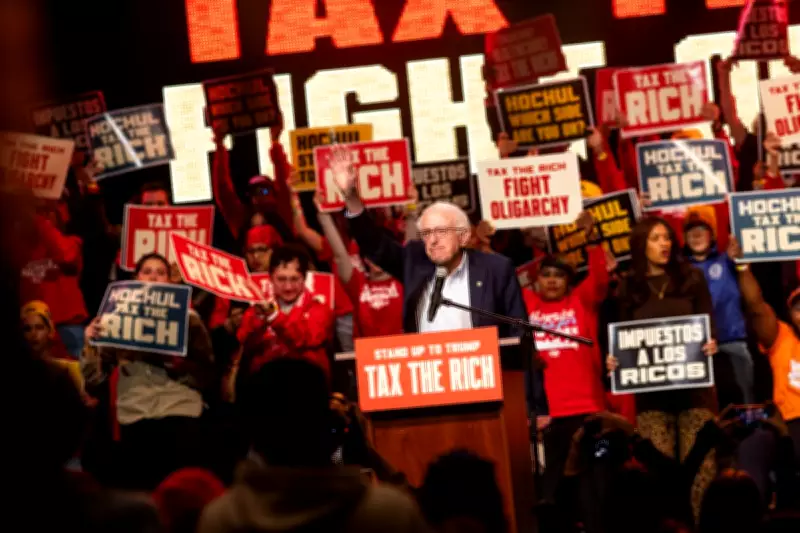
Senator Bernie Sanders recently addressed a Tax the Rich rally organized by the Democratic Socialists of America in New York on 29 March 2026, highlighting a growing national movement. As billionaire fortunes have soared to record levels under the Trump administration, so too has the push to impose taxes on the ultra-wealthy to address social needs.
Grassroots Campaigns Take Root in Multiple States
In at least 10 states, residents are actively organizing campaigns to tax wealth, aiming to generate revenue for schools, prisons, and other essential social services. For instance, Washington state passed its inaugural income tax targeting approximately 20,000 millionaire households in March. Similarly, states like Massachusetts and Minnesota already have laws in place where wealth tax proceeds fund preschool programs, K-12 meals, and infrastructure improvements such as transportation and roads.
Karen Sanchez, a volunteer from Los Angeles county, exemplifies this grassroots effort. She engages people at local events like trivia nights or brewery concerts, asking, “How do you feel about taxing the rich?” Sanchez is collecting signatures for a contentious “billionaire tax” on California’s November ballot, sponsored by her union, SEIU – United Healthcare Workers West. The proposal would levy a one-time 5% wealth tax on over 200 billionaires in the state to compensate for lost federal funding for hospitals and emergency services, while also supporting public education and food assistance programs.

Sanchez notes widespread enthusiasm, with many respondents questioning why the tax is limited to one time or only 5%. “A lot of people are like, ‘This should be happening on a bigger scale more often,’” she said.
Federal and Local Initiatives Amplify the Cause
The interest in billionaire taxes extends beyond state borders to cities, counties, and the federal level. In March, Senator Bernie Sanders and Representative Ro Khanna introduced the “Make Billionaires Pay Their Fair Share Act”, proposing an annual 5% wealth tax for billionaires. Khanna emphasized that the issue transcends mere taxation, pointing to billionaires’ influence in politics, such as funding private health insurance companies, defense contractors, and anti-union efforts. “Americans understand that there is a lack of fairness in America,” he stated.
This surge in proposals aims to channel Americans’ intensifying anger at the rich. A Data for Progress survey from last fall revealed that 70% of respondents across age and party lines agreed that “our economic system is rigged in favor of corporations and the wealthy.” Oxfam reports that billionaire fortunes grew three times faster in the 12 months after Trump’s re-election compared to the previous five years, while the federal minimum wage has remained stagnant at $7.25 per hour for 15 years.
Amy Hanauer, executive director of the Institute on Taxation and Economic Policy, observed, “People are angry, and they want to see this fixed. They’re trying to use whatever levers they have – federal, state or local – to get some fixes.”
Historical Context and Growing Class Antagonism
Class antagonism in the US has been simmering for nearly two decades. The Occupy movement of the early 2010s, with its focus on the 1% versus the 99%, reintroduced class consciousness into mainstream politics. In 2016, Bernie Sanders built on this by centering his presidential campaign on populism and taxing the rich, following precedents like Jesse Jackson’s Rainbow Coalition. Despite these efforts, inequality has worsened. A February Oxfam America report found that CEOs of the top five US companies earned an average of $52 million annually, over 1,000 times more than a typical worker.
Tech billionaires, including Peter Thiel, Jeff Bezos, Elon Musk, and Mark Zuckerberg, have aligned with the Trump administration, amplifying political spending. A New York Times analysis showed billionaire contributions to politics surged from 0.3% in 2008 to 19% of all campaign dollars in 2024, totaling over $3 billion from just 300 billionaires, many opposing wealth taxes.

The war in Iran has further fueled anti-wealth resentment, with the US spending $11.3 billion in the first week of bombardment, overshadowing budgets for agencies like the CDC or EPA. Chi Ossé, a New York City councilmember affiliated with the Democratic Socialists of America, noted, “People have woken up on being angry at billionaires. The national conversation is shifting to where it’s not just right versus left any more – it’s top versus bottom.”
Expanding Momentum and Local Victories
The movement’s popularity is evident in victories like that of New York City mayor Zohran Mamdani, who campaigned on taxing the rich to fund affordable rents, groceries, and transportation. Polling before his election showed majority support across New York state for corporate tax hikes and increased income taxes for top earners. Building on this, Ossé led 1,500 residents to the state capitol to push Governor Kathy Hochul to allow city-level millionaire taxes, with Democrats adding wealth tax proposals to the state budget this spring.
Other states, including Rhode Island, Hawaii, Pennsylvania, Virginia, Illinois, and New Mexico, are considering various wealth tax forms, such as income taxes, capital gains taxes, and “mansion taxes” on expensive real estate sales. Currently, at least 17 localities have enacted mansion taxes, most passed between 2018 and 2023.
In California, the battle is particularly intense, with billionaires like Matt Mahan and Tom Steyer competing in the gubernatorial race, backed by wealthy tech figures opposing the billionaire tax. For Karen Sanchez, the fight is personal, as the tax aims to replace $100 billion in federal funding cuts from Trump’s “One Big Beautiful Bill Act”, which threatens hospital closures and layoffs. Living 40 minutes from the nearest hospital on a good day, Sanchez is focused on collecting 875,000 signatures by late June to get the tax on the ballot.
She sees a growing network of groups united in their efforts, “We’re all finally like, ‘Oh, if we all do it all together, then we can really get somewhere.’” This collective action underscores a broader shift towards economic fairness and accountability in America.