Braverman's Dramatic Reform UK Defection Signals Farage's High-Risk Strategy
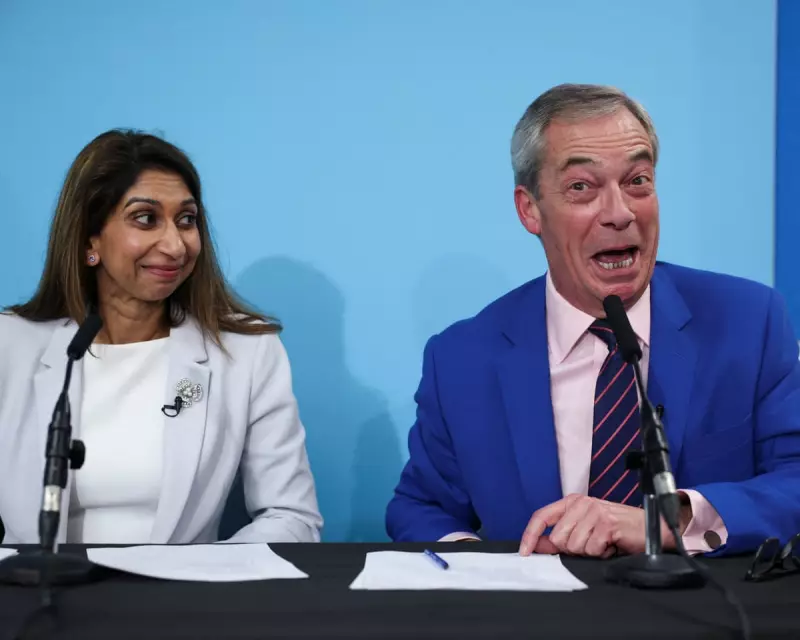
In a move that surprised few political observers yet carried significant implications, former home secretary Suella Braverman has officially joined Reform UK, marking what analysts describe as Nigel Farage's most substantial political gamble to date. The defection occurred during a London rally ostensibly focused on veterans' affairs, where Braverman dramatically appeared on stage to declare she had "come home" to cheering supporters.
The Not-So-Surprise Announcement
The Conservative Party's response to Braverman's departure was tellingly predictable, with a Tory spokesperson stating it was "always a matter of when, not if, Suella would defect." This sentiment reflects Braverman's position as what many describe as a high-profile yet semi-detached Conservative figure. Despite having served twice as home secretary and once as attorney general, she had spent more than three years on the backbenches with precisely zero chance of advancement under Kemi Badenoch's leadership.
Reform UK's media operation had managed to keep Braverman's appearance a closely guarded secret, with even some party officials apparently unaware of the planned announcement. Yet within political circles, the move was widely anticipated, highlighting the growing gravitational pull of Farage's insurgent party on disaffected Conservative figures.
Reform's Growing Parliamentary Presence
With Braverman's addition, Reform UK now boasts eight Members of Parliament, four of whom were originally elected as Conservatives. This represents a significant development for a party that effectively began from a standing start and now potentially stands to influence the formation of the next government. Crucially, three of these defectors bring top-level governmental experience to the table.
Danny Kruger previously served as a Downing Street adviser, while Robert Jenrick and now Suella Braverman both held cabinet minister positions. This accumulation of experienced politicians provides Reform with a veneer of governmental credibility that Farage has been keen to cultivate as he positions his party as a viable alternative to the established political order.
The Baggage Braverman Brings
Despite her experience, Braverman arrives at Reform UK carrying substantial political baggage, both in terms of her career history and ideological positioning. Her record includes the notable distinction of having been sacked as home secretary not once, but twice. The first dismissal came during Liz Truss's brief premiership, when she was forced to resign after just 45 days for using a personal email address to send sensitive documents to a fellow Conservative MP.
Less than a week later, Rishi Sunak reinstated her, but she lasted little more than a year before being ousted again. This second dismissal followed an unauthorised newspaper article in which she argued that police officers were tougher on right-wing extremists than pro-Palestinian demonstrators, a statement blamed for exacerbating community tensions.
These incidents represent just two entries in what critics describe as a long list of controversies generated by a politician who proved an irritant to all four prime ministers under whom she served. Indeed, as recently as July last year, Reform insiders confidently briefed the Daily Mail that Braverman would not be welcome in the party, describing her as "not a team player" and "too disruptive."
Farage's Calculated Risk
Speaking to reporters after Braverman's announcement, Farage denied that he had previously ruled out the possibility of her joining Reform UK, though he acknowledged that others within the party might have expressed reservations. "I didn't rule anything out," Farage stated. "Other people on my behalf might have done. I didn't."
This careful positioning reflects Farage's awareness of the delicate balancing act he must perform. While Braverman was rapturously received by Reform's existing supporters, Farage recognises that to win a general election, he must expand his party's appeal beyond the approximately 20% of voters currently committed to the Reform project. He needs to attract those with less trenchant political views who might be tempted by promises of national renewal and a fresh start.
The risk, as highlighted by Labour MPs and officials, is that voters may perceive Reform not as offering a genuine new beginning, but rather as presenting a Conservative replay led by either misfits or electoral rejects. This perception could be reinforced by the fact that most Tory defectors joining Reform are politicians associated with previous failed governments.
The Personal and Political Calculus
For Braverman personally, the defection represents something of a no-brainer. As one might imagine a mock chatshow host asking: what attracted her to the hard-right, culture war-friendly, anti-immigration party that currently leads in opinion polls? The answer likely involves both ideological alignment and practical political calculation.
For Reform UK, however, the acquisition is more complicated. Braverman brings with her a ready-made home secretary who knows her way around Whitehall and would enthusiastically implement restrictive immigration policies. Yet she also represents what some describe as a ticking timebomb and a potential barrier to expanding the party's appeal beyond its core supporters.
Farage's awareness of this delicate balance explains his recent announcement of a supposedly strict 7 May deadline for party-switchers. A momentum-creating flood of defections might be beneficial, but a gradual, slightly needy trickle could prove problematic. It also explains why the idea of Liz Truss defecting to Reform remains, as Farage delicately put it, "unlikely."
As Conservative MPs largely refrain from shedding tears over Braverman's departure, and Kemi Badenoch makes light of recent defections, the political landscape continues to shift. For a seasoned political gambler like Nigel Farage, the Braverman acquisition represents both opportunity and risk in roughly equal measure, setting the stage for what promises to be a fascinating chapter in British political realignment.