Chicago Mourns Civil Rights Legend Jesse Jackson
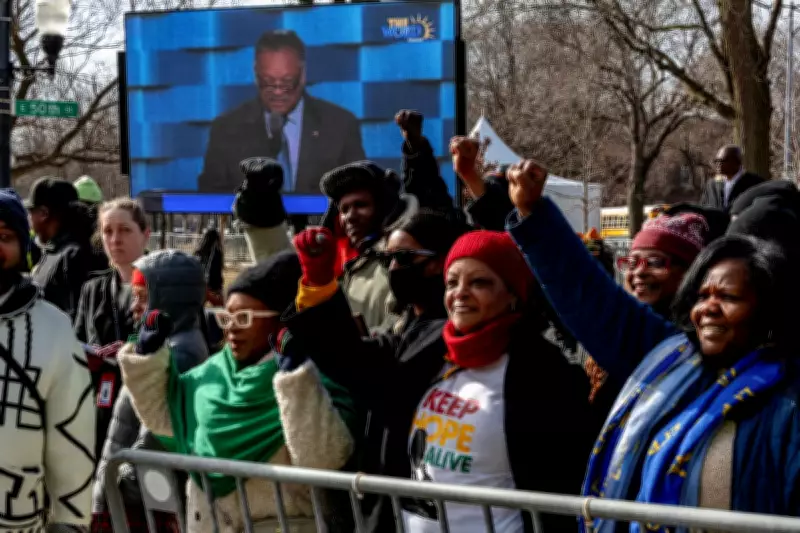
On a mercifully mild late February day in Chicago, a diverse crowd of thousands lined the blocks surrounding the Rainbow/Push Coalition headquarters. They came to pay their final respects to the civil rights leader Jesse Jackson, who lay in repose at the organization he founded and led for decades. The atmosphere was one of solemn reflection mixed with gratitude for a life dedicated to justice and equality.
A Final Public Farewell
Friday, 26 February 2026, marked the last day of public visitation for Jackson, who passed away in Chicago on 17 February at the age of 84. His body was displayed at the Rainbow/Push headquarters, a fitting location given his lifelong commitment to political activism and civil rights through this very coalition. The following day, Jackson began his final journey by road from Chicago near Lake Michigan to his birthplace of South Carolina, where he would lie in repose at the state capitol in Columbia ahead of funeral services on Monday.
Among the hundreds waiting patiently was Marva Watts, an 85-year-old retired college professor from Chicago's South Side. Her late husband, Reverend William "Bill" Watts, had worked closely with Jackson for many years. "I'm here in memory of my husband and to recognize all the work Reverend Jackson and his organization have done for our people and our country," Watts told reporters under partly sunny skies. She fondly recalled Jackson's iconic phrases like "I am somebody" and "keep hope alive," themes her husband had often preached in his sermons.

Generations United in Tribute
The crowd represented a cross-section of generations, from elderly activists who had marched alongside Jackson to younger admirers who knew him only through history. Ethan Davis, a 17-year-old high school student from Chicago's west suburbs, shared a poignant childhood memory of meeting Jackson by chance at O'Hare Airport in 2017. "He had a radiating aura off of him," Davis recalled. Despite his mother's initial hesitation, Jackson approached them, asked how they were doing, and shook the young boy's hand. "It seemed like a guardian angel just walking up," Davis said, describing how even as a child he could feel Jackson's significant presence.
Jackson had only retired from the Rainbow/Push Coalition in 2023 due to ill health, concluding more than six decades of national and international activism. The organization itself was a merger of two non-profits he founded to focus specifically on civil rights and political engagement.
A Legacy of Hope and Action
Outside the visitation area, stallholders sold commemorative T-shirts, pan-African flags, and art prints honoring Jackson. A pop-up screen played his most famous speeches on repeat, particularly his rousing 1988 Democratic convention address where he urged Americans facing inequality to "keep hope alive!"
Kenneth LeDale, a 40-year-old military veteran from Chicago's South Side, expressed profound gratitude for Jackson's work. "I'm so fortunate to never know the battles that I never had to fight personally because they did it for me," LeDale said, referencing the fight for desegregation that Jackson helped lead.
Diallo Ismail, a 60-year-old Chicago business owner originally from Guinea in West Africa, described Jackson as a "worldwide icon" known even in his homeland. "He fights for freedom, he fights for everybody. So we're gonna miss him," Ismail said.
Personal Connections and Lasting Impact
Adele Stichel, a 36-year-old lawyer and former Democratic congressional candidate from Virginia, first met Jackson when he visited her class at the University of Chicago. She had expected someone "loud or radical" but found him "actually really soft-spoken" with thoughtful policy ideas. Inspired, she volunteered at Rainbow/Push and eventually worked there as an assistant. "Then he officiated my wedding," Stichel revealed. She credited Jackson with influencing her career path, including her recent decision to leave a corporate law firm and run for Congress. "People know that he was brilliant and he was impactful, but he was also just a really kind person," she reflected.

As Chicago said goodbye to its hometown hero, the diverse crowd of mourners—some old friends, some strangers, some young admirers—stood as testament to Jackson's enduring legacy across generations and communities. His message of hope and equality resonated through the mild February air, a final tribute to a man who dedicated his life to making "I am somebody" more than just a slogan, but a reality for countless Americans.