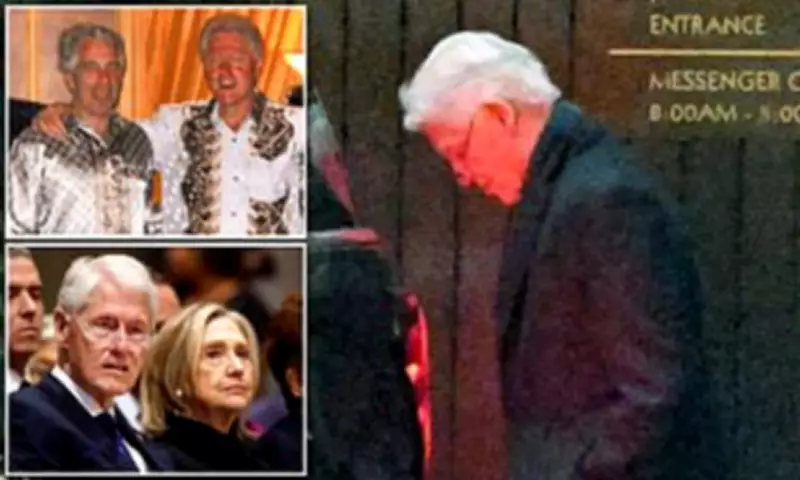
Former President Bill Clinton cut a sombre figure while walking through the streets of New York City on Tuesday, just hours after he and his wife Hillary Clinton agreed to testify before Congress regarding his alleged connections to the late financier Jeffrey Epstein. The 79-year-old Democrat, spotted heading to a business meeting in Manhattan, marked his first public appearance since capitulating to mounting political pressure.
A Dramatic Reversal in Political Strategy
The Clintons' decision represents a stark reversal of their long-standing refusal to comply with congressional subpoenas, coming mere days before lawmakers were scheduled to vote on holding them in criminal contempt of Congress. For months, the former president and former secretary of state had steadfastly rejected demands issued by Representative James Comer, the Republican chairman of the House Oversight Committee from Kentucky.
Trump's Unexpected Sympathy for Rivals
In a surprising turn, former President Donald Trump addressed the situation during a press briefing on Tuesday, expressing sympathy for his former political adversaries. "I think it's a shame, to be honest. I always liked him," Trump remarked about Bill Clinton. Regarding Hillary Clinton, whom he famously dubbed "Crooked Hillary" during the brutal 2016 presidential campaign, Trump offered measured praise: "Her, she's a very capable woman. She was better at debating than some of the other people. I will tell you that. She was smarter. Smart woman. I hate to see it in many ways."

Despite these sentiments, Trump remained unwilling to forget what he described as unfair treatment during the Russia investigation, stating: "I hate to see it, but, you know, then I look at me, they went after me like, you know, they wanted me to go to jail for the rest of my life. Then it turned out I was innocent."
The Political Calculus Behind the Shift
The Clintons' position shifted dramatically after several Democrats on the committee joined Republicans in supporting a recommendation to refer them to the Justice Department for potential prosecution. This rare and unprecedented escalation against a former first couple prompted their lawyers to contact Comer on Monday evening, confirming that both would sit for depositions at mutually agreed dates and urging the committee to abandon its planned contempt vote.
Negotiations and Rejected Proposals
In a letter obtained by The New York Times, Clinton's attorneys had initially proposed a four-hour recorded interview with the full committee—a format the former president had previously criticised as excessive. They also requested that Hillary Clinton be allowed to submit a sworn written statement, citing her claim that she never met or communicated with Epstein. Comer rejected these offers as "unreasonable," arguing that four hours was inadequate for what he described as a "loquacious individual" like Bill Clinton.
In a sharp reversal, the Clintons ultimately accepted every condition Comer laid out, agreeing to remove restrictions on deposition length or questioning scope. The only concession Comer had previously offered was allowing interviews to take place in New York, where the Clintons are based.
Epstein Connections Under Scrutiny
President Clinton has acknowledged knowing Epstein, who died in jail in 2019, but maintains he never visited Epstein's private island and severed ties approximately two decades ago. However, flight records indicate Clinton took four overseas trips on Epstein's private aircraft in 2002 and 2003. The Democrat insists they were barely acquaintances, denies knowledge of Epstein's sex trafficking network, and asserts he never set foot on Little Saint James—infamously nicknamed 'Pedo Island.'
Political Divisions and Democratic Concerns
While several House Democrats voted alongside Republicans to advance contempt charges, others voiced strong objections—particularly regarding Hillary Clinton's involvement. Representative Kweisi Mfume, a Maryland Democrat, questioned during a committee hearing: "I'm not seeing anything to suggest she ought to be a part of this in any way," suggesting she had been included simply because "we want to dust her up a bit if we get her before this committee."

Many Democrats have been wary of appearing to defend anyone connected to Epstein, especially polarising figures like the Clintons. For the former first couple, this episode represents another chapter in what they view as decades of Republican investigations and attacks. In their January letter to Comer, they accused him of risking congressional paralysis in pursuit of a partisan operation "literally designed to result in our imprisonment."
Historical Precedent and Broader Implications
Bill Clinton's agreement to testify would place him among rare historical company. The last time a former president appeared before Congress was in 1983, when Gerald R. Ford testified about constitutional bicentennial preparations. This stands in stark contrast to Donald Trump's response when subpoenaed in 2022 by the January 6 committee—he filed a lawsuit to block the demand, and the panel later dropped the subpoena.
The move advances Comer's broader strategy of redirecting his committee's Epstein investigation away from scrutiny of Trump's past connections toward high-profile Democrats with social or professional ties to Epstein and his associate Ghislaine Maxwell. As the political drama unfolds, all eyes remain on the upcoming testimonies that could reshape narratives around one of America's most controversial political families and their connections to a convicted sex offender.