Parliamentary Theatre Descends into Farce as Coalition Marriage Breaks Down
The Australian House of Representatives resembled a stage for political theatre on Tuesday, but the performance was one of disintegration rather than unity. As Sussan Ley led the smallest opposition party in the history of the current Parliament House, the once-formidable Coalition appeared more like estranged partners than a unified political force.
A Question of Legitimacy from the Crossbench
Amid the schoolyard taunts and procedural jostling, independent MP Andrew Wilkie posed a question that cut to the heart of the parliamentary crisis. "Seeing as the crossbench is now as big as the Liberal party and likely to soon exceed them with more defections, on what basis are the Liberals still regarded as the opposition?" he asked, injecting a note of sober reality into the chamber's chaos.
While Wilkie's question contained an element of levity – given the near-impossible task of uniting the diverse crossbench of independents, teals, Greens, One Nation, and Katter's Australian Party into a coherent voting bloc – it highlighted a fundamental constitutional question. The traditional opposition had been reduced to numerical equivalence with the parliamentary outsiders.

Leadership Tensions and Procedural Uncertainty
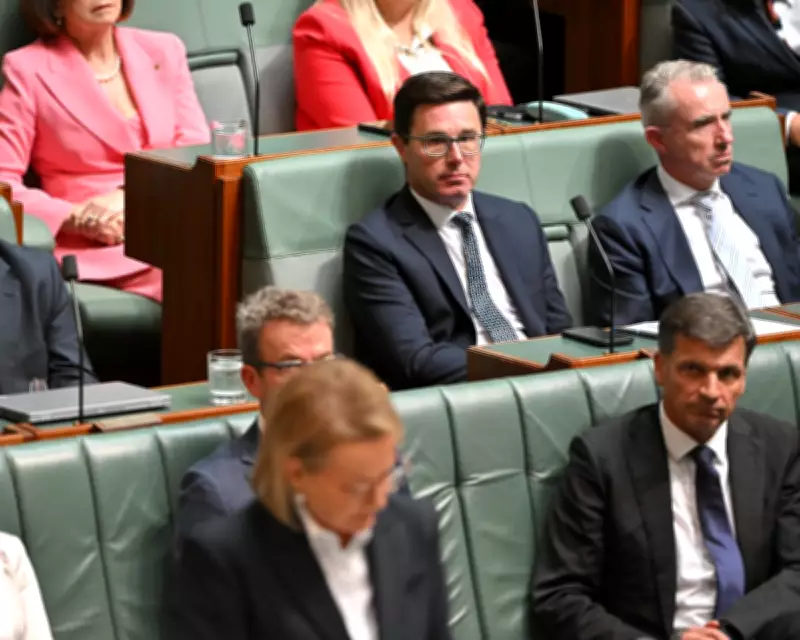
Watching the disintegration unfold in real-time revealed deeper fractures. Ley stood at the dispatch box with leadership aspirants positioned strategically behind her – Angus Taylor just to her rear-left, Andrew Hastie further back over her right shoulder. The physical arrangement mirrored the political tensions simmering within the diminished Liberal ranks.
Manager of Opposition Business Paul Fletcher attempted to project normalcy, but the numbers told a different story. With the Nationals now formally separated and sitting as their own bloc, the opposition benches appeared threadbare and isolated. Labor's Tony Burke delivered the statistical reality: "We still have the traditional crossbench, but now we've got the cross, the very cross and the apoplectic," he told the chamber, gesturing respectively toward the independents, the Nationals, and the Liberals.
Metaphors of Marital Breakdown Dominate Discourse
The day's proceedings were framed by metaphors of relationship breakdown from beginning to end. Before parliament even convened, Liberal MP Scott Buchholz joked that his colleagues needed "divine intervention" as they attended Canberra's traditional first-day ecumenical service. Others spoke of praying for the Liberals and Nationals to end their "trial separation" and resume their troubled political marriage.
Prime Minister Anthony Albanese had set the tone on Monday by comparing the situation to the reality TV spectacle of Married At First Sight. Education Minister Jason Clare suggested it more closely resembled the Beckham family's very public breakdown, while Greens sources privately likened the drama to an episode of Jerry Springer. The theatrical comparisons underscored how far parliamentary norms had deteriorated.
Missed Opportunities and Government Glee
While the opposition descended into internal chaos, significant policy matters went largely unscrutinised. Reserve Bank Governor Michelle Bullock announced the first interest rate rise since 2023 – a development that would typically provide fertile ground for opposition attacks on economic management. Instead, Treasurer Jim Chalmers skated through question time without breaking a sweat, instead poking fun at counterpart Ted O'Brien for being named as his own assistant.
Liberal MPs attempted to counterpunch, arguing that the government's barely-concealed glee at the Coalition's catastrophe was designed to divert attention from unpopular changes to freedom of information laws and years-long delays in responding to the late Peta Murphy's report on gambling harm. Both were legitimate criticisms, with the FoI bill attracting little support and even Labor MPs expressing frustration about inaction on gambling advertising.
Yet a coherent, organised opposition might have effectively prosecuted these arguments, holding the government to proper account. Instead, the opportunity slipped away amid the internal turmoil.

Strange Alliances and Unlikely Voices of Reason
The political realignment produced surreal moments throughout the day. Recent One Nation defector Barnaby Joyce – no stranger to political controversy himself – condemned the "total fiasco" and urged his former colleagues to "get it together." The spectacle of Joyce positioning himself as the calm voice of reason and advocate for sensible politics demonstrated just how off-kilter the parliamentary landscape had become.
Nationals MP Darren Chester captured the physical and metaphorical distance between the former coalition partners when he looked up at the press gallery and curled his hands into the shape of binoculars, as if struggling to see his Liberal counterparts from his relegated position on the side benches.
Grinning and Bearing It Through Question Time
Through the barrage of government gags and derision during question time, Liberal and National MPs maintained fixed smiles that might as well have been painted on. Their curled lips served as masks against the onslaught, embodying the dictionary definition of having to "grin and bear it."
Health Minister Mark Butler aimed squarely at the leadership tensions, claiming Angus Taylor was "plotting against his leader from the frontbench." After Liberal protests about the language, Burke countered by noting that Taylor "never claimed he was misrepresented." Taylor sat through the exchange, protesting and making pained faces that spoke volumes about the internal dynamics.
Procedural Consequences and an Uncertain Future
The split has created genuine procedural headaches that extend beyond political theatre. Burke informed the lower house that the opposition would now receive the same allocation of questions as the newly-expanded crossbench – the expansion courtesy of David Littleproud and the Nationals' departure. Committee memberships and other parliamentary arrangements remain unresolved until there's clarity about the Coalition's future.
"We could restructure the committees, I just have no idea what the arrangements will be on that side in seven days' time," Burke admitted, highlighting the uncertainty that now permeates parliamentary operations.
With no Coalition reunion in sight, this disarray may define the parliamentary week – an opposition in fragments, a government facing minimal scrutiny, and a crossbench suddenly wielding unprecedented relative influence. While Andrew Wilkie won't be named opposition leader for the crossbench party, persistent whispers about a potential Taylor leadership spill suggest further changes might be imminent. As astrologically-minded observers note, the end of 2025's "year of the snake" is prime time for shedding old baggage – though for Sussan Ley and her diminished team, the troubles appear anything but light.