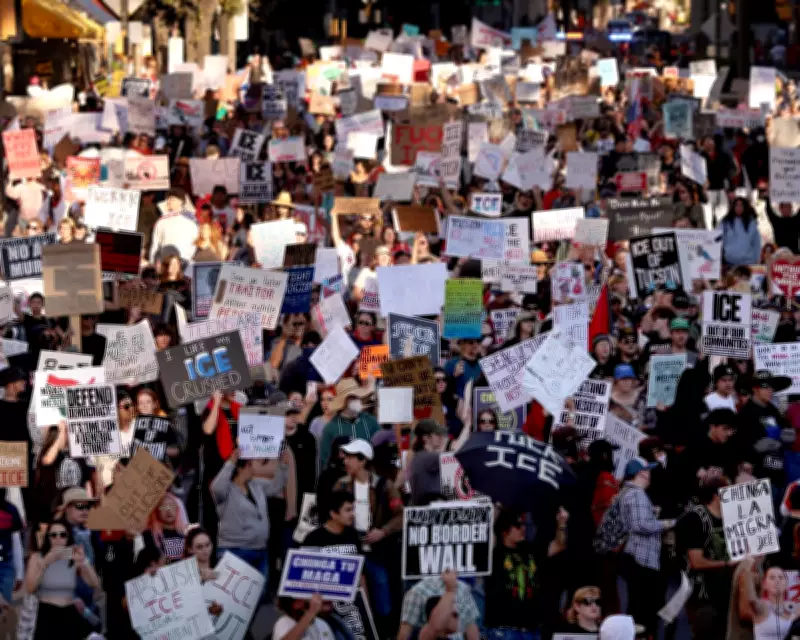
Democrats Possess Constitutional Tool to Challenge Trump's ICE Policies
Political commentator Sidney Blumenthal has issued a compelling call for the Democratic party to rediscover and deploy a powerful constitutional mechanism that has lain dormant for over a century. He argues that state legislative resolutions could provide a crucial mobilising force against what he describes as the Trump administration's "ruthless attempt to impose a police state" through aggressive Immigration and Customs Enforcement (ICE) operations.
Historical Precedent for Legislative Intervention
Blumenthal highlights that before the enactment of the 17th Amendment in 1913, state legislatures regularly issued "orders of instruction" to their US senators, who were then selected by legislators rather than by popular vote. These resolutions, while not legally binding, carried substantial political weight as legislatures controlled Senate appointments.
The practice proved particularly significant during the antislavery movement, with northern state legislatures using resolutions to instruct congressional representatives to protest the gag rule that suppressed antislavery petitions in the 1830s. Similarly, after the Mexican War, northern states passed resolutions supporting the Wilmot Proviso to prohibit slavery in new territories—a position championed by Congressman Abraham Lincoln that later became central to the emerging Republican party's platform.

A Modern Political Strategy
Blumenthal contends that reviving this practice could provide Democrats with substantial political leverage they currently lack in Congress, where they operate as a perpetual minority unable to call hearings, subpoena witnesses, or set legislative agendas. State resolutions would, he argues, command significant media attention, particularly from Democratic-controlled states like New York and California that house major media outlets.
The process would involve organising legislative debates, holding public hearings with experts, forcing recorded votes that place Republicans on the record, conducting gubernatorial signing ceremonies, and sending formal delegations to Congress. This approach would shift Democrats from a defensive to an offensive position while highlighting what Blumenthal characterises as the administration's hypocrisy regarding states' rights principles.
Targeting Republican Vulnerabilities
The strategy specifically targets Republican legislators in Democratic-controlled states—659 state legislators and 38 House members, many in swing districts. Forcing votes on ICE-related resolutions would, according to Blumenthal, place these Republicans in a political vice between the MAGA base and the broader electorate.
He points to several key battleground states where this approach could prove particularly effective. In Pennsylvania, Democrats control the governorship and state House while Republicans hold the Senate by a narrow 27-23 margin. Four potentially vulnerable Senate seats could flip control with the Democratic lieutenant governor's tie-breaking vote. Meanwhile, Hispanic voters constitute significant shares in four competitive Pennsylvania congressional districts, ranging from 7% to 20%.
Shifting Hispanic Sentiment
Blumenthal notes a significant shift in Hispanic voter sentiment since the 2024 election. While Trump increased his Hispanic support in Pennsylvania from 27% in 2020 to 41% in 2024, recent polling shows 71% of Hispanics nationally now disapprove of the president. In Arizona, an Equis Research poll from September 2025 found that 35% of new Trump Hispanic voters from 2024 already disapproved of his performance, with overwhelming majorities expressing concern about specific ICE practices.
"The sentiment that ICE abuses have aroused has combined with an overwhelming sense of betrayal on the economy to foster a combustible anti-Trump feeling," Blumenthal observes, suggesting this creates a ripe political environment for Democratic action.

Historical Context of Immigration Reform Failures
The article traces decades of Republican resistance to comprehensive immigration reform, from the defeat of President George W. Bush's bipartisan bill in 2006 (which passed the Senate with 62 votes including 23 Republicans) to the failure of President Barack Obama's 2013 legislation (which passed the Senate with 68 votes) and the recent collapse of a border security agreement negotiated by Senate Republican leader Mitch McConnell with President Joe Biden in February 2024.
Blumenthal argues that Trump has weaponised immigration issues for political advantage, demonising immigrants throughout his campaign and building ICE into what he describes as "a massive paramilitary domestic force" targeting immigrant communities in Democratic strongholds.
Proposed Resolution Language
The article includes suggested language for state resolutions that would urge congressional representatives to support legislation limiting ICE's authority and funding. The proposal would restrict ICE activities to removing only those undocumented persons violating federal criminal law, exempt asylum seekers and DACA recipients, require proper judicial warrants, protect protest rights, and prohibit ICE deployment on voting days.
Blumenthal acknowledges that Trump would likely respond with budget threats and pressure on Republicans, but argues this would only intensify focus on what he characterises as police state tactics. He concludes by quoting Thomas Jefferson's response to the Alien and Sedition Acts of 1798—legislation Trump has cited to justify ICE actions—expressing hope that "the reign of witches" will pass and principles be restored.
As a former senior adviser to both Bill and Hillary Clinton and author of a multi-volume biography of Abraham Lincoln, Blumenthal brings historical perspective to his argument that state legislatures now offer Democrats a "golden opportunity" to reclaim political initiative and constitutional principles.