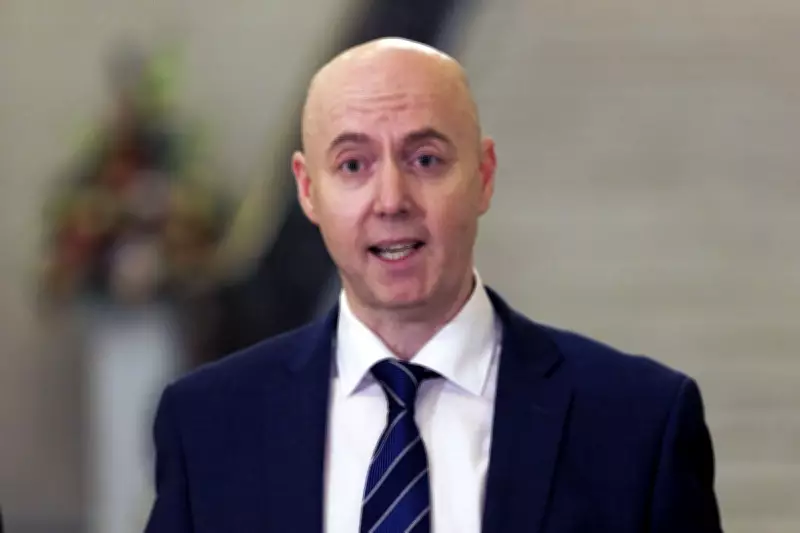
Jon Burrows, the newly elected leader of the Ulster Unionist Party (UUP), has experienced one of the most remarkable political ascents in Northern Ireland's recent history. The former senior police officer, who only entered the Stormont Assembly last year, now finds himself at the helm of a party seeking to reclaim its position as the leading voice of unionism.
A Distinguished Policing Career
Mr Burrows' journey to political leadership began with an impressive 22-year career in law enforcement. Following in the footsteps of his father Colin, a former assistant chief constable of the Royal Ulster Constabulary, he established himself as a respected figure within the Police Service of Northern Ireland (PSNI). His service included commanding roles in some of the region's most challenging environments.
Commanding Through Crisis in Derry
As area commander in Foyle, covering the city of Londonderry, Mr Burrows faced significant threats against police officers. During his tenure, dissident republicans plotted to kill officers by attaching a bomb to a bicycle in 2012. The following year, he was based in Derry when Constable Philippa Reynolds, aged just 27, tragically died in a crash involving a stolen vehicle. Speaking in the Assembly in December, he later criticised what he described as the "paltry sentence" given to the driver convicted of manslaughter in that case.

Rising Through Police Ranks
Mr Burrows progressed to serve as chief inspector of operations for Armagh, Banbridge and Craigavon before concluding his policing career as head of the PSNI's discipline branch. His final role involved overseeing professional standards within the force, giving him unique insight into police governance and accountability mechanisms.
Transition to Political Commentator
After leaving the PSNI in 2021, Mr Burrows established himself as a prominent commentator on policing matters through his Burrows Blog, social media platforms, and appearances across broadcast and print media. He developed a reputation for speaking frankly about police leadership and accountability issues.
Outspoken Criticism of Police Decisions
Among his most notable interventions was criticism of the decision to discipline two junior officers who made an arrest following a commemoration for victims of the 1992 loyalist attack at Sean Graham's bookmakers on Belfast's Ormeau Road. Mr Burrows described this as "one of the worst examples of leadership" he had witnessed. He has also been openly critical of Police Ombudsman Marie Anderson's approach to investigations.
Rapid Political Ascent
Mr Burrows' political career began in earnest last summer when he passed what the UUP described as a "rigorous internal selection process with independent oversight" to become an MLA for North Antrim. This followed the resignation of Colin Crawford, with the party hailing their new representative as an "exceptional individual."
Becoming a Stormont Force
Within just six months at Parliament Buildings, Mr Burrows established himself as one of Stormont's most outspoken members. While serving actively on the Education Committee, his interventions extended far beyond this single policy area. He has:
- Accused Sinn Féin of "interference in policing"
- Opposed what he terms the "distortion of history" regarding Northern Ireland's troubled past
- Advocated for prison dog Bailey at Magilligan prison
- Engaged in sharp exchanges during Assembly debates
Leadership Ambitions Realised
During his initial media interviews as an MLA, Mr Burrows dismissed questions about future leadership aspirations as not being "serious." Remarkably, less than a year later, he launched a leadership bid alongside deputy leadership hopeful Diana Armstrong, arguing the party needed "fresh talent" to revive its fortunes.
Family Legacy and Personal Background
Originally from Bangor in County Down, Mr Burrows comes from a family with strong connections to public service. Beyond his father's policing career, he has written with pride about his grandfather Stanley Burrows, who served as a D-Day hero during the Second World War. This family tradition of service appears to have influenced his own career trajectory from policing to politics.

Challenges Ahead for UUP Leadership
As he assumes leadership of the Ulster Unionist Party, Mr Burrows faces the significant challenge of restoring the party's standing within Northern Irish politics. Once the dominant force in unionism, the UUP has seen its influence decline in recent decades. His rapid rise from police commander to party leader suggests he brings both determination and a fresh perspective to this task, though his outspoken style may prove both an asset and a challenge in the delicate political landscape of Northern Ireland.
The former police officer's journey from policing Derry's streets to leading one of Northern Ireland's major political parties represents one of the most unusual and rapid political transformations in recent memory. His experience in law enforcement, combined with his brief but impactful period as an MLA, provides him with a unique perspective as he attempts to steer the UUP toward renewed political relevance.