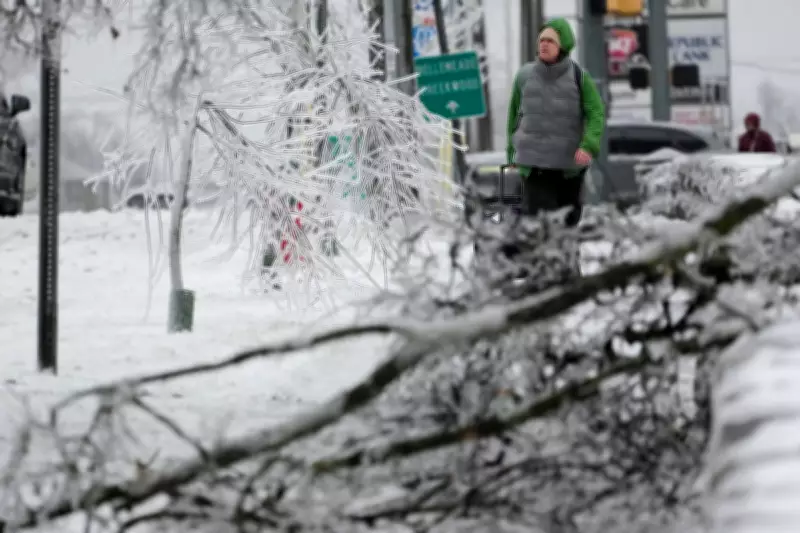
FEMA's Financial Buffer Could Maintain Winter Storm Response During Potential Shutdown
The Federal Emergency Management Agency possesses sufficient financial reserves to continue responding to the extensive winter storm still affecting numerous American states, even if a partial government shutdown commences this Friday. This assessment comes from experts and former agency officials, directly contradicting warnings issued by the Trump administration regarding potential funding disruptions.
Substantial Disaster Fund Balance Provides Cushion
According to informed sources speaking anonymously, FEMA's Disaster Relief Fund currently holds an estimated $7 billion to $8 billion. This balance would remain available even if congressional appropriations from November's spending bill were to expire at midnight on Friday. The substantial reserve is expected to mitigate immediate impacts on the ongoing emergency response operations across multiple states.
"They have enough money for winter storm recovery and anything else likely to come up in the next few weeks," stated Sarah Labowitz, a senior fellow at the Carnegie Endowment for International Peace who maintains the Disaster Dollar Database tracking federal disaster expenditure.

Political Standoff Threatens Department Funding
The agency operates under the Department of Homeland Security, whose fiscal year 2026 funding remains contingent upon Senate approval of a spending package already passed by the House. Political tensions have escalated following the fatal shooting of a Minneapolis man by federal immigration officers, with some Senate Democrats now demanding restrictions on mass deportation policies within any DHS funding legislation.
This political impasse significantly increases the likelihood of a partial government shutdown by week's end, creating uncertainty around numerous federal operations.
Administration's Contradictory Messaging on FEMA's Role
Trump administration officials have publicly cited the winter storm emergency as justification for avoiding a funding lapse. "We are in the midst of the winter storm that took place over the weekend and many Americans are still being impacted by that, so we absolutely do not want to see that funding lapse," White House press secretary Karoline Leavitt told reporters earlier this week.
This position appears contradictory to the administration's broader approach to FEMA. President Trump has repeatedly suggested phasing out the agency and transferring greater disaster responsibility to state governments. Despite this, officials now emphasize FEMA's critical function in their arguments against a shutdown.
"This funding supports national security and critical national emergency operations, including FEMA responses to a historic snowstorm that is affecting 250 million Americans," declared DHS Assistant Secretary Tricia McLaughlin during a Fox News appearance.
Current Storm Response and Future Concerns
FEMA is currently supporting state-led responses to the massive winter system that left hundreds of thousands without power across multiple states and has been connected to at least 70 fatalities. President Trump has approved emergency declarations for 12 states, enabling federal support for emergency measures and debris removal operations.
The agency has pre-positioned generators in states including Louisiana and Texas, while coordinating federal assistance for tasks such as clearing fallen trees from roadways in Mississippi and Tennessee. States continue assessing damages to determine whether to request major disaster declarations, which could unlock additional funding for infrastructure repairs and household assistance.
"The winter storm at this time is well within the capability of local communities and states," observed Michael Coen, former FEMA chief of staff during both the Obama and Biden administrations.
Shutdown Implications and Seasonal Timing
The potential timing of any shutdown provides some reassurance regarding FEMA's operational capacity. "We're a bit of a ways off from wildfire season and hurricane season, so I don't see a huge impact in the short run in terms of FEMA operations," noted Noah Patton, director of disaster recovery at the National Low Income Housing Coalition.

However, a partial shutdown would still affect certain FEMA functions not funded through the Disaster Relief Fund. These would include the ability to write or renew National Flood Insurance Program policies, which would pause as occurred during last year's 43-day shutdown. Essential employees would continue working without pay during such an event.
Longer-Term Pressures and Policy Impacts
An extended shutdown could gradually increase pressure on the Disaster Relief Fund, particularly if FEMA must respond to new disasters while reimbursements for past events slow further. Several experts highlighted that reimbursement processes have already been delayed due to a DHS policy requiring personal approval from Homeland Security Secretary Kristi Noem for expenditures exceeding $100,000.
The pending Senate spending bill proposes allocating over $26 billion to the Disaster Relief Fund, alongside nearly $4 billion for various FEMA emergency preparedness and security grants. Language within the proposed legislation seeks to constrain certain administrative actions, including limiting FEMA's ability to pause grants and trainings while mandating public reporting on disaster reimbursement status to states.
Former officials argue that the greater threat to FEMA originates from policy directions rather than potential funding lapses. "The administration has been dismantling FEMA over the last year," Coen asserted. "Using the agency as a justification for congressional action is laughable."
Despite discussing FEMA overhaul proposals, the Trump administration has not presented a comprehensive reform vision. The December release of a long-awaited report from the FEMA Review Council was unexpectedly canceled without rescheduling, while various policies have contributed to significant staff departures and grant program interruptions.
Labowitz suggested that administrative approaches have indirectly preserved Disaster Relief Fund balances through delayed major disaster approvals and reimbursements. "All last year they were slow walking spending in the DRF," she remarked, highlighting how policy decisions have influenced the agency's financial position irrespective of congressional funding debates.