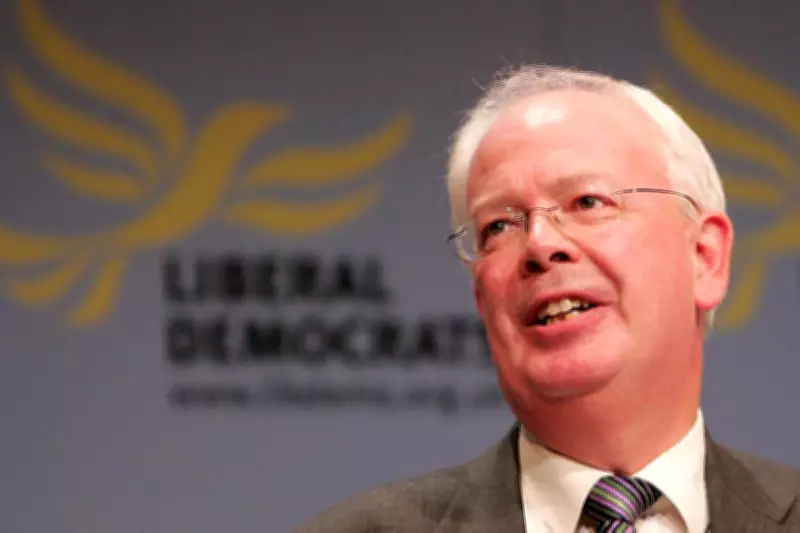
The Scottish political landscape is in mourning following the announcement of the death of Lord Jim Wallace, the nation's first ever deputy first minister. The distinguished Liberal Democrat peer passed away on Thursday after developing complications during what was described as a scheduled but major surgical procedure at the Royal Infirmary of Edinburgh.
A Sudden and Shocking Loss
His family confirmed the tragic news, expressing profound shock at the sudden nature of his passing. His wife, Rosie Wallace, stated that the family were devastated by the unexpected turn of events, noting that Lord Wallace had remained remarkably active across numerous spheres of public and private life right up until his death.
"The family are very shocked by Jim's death. It was all so sudden," Mrs Wallace said. "He was still incredibly active in a whole host of areas."

A Life of Service and Family
She painted a picture of a man fully engaged with his duties and passions, detailing his continued work in the House of Lords, his participation in the Dunblane Cathedral choir over the recent festive period, and his eager anticipation of spending more time with his grandchildren.
Mrs Wallace added that it "brings some comfort" that he had been "surrounded by those he loved most when he died". She expressed thankfulness that the entire family had been together in Scotland over Christmas, after one of their two daughters, Clare, and her family had flown in from New Zealand for the holidays.
A Pioneering Political Career
Lord Wallace's political legacy is deeply woven into the fabric of modern Scottish governance. A former Liberal and later Liberal Democrat MP for Orkney and Shetland, he served for 18 years in the House of Commons, assuming leadership of the Scottish Liberal Democrats in 1992.
His career took a historic turn when he led the Scottish Lib Dems into the first ever elections for the newly established Scottish Parliament in 1999. He won the Orkney constituency decisively with 67% of the vote, serving simultaneously as both an MSP and an MP until standing down from Westminster in 2001.
Architect of Holyrood's First Coalition
In a pivotal move for the nascent devolved institution, he took his party into a coalition government with Labour, which had emerged victorious in those inaugural Holyrood elections. This coalition agreement led directly to his appointment as Scotland's very first deputy first minister, a role in which he helped to stabilise and shape the early parliament.
His steady hand was called upon three times to serve as acting first minister. He first assumed the role in 2000 when the then First Minister Donald Dewar underwent heart surgery, and again later that same year following Mr Dewar's tragic death. He stepped into the position once more in 2001 after the resignation of Mr Dewar's successor, Henry McLeish.
Continued Influence Beyond Holyrood
After stepping down from the Scottish Parliament at the 2007 elections, Lord Wallace was elevated to the House of Lords as a life peer that same year. He continued his service to the nation in a UK government capacity, holding the post of Advocate General for Scotland from 2010 to 2015, providing legal advice to the government on Scots law.
Beyond politics, he maintained a significant role in civic and spiritual life, serving as the Moderator of the General Assembly of the Church of Scotland from 2021 to 2022. His death marks the loss of a foundational figure whose career spanned the creation of devolution, high office in both Edinburgh and London, and dedicated service to his community and faith.