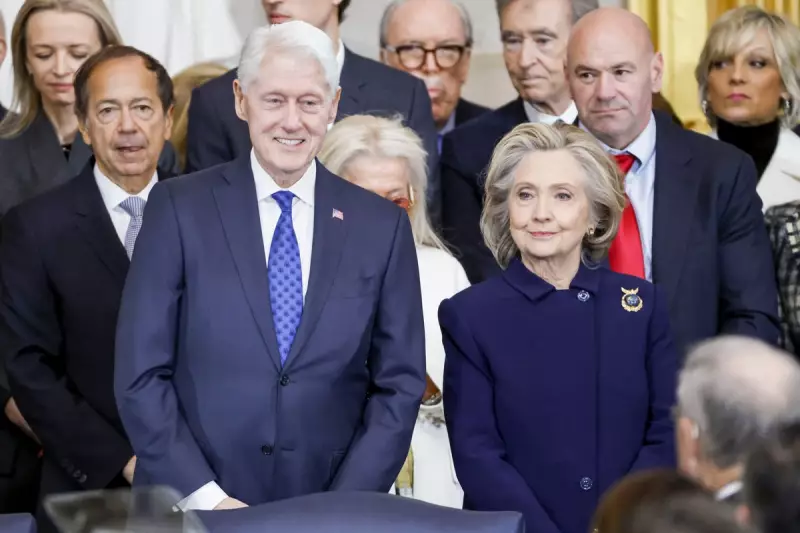
House Republicans have commenced a significant push to hold former President Bill Clinton and former Secretary of State Hillary Clinton in contempt of Congress, marking a dramatic escalation in the ongoing Jeffrey Epstein investigation. This move opens the prospect of the House employing one of its most severe punishments against a former president for the first time in history.
Contempt Proceedings Initiated After Refusal to Testify
Lawmakers announced their intention to begin the process following the Clintons' refusal to provide testimony in the high-profile Epstein probe. The contempt proceedings represent an initial step toward potential criminal prosecution by the Department of Justice. If successful, this could result in substantial fines or even incarceration for the prominent political figures.
Chairman Comer's Strong Stance on Subpoena Compliance
Representative James Comer, the Republican chairman of the House Oversight Committee, opened the committee's hearing with a firm declaration regarding the Clintons' response. "Subpoenas are not mere suggestions, they carry the force of law and require compliance," stated Comer, emphasising that the Clintons had responded with "defiance rather than cooperation."
The repercussions of contempt charges loom particularly large, given the possibility of both significant financial penalties and potential imprisonment. Historically, such charges have been employed only as a last resort, though lawmakers in recent years have demonstrated increased willingness to utilise this option.
Clintons Challenge Subpoena Validity
The Clintons have mounted a defence against the contempt proceedings, arguing that the subpoenas lack validity. They contend that the demands do not serve any legitimate legislative purpose and have offered written declarations regarding their interactions with Epstein instead of oral testimony.
In a letter released last week, the Clintons criticised Comer for seeking their testimony while the Justice Department remains behind schedule in releasing complete case files on Epstein. "We have tried to give you the little information we have. We've done so because Mr. Epstein's crimes were horrific," the Clintons wrote to the committee chairman.
Negotiation Attempts and Potential Compromise
Behind the scenes, longtime Clinton lawyer David Kendall has attempted to negotiate an agreement that might avoid contempt proceedings. According to the committee's account of negotiations, Kendall raised the prospect of having the Clintons testify on Christmas and Christmas Eve, though this offer was ultimately rejected.
Comer specifically dismissed an alternative proposal from the Clintons' legal team that would have involved interviews with Bill Clinton in New York. "You have to have a transcript in an investigation," Comer insisted. "So no transcript, no deal."
Historical Context of Congressional Contempt Proceedings
Contempt of Congress proceedings remain relatively rare in American political history, typically reserved for compelling testimony in high-profile investigations. Historical precedents include the infamous inquiry during the 1940s into alleged Communist sympathisers in Hollywood and the impeachment proceedings against President Richard Nixon.
More recently, former Trump advisers Peter Navarro and Steve Bannon faced convictions on contempt charges for defying subpoenas from the House panel investigating the January 6th Capitol riot. Both individuals served months in prison as a result of their convictions.
Democrats Focus on Epstein Investigation Rather Than Clinton Defence
Democratic responses have largely concentrated on advancing the Epstein investigation rather than mounting comprehensive defences of the Clintons, who have led their party for decades. Representative Robert Garcia, the top Democrat on the committee, emphasised that "no president or former president is above the law" while criticising Republican focus on the Clintons.
Garcia highlighted the Justice Department's delay in releasing Epstein files, questioning why Republicans have "been obsessed about putting all their energy behind" this particular subpoena. Democrats have embraced calls for full transparency regarding Epstein following Donald Trump's return to the White House.
Epstein Connections and Bipartisan Investigation
The wealthy financier Jeffrey Epstein, who died by suicide in 2019 while awaiting trial in a New York jail cell, maintained connections with numerous high-profile individuals. Publicly released case files have revealed details of relationships between Epstein and both Bill Clinton and Donald Trump, among other powerful figures.
Epstein previously donated to Bill Clinton's 1992 presidential campaign and Hillary Clinton's joint fundraising committee ahead of her 2000 Senate campaign in New York. The bipartisan nature of the investigation has scrambled traditional ideological lines, with Republicans joining Democrats in demanding further examination of Epstein's activities.
The pressure eventually resulted in a bipartisan subpoena from the committee ordering the Justice Department and Epstein estate to release files related to the financier. Republicans subsequently moved to include the Clintons within the scope of this subpoena, leading to the current confrontation.
Uncertain Path Through the House
Despite the initiation of contempt proceedings, passage of charges through the full House remains far from guaranteed. Success would require a majority vote, something Republicans have increasingly struggled to achieve in recent legislative sessions. This political reality creates uncertainty about the ultimate outcome of the proceedings against the Clintons.
The clash represents the latest development in the ongoing Epstein saga as Congress continues investigating how the financier managed to sexually abuse dozens of teenage girls over many years. The investigation seeks to uncover not only Epstein's crimes but also the network of connections that may have enabled or concealed his activities.