Veteran Republican Senator Indicates Possible Rift with Trump Over Voter ID Legislation
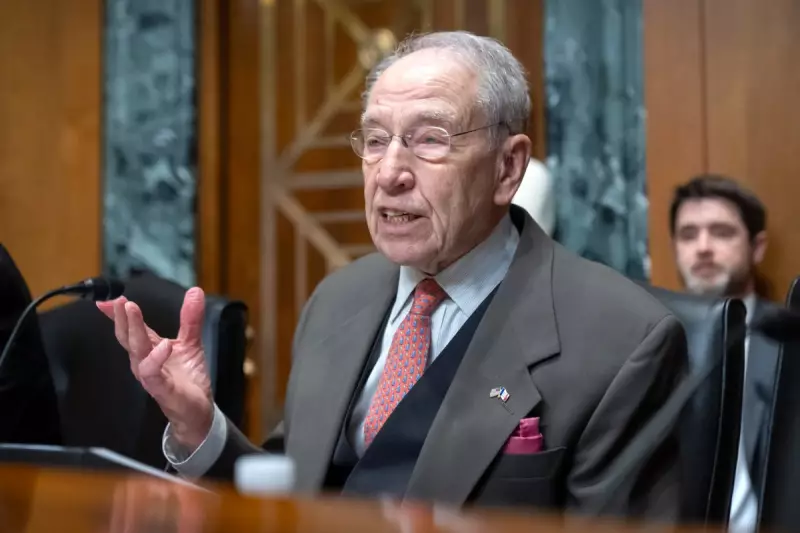
Long-serving Iowa Republican Senator Chuck Grassley has hinted at a potential break with President Donald Trump regarding federal intervention in state election laws. The development centres on the controversial Safeguard American Voters Eligibility (SAVE) Act, which would mandate proof of citizenship for voting in federal elections.
Grassley's Stance on Federal Election Oversight
In a letter to a constituent shared publicly by MAGA activist Scott Presler, the 92-year-old Senate president pro tempore articulated his reservations about Washington's role in dictating electoral procedures. Grassley wrote, "I have opposed partisan efforts in Washington, D.C. to federalize elections in order to undermine election integrity... I do not believe that Iowa and other states need politicians in Washington, D.C., dictating and controlling how states run their elections."
While the senator did not explicitly mention the SAVE Act by name, Presler interpreted his comments as signalling opposition to the legislation. Grassley's correspondence emphasised the constitutional principle that states hold primary responsibility for crafting and implementing election laws, referencing the Elections Clause which permits congressional intervention while affirming state authority.

The SAVE Act and Its Implications
The proposed legislation, introduced by Texas Republican Representative Chip Roy in January 2025 and passed by the House of Representatives on April 10 by a narrow 220-208 margin, seeks to amend the National Voter Registration Act. Its central provision would prohibit non-citizens from voting in federal elections.
Critics argue the bill could disenfranchise millions of eligible voters who lack immediate access to identification documents. According to data from the Brennan Center for Justice:
- Approximately 146 million Americans do not possess a passport
- Roughly 13 million U.S. citizens lack ready access to citizenship documentation
If enacted, the SAVE Act would fundamentally alter how states conduct voter registration, potentially disrupting online, automatic, and same-day registration systems currently operating across the country.
Trump's Position and Executive Authority
President Trump has consistently advocated for stringent voter identification requirements since his defeat in the 2020 presidential election to Democrat Joe Biden. Despite failing to substantiate claims of widespread fraud affecting the election outcome, Trump has maintained that the current electoral process remains vulnerable.
In a Truth Social post from August 2025, the president declared: "Voter I.D. Must Be Part of Every Single Vote. NO EXCEPTIONS! I Will Be Doing An Executive Order To That End!!!" However, no such executive order has been issued to date.
White House spokesperson Abigail Jackson affirmed the administration's commitment to "securing our elections and ensuring only American citizens vote in American elections," while election experts like David J. Becker of the Center for Election Innovation & Research noted the president lacks direct authority to compel states to modify their election laws.
Current State Requirements and Opposition
According to the National Conference of State Legislatures, voter identification requirements already vary significantly across the United States:
- 36 states mandate some form of ID at polling stations
- 14 states and the District of Columbia verify voter identity through alternative methods such as signature matching or personal information requests
The SAVE Act has drawn criticism from election officials including Vermont's Democratic Secretary of State Sarah Copeland-Hanzas, who previously characterised the legislation as "a voter suppression tactic that's dressed up as some sort of reform."
Grassley's letter notably balanced his federalism concerns with support for voter identification principles, stating: "I also support requiring voter identification because I believe that every fraudulent vote dilutes the votes of legitimate voters." The Independent has contacted Senator Grassley's office for further clarification regarding his position on the specific legislation.