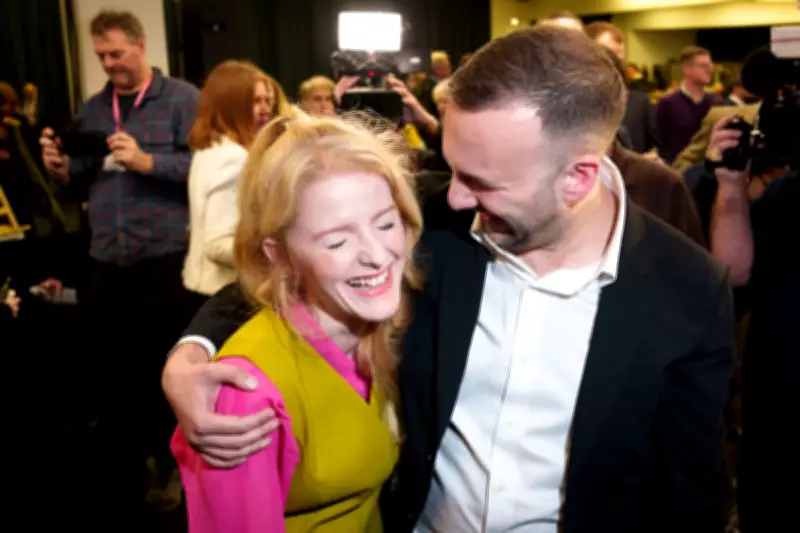
Green Party Secures Historic Victory in Gorton and Denton By-Election
In a stunning political upset, the Green Party has achieved a landmark victory in the Gorton and Denton by-election, delivering a severe blow to the Labour Party and potentially reshaping the British political landscape. Hannah Spencer's triumph represents the first time the Greens have won a parliamentary by-election, marking an historic moment that echoes previous political realignments in UK history.
Unprecedented Challenge to Labour's Dominance
This result represents a seismic shift in British politics, marking the first occasion in over a century that Labour has faced such a credible challenge from a progressive rival on the left in England. While Labour has previously lost seats to centrist and right-wing parties, including Reform UK's victory in Runcorn last year, this defeat to the Greens signals a new vulnerability for Keir Starmer's government.
The scale of Labour's defeat is particularly striking, with the Greens securing a solid 41 percent of the vote on a 26 percent swing from Labour. This commanding 12 percentage point lead over Reform UK demonstrates the Green Party's growing appeal in urban, ethnically diverse constituencies where Labour has traditionally dominated.

Political Implications and Leadership Concerns
For Prime Minister Keir Starmer, the only consolation appears to be that the sheer scale of Labour's poor performance makes an immediate leadership challenge before the May elections less likely, as such disruption would only compound existing problems. However, this result serves as a worrying precursor to potential difficulties in upcoming contests in Scotland, Wales, and local council elections, making Starmer's position increasingly precarious in the medium term.
The Green Party's success under charismatic leader Zack Polanski demonstrates their ability to challenge Labour in previously safe seats, building on their four-seat gain in the general election and current polling strength of approximately 14 percent. While Polanski himself didn't stand in this by-election, the result validates his leadership strategy and shows the Greens can effectively compete with established parties.
Historical Context and Political Realignment
This victory places the Green Party in a historical context similar to other political movements that began their ascent through by-election successes. The parallels with the Liberal Party's recovery in the 1950s, the SNP's breakthrough in Scotland during the 1960s, and UKIP's emergence in the 2010s are striking and suggest this could represent a genuine turning point in British politics.
The result also highlights the changing nature of protest voting in contemporary Britain. Voters seeking to punish the Labour government had multiple options beyond traditional alternatives like Reform UK, the Conservatives, or Liberal Democrats. The Green Party offered a viable progressive alternative that allowed voters to both protest against Starmer's government and prevent a hard-right victory.
Broader Political Consequences
The by-election revealed significant weaknesses across the political spectrum. Reform UK's disappointing performance suggests they may have lost momentum, with Nigel Farage's hand-picked candidate Matt Goodwin proving poorly suited to the constituency. Meanwhile, the Conservative Party suffered what can only be described as an extinction-level event, with their candidate receiving just 1.8 percent of the vote - the worst ever showing for the party in a Westminster by-election.
This pattern extends beyond Gorton and Denton. Of the two by-elections held since Labour came to power, Reform UK won Runcorn while the Greens have now taken Gorton and Denton. Additionally, Labour's loss to Plaid Cymru in the Caerphilly Senedd by-election last October, where they were pushed into third place, further demonstrates the party's vulnerability.

Long-Term Implications and Cautions
While this result suggests significant political realignment, some perspective is necessary. The next general election remains years away, and predictions about the death of the two-party system have proven premature on numerous previous occasions. Both Labour and the Conservatives have demonstrated remarkable resilience throughout their histories, with Labour's own unexpected revival after 2019 serving as a recent example.
Nevertheless, the Green Party's emergence as what some are calling the "Green Menace" has clearly unsettled traditional political establishments. If significant numbers of former Labour voters follow similar patterns in future elections, Labour could face historical-scale damage comparable to what the Conservatives experienced in the 2024 general election.
The Gorton and Denton by-election has fundamentally altered the political landscape, demonstrating that in certain constituencies, Labour now faces credible challenges from both the populist right and the progressive left. How traditional parties respond to this new reality will shape British politics for years to come.