Some 250 years after the United States declared independence from the British Crown, King Charles and Queen Camilla’s four-day state visit will be a happy and glorious spectacle, and could even repair Donald Trump’s growing rift with Keir Starmer. However, it will also be a reckoning for the special relationship, says Mary Dejevsky.
A Spectacle of Ceremony and Protocol
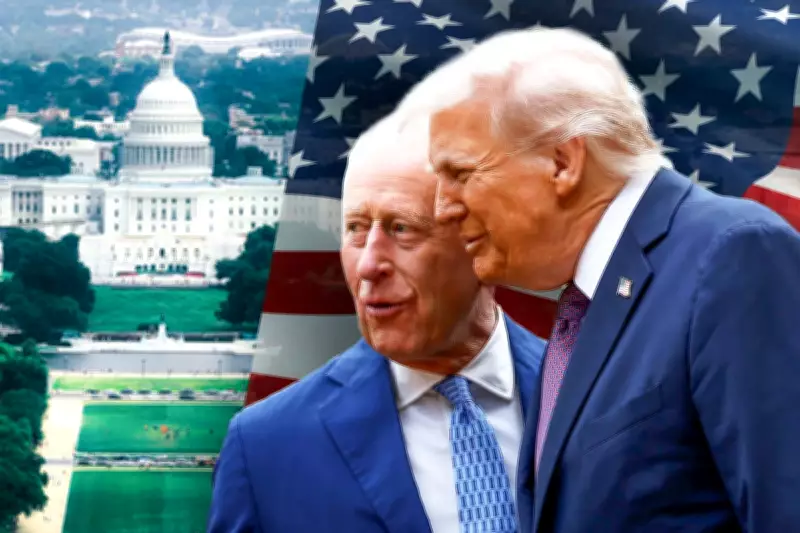
The dominant backdrop to next week’s global news cycle will be a succession of sometimes joyous, sometimes solemn state occasions, where the Union flag and the Stars and Stripes fly side by side. Assuming no last-minute hitches, King Charles and Queen Camilla will be making their long-trailed and minutely choreographed state visit to commemorate the 250th anniversary of US independence.
Any remaining contention in the UK surrounding the timing of the royal couple’s visit – and indeed the visit itself – will be swept aside as ceremony and protocol take over.

Trump’s Televisual Appeal
With Donald Trump mindful of the four-day set piece’s televisual appeal, this will be as impressive and colourful a spectacle as the president’s “unprecedented second state visit” to Britain last year. Then, the dynamic of UK-US relations was very different.
Then, the UK and the prime minister, Sir Keir Starmer, appeared to be navigating the shocks of Trump’s second term with notable success – at least, compared with many other national leaders. That included generous doses of flattery and a Brexit-assisted flexibility on tariffs. Since then, the US eviction of Venezuela’s president, Trump’s repeated claim to Greenland, and now the war with Iran have created a very different climate, one in which questions have been raised about whether it was even appropriate for the King to visit.
Diplomatic Calculations
That it has carried on regardless is a victory for those who argued against further rocking the boat, or even that fielding the King would be a canny diplomatic move that could speed a return to something like normal relations. Amid a growing rift with Starmer, Trump has said the King’s arrival could “absolutely” repair relations with the UK.
But that might also require Trump’s loudest critics in the UK government to pipe down, so that at least for the duration of the visit – when, between them, Charles and Camilla will shuttle between Washington, New York, Virginia and Bermuda – the dissonance between Crown and state is not too sharp.
What is even harder to ensure is that Trump springs no adverse surprises that could embarrass the monarch. Given his clear liking for the King, that may be a lesser risk than it seems.
Misgivings About the Visit
My misgivings about this visit are mostly less to do with current circumstances than with the past and future of UK-US relations, and about the strangeness, as it seems to me, of the UK commemorating in a state visit what was a landmark political victory for the embryonic United States in the 1776 Declaration of Independence, followed by the military victory and peace treaty of 1783. These were serial defeats for the British monarchy by a clutch of rebel colonies.
Granted that, for the Royals to mark this anniversary might be regarded on this side of the Atlantic – and by some Americans – in an entirely positive light: as a gracious gesture to illustrate that the bygones of two and a half centuries are really bygones, and that Britain is fully reconciled to its defeat, just so long as the increasingly lop-sided relationship can be designated “special”. All’s well, in other words, that ends well, with a small play on words.
But something quite important is being lost here. As a past correspondent for this newspaper in Washington and the wife for more than four decades of a US citizen, my view is that the extent and intensity of transatlantic difference – and specifically UK-US difference – tends to be underestimated, and that the US Declaration of Independence, which still underpins much in today’s United States, marked, and to a large extent still marks, a definitive parting of the ways.

Divided by More Than Language
What is more, I would argue that the neat and oft-quoted truism that the US and the UK are “two nations divided by a common language” is an understatement. It is not just language where we are divided – although such basic concepts as freedom, democracy and good governance take on sometimes strikingly different meanings in today’s US and UK. There are divisions on fundamental attitudes relating to the reach and obligations of the state towards the individuals and citizens, on wealth and poverty, on a politicised judiciary, on the role of religion, and much else.
One reason why the US and the EU have found it so difficult to conclude agreements on data protection or privacy, for instance, is because the two sides start from very different opening positions; with the UK, it might be worth noting, tending to line up behind the continental Europeans. I would add that my own greatest surprise about living in the “land of the free” was the degree of expected, and required, social conformity – which could be seen as an asset in a nation of immigrants.
Trump’s Impact
Of course, Trump’s two presidential terms may be seen as exceptional, but he has done little more than take underlying differences and difficulties between the US and the UK to a new level, whether in his uneasy combination of isolationism and interventionism, or in flouting generally respected international rules. Those differences might shrink, a little, after he leaves office, but to an extent they have always been there.
As such, this coming state visit, for all its efforts at contemporary relevance – with a 9/11 commemoration, and events about food security and Appalachian culture – may rely largely on the personal charm of the King and President Trump’s fascination with royalty to succeed. Once it is over, however, perhaps both the “special” in “special relationship” and the pretence of shared values can be laid to rest – replaced with a more honest appraisal both of our real differences, and of the comprehensive British political, military and economic defeat where it all began.