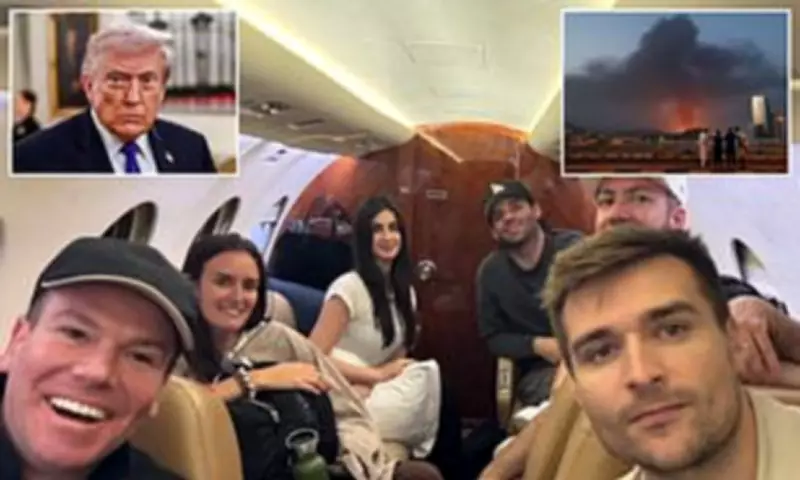
White House Facilitates Private Jet Escape for MAGA Figures as Millions Remain Trapped
In a dramatic development following recent US military strikes on Iran, several prominent MAGA influencers have been evacuated from the Middle East via a privately chartered jet with direct assistance from White House connections. This exclusive escape stands in stark contrast to the plight of over one million ordinary American citizens who remain stranded across the region with limited evacuation options.
The Elite Evacuation Operation
The group of six evacuees included Trump adviser Alex Bruesewitz, dogwalker Sarah Daither, and former lobbyist Jay Footlik. According to Bruesewitz's account to Politico, this evacuation represented "the craziest experience of my life." The operation was coordinated through a network of high-level contacts spanning multiple governments and political spheres.
Bruesewitz leveraged his White House connections alongside officials in Saudi Arabia and Qatar to secure safe passage after regional airports closed and the US Embassy issued shelter-in-place orders. The group ultimately flew to Athens, Greece, arriving around midnight local time, with Greece selected because Bruesewitz had established US connections there.

Political Connections Pave the Way
Key figures instrumental in facilitating this evacuation included:
- White House Chief of Staff James Blair
- Representative Anna Paulina Luna
- Kimberly Guilfoyle, US Ambassador to Greece and former fiancé of Donald Trump Jr.
Bruesewitz publicly acknowledged these individuals on social media platform X, specifically thanking Saudi officials for "ensuring that the other Americans and I could safely board our flight and depart the Gulf without incident." Guilfoyle's staff reportedly ensured a safe landing in Athens despite the operation's "short notice."
Individual Circumstances and Ongoing Efforts
Sarah Daither found herself stranded during a layover in Doha, Qatar, while returning from an African safari. After she posted about her predicament on social media, Bruesewitz saw her messages and offered her a seat on the chartered jet. Bruesewitz described the preceding 72 hours as "utterly surreal," noting that "Iranian missiles were flying directly over my head."
Remarkably, Bruesewitz has chosen to remain in the region to help coordinate additional private evacuations for other Americans, according to reports from the Daily Beast. His actions highlight the disparity between those with political connections and the broader American population facing the crisis.
Broader Regional Crisis Unfolds
This privileged evacuation occurs against a backdrop of severe regional instability. The US State Department has issued urgent warnings to Americans in 16 countries—including Israel, Qatar, Iran, and Saudi Arabia—instructing them to "DEPART NOW" using commercial transportation due to "serious safety risks."
Critical infrastructure has been severely impacted:
- The US Embassy in Jerusalem cannot evacuate anyone and has warned staff to shelter in place
- Tel Aviv's airport remains completely closed
- Jordan's Queen Alia International Airport is operating with limited service
Multiple US embassies remain on high alert, with facilities in Saudi Arabia and Kuwait coming under direct attack. The State Department has ordered the evacuation of non-emergency personnel and family members from Kuwait, Bahrain, Iraq, Qatar, Jordan, and the United Arab Emirates.
Military Escalation and Political Context
The crisis stems from US and Israeli military strikes targeting Iran, including fresh attacks on Tehran that prompted warnings for civilians to evacuate specific industrial zones and airport areas. These followed overnight barrages that Israeli officials said destroyed key government and security compounds in the Iranian capital.

Former President Donald Trump, who announced the initial US strikes on Iran from his Mar-a-Lago estate, warned that "the big one is coming" and that "the big wave hasn't even happened." In his address, Trump justified the military action as necessary to defend American people from "a vicious group of very hard, terrible people" in the Iranian regime, citing historical grievances including the 1979 embassy takeover and hostage crisis.
As the situation continues to deteriorate, the contrast between the privileged evacuation of politically connected individuals and the plight of over one million stranded Americans raises serious questions about equity in crisis response and the advantages afforded by political access during international emergencies.