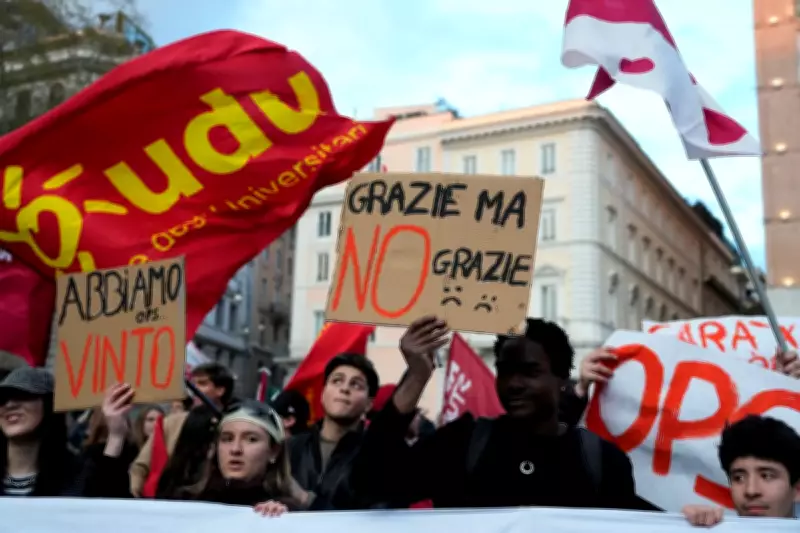
Italian Voters Deliver Stinging Rebuke to Premier Meloni in Judicial Reform Referendum
Italian Prime Minister Giorgia Meloni has suffered a significant political setback after voters decisively rejected her government's flagship judicial reforms in a constitutional referendum. The defeat comes just one year before national elections and represents a major blow to the conservative leader's authority.
Referendum Results Show Clear Opposition to Government Proposals
Final results released by the Interior Ministry revealed that the "No" campaign secured a decisive victory with almost 54% of the vote, while the government-backed "Yes" side garnered approximately 46%. Turnout for the two-day ballot, which began on Sunday, exceeded expectations at nearly 59%, indicating substantial public engagement with the contentious issue.
Following the defeat, Prime Minister Meloni took to Instagram to acknowledge the outcome, stating: "Italian citizens have decided and we respect their decision as always." She affirmed her commitment to completing her mandate, which extends until 2027, adding: "We will move forward as we always have: with responsibility, determination, and above all, with respect for Italy and its people." The Premier expressed particular "regret for a missed opportunity to modernize Italy."

Polarising Campaign Exposed Deep Political Divisions
The referendum campaign proved intensely polarising, energising the centre-left opposition which successfully framed the proposed judicial changes as a threat to institutional independence. Opposition parties, civil society groups, and legal associations formed a unified front against the reforms, warning they could dangerously concentrate power within the executive branch and undermine essential checks and balances.
With political tensions already elevated across Italy, public debate intensified dramatically during the final weeks before the vote, transforming the referendum into what many observers described as a de facto confidence test on Meloni's leadership itself. The campaign highlighted significant internal divisions within Meloni's right-wing coalition government.
Analysts Question Stability and European Standing
Political analysts suggest the referendum defeat, particularly following a campaign so closely tied to Meloni's personal leadership, raises serious questions about the stability and cohesion of her governing coalition. The setback punctures Meloni's carefully cultivated image of strength and could weaken her status as a pillar of domestic stability.
Jess Middleton, senior Europe analyst at risk intelligence company Verisk Maplecroft, commented: "Italy has defied its reputation for government instability in recent years. This defeat punctures Meloni's image of strength, weakening her status as a pillar of domestic stability and as a consistent player in an increasingly volatile European political landscape."
Opposition Gains Momentum Ahead of National Elections
The referendum outcome provides a substantial boost to Italy's centre-left opposition forces, with frustrations regarding the government's economic performance and its stance on international conflicts coming into sharp focus throughout the campaign. Elly Schlein, leader of the centre-left Democratic Party, hailed the referendum result and pledged continued opposition unity.
At a news conference celebrating the "No" victory, Schlein declared: "We'll continue to work together and we'll build a real alternative to this government." Analysts now question whether these disparate opposition forces can maintain sufficient cohesion to present themselves as a credible alternative ahead of next year's crucial national vote.
The proposed judicial reforms had been championed by Meloni's government as essential measures to streamline Italy's notoriously slow and bureaucratic judicial system, which has long faced criticism for its susceptibility to political influence. However, critics successfully argued that the changes risked undermining judicial independence and concentrating excessive power within the executive branch.