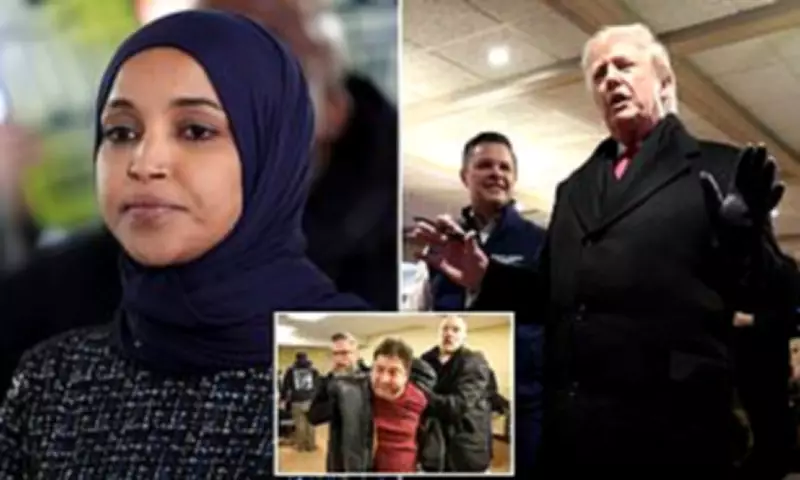
Congresswoman Ilhan Omar has publicly suggested that former President Donald Trump may be 'suffering from dementia' in the wake of a disturbing syringe attack against her and his subsequent dismissive comments. The incident has ignited a fierce political debate, highlighting the intense polarisation and security concerns facing elected officials.
Omar's Stinging Rebuke of Trump's Remarks
The controversy erupted after Trump was asked about the attack on Omar, during which a supporter sprayed her with a substance believed to be apple cider vinegar. His response was blunt: 'I don't think about her. I think she's a fraud. I really don't think about that. She probably had herself sprayed, knowing her.' Omar reacted with incredulity, pointing to the stark contradiction in his statements.
'It is ironic that last night, he was on stage just moments before I was attacked, talking about me and then when asked about my attack he said, "I don't think about her,"' Omar stated. She posed a series of pointed questions: 'Does he not remember? Is he suffering from dementia? How do you spend 20-30 minutes on stage obsessing over me by name, multiple times and then moments later, say "Ilhan Omar? I don't think about her."'

The Rally That Preceded the Assault
Trump had indeed focused on Omar during a rally in Iowa on Tuesday night, just prior to the attack at her town hall event in North Minneapolis. Addressing the crowd, he criticised immigration policy, stating his administration would only admit immigrants who 'can show that they love our country.' He explicitly contrasted this with Omar, saying, 'They have to be proud, not like Ilhan Omar,' a remark that drew loud boos from the audience.
He further disparaged her background, adding, 'She comes from a country that's a disaster. So probably, it's considered, I think - it's not even a country.' This rhetoric, Omar argues, has direct and dangerous consequences.
A Pattern of Threats and Political Blame
Omar directly linked Trump's language to the threats she faces. 'What the facts have shown since I have gotten into elected office is that every time the President of the United States has chosen to use hateful rhetoric to talk about me and the community that I represent, my death threats skyrocket,' she explained. She noted that these threats had 'plummeted' during President Joe Biden's tenure.
Despite the alarming incident, Omar remained defiant. When asked if she was nervous about public appearances, she asserted, 'Fear and intimidation doesn't work on me.' She stood her ground immediately after the attack, telling her team, 'We will continue. These f**king a**holes are not going to get away with it.'
Details of the Attack and the Attacker
The assailant, identified as 55-year-old Anthony J. Kazmierczak, charged towards Omar during her town hall and sprayed her with a syringe. He shouted for her to resign, claiming she was 'tearing Minnesota apart' before being subdued by security. Omar muttered 'F**king a**hole' as he was dragged away.
Kazmierczak has been charged with third-degree assault and is being held without bail in Hennepin County Jail. His background reveals a troubled history:
- Convicted of felony auto theft in 1989.
- Multiple arrests for driving under the influence.
- Numerous traffic citations and significant financial problems, including two bankruptcy filings.
His social media activity showed support for Trump and criticism of Democrats and Joe Biden. In one post, he wrote that Trump 'wants the US is stronger and more prosperous.' Disturbingly, his own brother told reporters he was 'not surprised' by the actions, describing Kazmierczak and their mother as 'right-wing extremists.' The brother added that Kazmierczak had held a long-standing dislike for Omar and 'has had a hatred of the Somali community for probably 20 years.'
A Broader Context of Political Violence
This attack is not an isolated event. It came days after a separate incident where a man was arrested for allegedly punching Congressman Maxwell Frost, a Democrat from Florida, at the Sundance Film Festival. The assailant reportedly referenced Trump's deportation policies during the assault.

Alarmingly, the US Capitol Police reported that threat assessment cases against members of Congress, their families, and staff increased by 57 percent in 2025, totalling 14,938 investigations. US Capitol Police Chief Michael Sullivan emphasised ongoing efforts to enhance security, stating, 'We want to make sure agencies have the resources they need to be able to enhance protection, which is critical to the democratic process.'
The White House has been approached for comment on Omar's allegations regarding Trump. The incident underscores the volatile intersection of political rhetoric, personal security, and the deepening divisions within American politics.