Outcry Over Trump's 'Clown Car' Cabinet Intensifies Amid Bizarre Antics
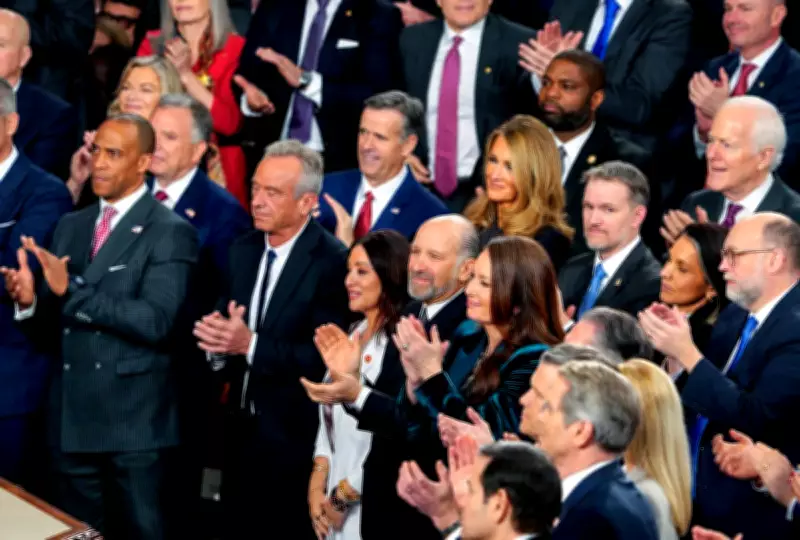
As members of the Trump cabinet gathered for Tuesday night's State of the Union address, a solemn prayer circle formed, with Tulsi Gabbard, the director of national intelligence, later reflecting on social media about the importance of quiet moments. However, this display of unity starkly contrasts with the growing public and political outcry over what critics are labelling a 'clown car' administration, filled with individuals whose erratic behaviour and questionable qualifications are drawing unprecedented derision.
A Cabinet Unlike Any Other in US History
In the past fortnight alone, the American public has witnessed a health secretary boasting about snorting cocaine off toilet seats, a homeland security secretary allegedly firing a pilot over a misplaced blanket, and an FBI director chugging beer with Olympic athletes at taxpayer expense. This collection of characters represents a government leadership team without parallel in the annals of United States history.
Tara Setmayer, founder of the women-led political organisation Seneca Project, minced no words in her assessment. "If you elect a clown, he brings the circus. This is the cabinet that we currently have. It is the most corrupt, incompetent, and embarrassing cabinet in the history of the United States and unfortunately it's the American people who are paying for it, literally and figuratively."

She posed the fundamental question: "When you look at Donald Trump's cabinet, and how they have performed, you have to ask yourself, how are any of these people making America great again?"
Historical Precedents and Present Peculiarities
While presidential cabinet selections have historically presented challenges—from Albert Fall's Teapot Dome scandal under Warren Harding to John Mitchell's Watergate convictions under Richard Nixon—Trump's current team represents a new departure. Unlike his first term, which included relatively conventional picks like Rex Tillerson and Jim Mattis, Trump 2.0 features what Larry Sabato, director of the Center for Politics at the University of Virginia, calls "problematic characters who are just awful."
Sabato observes: "Trump keeps them around because, in a way, they may look him better. They're so awful and we're more used to him that somehow he's more acceptable. You have to use this kind of twisted psychology in analysing Trump."
The Circus Performers: A Rogue's Gallery
The cabinet's peculiarities read like a catalogue of political misfires:
- Robert Kennedy Jr, the health secretary with a history of vaccine scepticism, recently insisted in a podcast interview: "I used to snort cocaine off of toilet seats."
- Kristi Noem, homeland security secretary, faces controversy over anti-immigration crackdowns and the alleged firing of a Coast Guard pilot over a personal blanket left on a government plane.
- Pam Bondi, the attorney general, earned mockery for calling Trump "the greatest president in American history" during a congressional hearing about Jeffrey Epstein files.
- Kash Patel, FBI director, was spotted celebrating raucously in the locker room with the US men's hockey team after their gold medal win at the Milan Winter Olympics.
- Howard Lutnick, commerce secretary, claimed he avoided Epstein after 2005, yet visited his private island for lunch in 2012.
- Lori Chavez-DeRemer, labor secretary, faces an inspector general investigation into allegations of inappropriate relationships and misuse of funds.
Loyalty Over Competence: The New Standard
Critics argue that job performance in this administration is judged primarily on loyalty to the president rather than relevant experience or competence. This has created what Democratic strategist Antjuan Seawright describes as "the most unserious, unqualified, uncommitted cabinet we've seen in many of our lifetimes."
Seawright notes: "They seem committed to an audition for an audience of one—that's the president—and they seem committed to one agenda, and that's the Maga extreme agenda."

Stability Without Accountability
Paradoxically, while Trump's first term was marked by personnel turbulence, his second has shown remarkable stability. Even Mike Waltz, culpable for the "Signalgate" security breach involving warplane launch timings, was merely transferred to become US ambassador to the UN rather than fired.
Setmayer explains this lack of accountability: "The reason we're not seeing really any accountability for the transgressions of virtually the entire cabinet is because if they hold one of them accountable then that means you have to hold Donald Trump accountable. It flows from the head here."
The Political Calculus
The president appears reluctant to admit mistakes or provide the media with sacrificial lambs. New appointees would face difficult Senate confirmation processes, and Trump seems content to bask in the extravagant displays of sycophancy that characterise his cabinet meetings.
As Seawright observes the double standard: "In no way, shape or form would this be tolerated by any Democratic administration. If we came close to any of this, they would have been calling for impeachment, calling for resignation and acting as if the world was on fire."
Yet despite Democratic efforts—including more than 160 representatives backing impeachment proceedings against Noem and attempts to subpoena Lutnick over his Epstein lies—there is little indication that any Trump cabinet members will lose their positions. The circus, it seems, will continue its performance, with the American public as both audience and, according to critics, the ones ultimately paying the price.