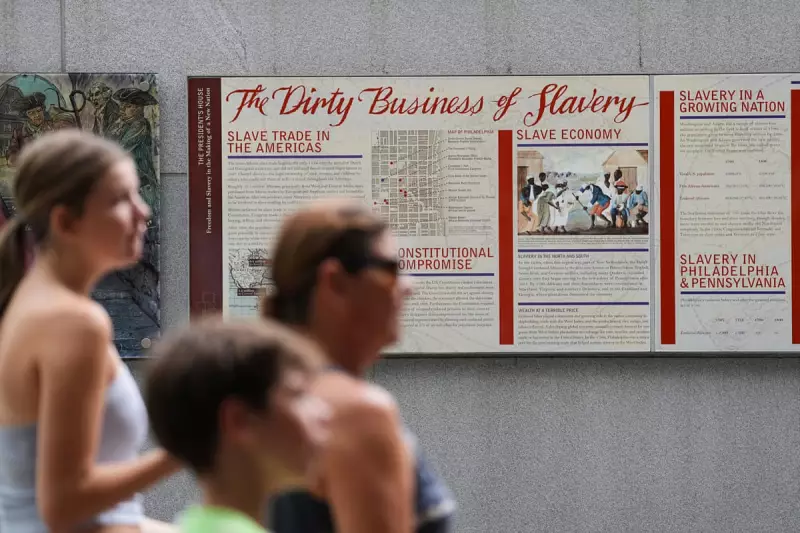
The city of Philadelphia has initiated a significant legal challenge against the United States federal government, following the controversial removal of a slavery-related exhibition at a prominent historical site. This decisive action targets the Trump administration's National Park Service, which recently dismantled long-standing interpretive displays at the President's House site within Independence National Historical Park.
Legal Action and Historical Context
Philadelphia's lawsuit was formally filed in federal court on Thursday, naming the US Department of the Interior, its Secretary Doug Burgum, the National Park Service, and its acting director Jessica Bowron as defendants. The city is seeking a court order to compel the immediate restoration of the exhibits while the legal proceedings advance. This display, situated at the former residence of Presidents George Washington and John Adams, specifically acknowledged individuals enslaved by Washington and provided a broader historical chronology of slavery in America.
Condemnation from Local and State Leaders
The decision to remove the exhibition has provoked strong criticism from Pennsylvania's political leadership. Democratic Governor Josh Shapiro issued a sharp rebuke, accusing former President Donald Trump of attempting to "rewrite and whitewash our history." In a message posted on social media platform X, Shapiro asserted, "We learn from our history in Pennsylvania, even when it's painful," emphasising the educational value of confronting uncomfortable historical truths.

Philadelphia City Council President Kenyatta Johnson echoed these sentiments, stating that removing the exhibits constitutes "an effort to whitewash American history." Johnson emphasised that "history cannot be erased simply because it is uncomfortable," arguing that such actions merely alter the physical landscape without changing the historical record itself.
Background of the Exhibition and Legal Arguments
The lawsuit details that Congress had encouraged the National Park Service back in 2003 to formally acknowledge the enslaved people who lived and worked at the President's House. Subsequently, in 2006, the city of Philadelphia and the federal agency agreed to collaborate on creating an exhibit for the site. This exhibition opened to the public in 2010, featuring a memorial and informational panels specifically focused on the history of slavery.
Philadelphia's legal filing argues that "the interpretive displays relating to enslaved persons at President's House are an integral part of the exhibit and removing them would be a material alteration." Furthermore, the city contends that officials were not provided with advance notice regarding the planned changes to the exhibition, raising procedural concerns about the removal process.
Broader Political and Cultural Implications
The removal of this slavery exhibit appears to be part of a wider initiative by the Trump administration to eliminate cultural content that does not align with its policy agenda. Last March, Trump issued an executive order accusing the previous Biden administration of promoting "improper, divisive, or anti-American ideology." This order instructed the Interior Secretary to alter materials under departmental control that "have been improperly removed or changed in the last five years to perpetuate a false revision of history or improperly minimize or disparage certain historical figures or events."
This approach has manifested in other cultural institutions as well. Since Trump's return to office, changes have been implemented at the Smithsonian Institution, including the removal of text discussing his impeachment and his role in the 6 January 2021 attack on the Capitol from displays near his official portrait at the National Portrait Gallery.
The legal battle in Philadelphia represents a significant confrontation over historical interpretation, cultural memory, and the appropriate commemoration of America's complex past. The outcome of this lawsuit could establish important precedents regarding how historical narratives are presented at federally managed sites across the United States.