Public Trust in British Justice Plummets Amid 'Two-Tier' System Claims
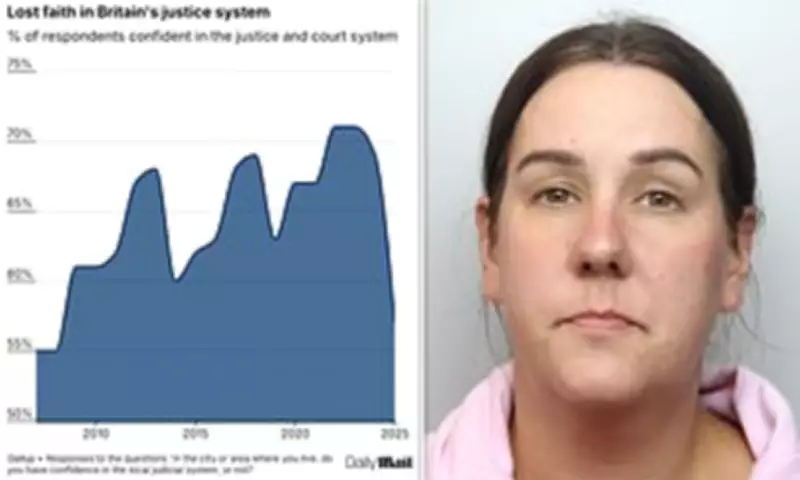
Public confidence in Britain's once-revered justice system has eroded significantly, according to critics who point to rising concerns over 'wokery' and perceived unequal treatment. A new Gallup poll has found that just 57% of adults now express confidence in the courts, marking a dramatic decline from 69% in 2024. This represents the largest year-on-year fall since records began, highlighting a deepening crisis of faith in legal institutions.
Poll Reveals Stark Drop in Confidence
The data, gathered by respected pollster Gallup, suggests that the loss of trust could be partly attributed to the emergence of a supposed 'two-tier' justice system. This perception has grown following disputes and riots fuelled by events like the Southport murders. Notably, the justice system is now the only national institution that the public trusts less than pre-Covid levels, with faith in the NHS, military, and government remaining much steadier.
Political divides are evident in the polling figures. Only 30% of Reform UK voters trust the justice system, compared to 67% of Labour voters and 63% of Conservative voters. This disparity underscores the polarised views on legal fairness and enforcement across the political spectrum.

Critics Point to Lenient Sentencing and 'Two-Tier' Treatment
Zia Yusuf, Reform's shadow home secretary, told the Daily Mail: 'These figures confirm what Reform UK has long argued: Confidence in our courts is at rock bottom. For too long the public have seen violent criminals and sexual predators given lenient sentences while those prosecuted for speech-related offences are treated like terrorists.' He added that a Reform UK government would end the current two-tier system, crack down on violent and repeat offenders, and restore faith in the rule of law.
Jim McConalogue, chief executive of the Civitas think-tank, echoed these concerns, stating that the loss of trust stems from 'the perception of preferential treatment between groups.' He explained: 'From disorderly activism on Palestine or climate to an absence of effective responses to problems such as illegal immigration, there is a notable difference in how the justice system deals with these problems.'
Controversial Cases Highlight Sentencing Disparities
Both the Tories and Reform have highlighted specific cases as evidence of harsh or inconsistent sentencing. Lucy Connolly, a mother jailed in October 2024 for 31 months for inciting racial hatred in an X post, has been cited as an example of severe punishment. Incensed by misinformation that killer Axel Rudakubana was in the country illegally, she posted that people should 'set fire to all the f*****g hotels full of the b*****ds for all I care.'
In contrast, shamed BBC newsreader Huw Edwards dodged jail when sentenced in September 2024 after pleading guilty to possessing indecent images of children, including one of a child as young as seven. This case has fuelled accusations of a two-tier system where some offenders receive preferential treatment based on identity or characteristics.
Backlog and Reform Proposals Add to Concerns
The justice system faces additional challenges, including a record backlog of 80,000 cases. Analysis revealed last month that more than 64 crown courtrooms sit unused daily, with projections showing crown caseloads could reach 100,000 by 2028. This means a suspect charged today might not appear before a jury until 2030, exacerbating delays for victims.
In an effort to reduce the backlog, Labour is planning to scrap jury trials for some cases, relying instead on a judge sitting alone. This proposal has sparked backlash from legal professionals and the public, who view it as a threat to a cornerstone of the constitution dating back over 800 years.
Early Release Schemes and Accidental Freedoms
Keir Starmer's policy of releasing convicted criminals early to free up prison space has also proven controversial. Disturbing scenes from 2024 showed freed inmates celebrating with champagne, being picked up in luxury cars like Lamborghinis, and even boasting about becoming 'lifelong Labour voters.' Victims and their families warned that such decisions left them feeling 'sick to the stomach.'

Compounding these issues, figures show that 262 prisoners were mistakenly freed from prisons in England and Wales between April 2024 and March 2025—the highest one-year tally on record. A notorious example was the accidental release of asylum seeker Hadush Kebatu, who sexually assaulted a teenage girl in Epping, leading to public protests.
Government Response and Future Plans
The Government has acknowledged these challenges, with a Ministry of Justice spokesman stating: 'This government inherited a justice system on the brink of collapse with overflowing prisons and a record court backlog that left victims facing unacceptable delays.' They plan to invest £7 billion between 2024-25 and 2029-30 to deliver 14,000 new prison places by 2031, having already opened over 3,000 since July 2024. This follows a period where only 500 net places were added between May 2010 and July 2024, despite a rapidly rising prison population.
However, critics argue that deeper issues—such as the perception of politically biased judges and the influence of identity politics—must be addressed to restore public trust. As Jim McConalogue noted, 'With the growth of identity politics and implausible victimhood narratives encouraged across many of our public institutions, it has been permitted that some groups have been unjustly favoured under the law, which needs to be addressed.'