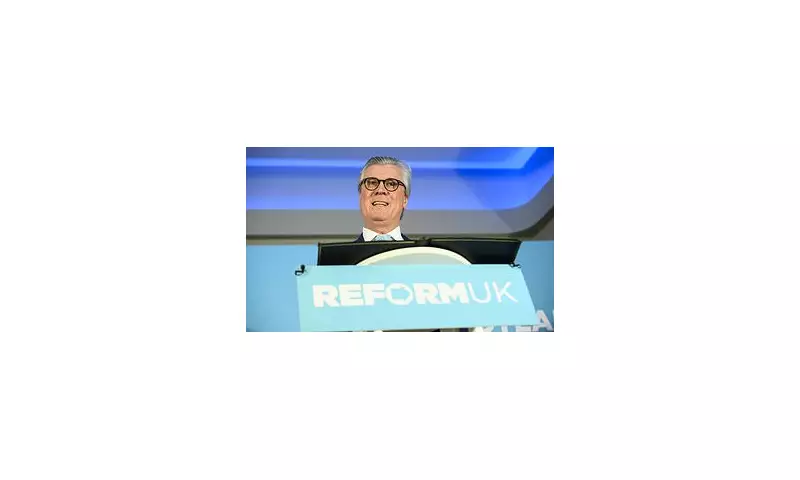
In a significant development for Scottish politics, the newly appointed Scottish leader of Reform UK has declined to definitively rule out supporting another independence referendum at some point in the future. Malcolm Offord, delivering his first major address since taking on the role, outlined a nuanced position that seeks to bridge divides while setting clear electoral boundaries.
A Decade-Long Pause on Constitutional Debate
Mr Offord, who recently defected from the Conservative Party, stated that Reform UK's official policy will be to oppose a second independence referendum, often referred to as Indyref2, for a minimum of ten years. However, he deliberately left the door ajar for the longer term, emphasising a stance of 'without ruling one out in the future'. This positioning attempts to carve out a middle ground in Scotland's often polarised constitutional landscape.
Admission of Nationalists Within Party Ranks
During his speech, held at the Ingliston Country Club and Hotel in Bishopton, Renfrewshire, Mr Offord made a candid admission that has sparked considerable political commentary. When questioned about whether any of Reform UK's candidates for the upcoming Holyrood election in May would be supporters of Scottish independence, he acknowledged, 'we do have some Nationalists'.

He was quick to clarify, however, that these individuals were not former Members of the Scottish Parliament (MSPs). He insisted that, as Reform UK is fundamentally a Unionist party, any prospective candidate who actively desires another referendum in the immediate future would not be permitted to stand under its banner. 'They will know that is our position, so if you had that position you wouldn't stand for Reform,' he asserted.
Policy Platform for the Holyrood Elections
With the Scottish Parliament elections now just 100 days away, Mr Offord used the platform to unveil several key policy proposals. The centrepiece is a bold fiscal plan involving a substantial £2 billion cut to public spending. The stated aim of this reduction is to fund significant income tax cuts for Scottish residents.
The proposal involves immediately realigning Scotland's five income tax bands with the three bands used in the rest of the United Kingdom. Following this, each tax rate would be cut by 1p in the pound, with a further ambition to reduce each band by 3p within a five-year timeframe. Mr Offord claimed the realignment would cost approximately £1.2 billion, with each 1p cut costing around £850 million.
To finance this £2 billion initiative on day one, he identified savings from a £9 billion budget covering areas he described as 'highly dubious environmental protection, economic development and 132 unaccountable quangos'. He argued that the current tax regime discourages economic growth, stating, 'The pendulum at Holyrood has swung too far - from work to welfare.'
A "Tougher Approach" to Immigration
Another major policy pillar outlined was a commitment to a stricter immigration stance. Mr Offord, describing his approach as shaped by his Christian faith, argued for a system that prioritises British citizens, especially during the ongoing cost-of-living pressures. 'Right now, especially in this cost of living scenario, we need to prioritise our own people over strangers,' he stated, pledging to 'speak the truth' on the issue.
Political Reactions and Unionist Concerns
The speech and its revelations have drawn sharp criticism from political rivals, particularly the Scottish Conservatives. Scottish Tory leader Russell Findlay described Reform UK as 'a gift to John Swinney', the SNP leader, and issued a stark warning to Unionist voters.
'Lord Offord's admission that there are still nationalists in Reform's ranks is a wake-up call for Unionist voters,' Mr Findlay said. 'It explains Reform's repeated refusal to rule out another divisive independence referendum.' He further accused Reform of having fielded pro-independence candidates in past elections and being set to do so again, undermining the Unionist cause.

A Vision for a United Scotland
In his address, Mr Offord, who was installed as Scottish leader by Nigel Farage and the UK party leadership without a vote of its 12,500 Scottish members, presented an ambitious vision. He appealed for national unity around economic prosperity, seeking to temporarily sideline the constitutional question.
'I believe moderate unionists – no longer represented by the Tories – and rational nationalists – no longer represented by the SNP – can find common ground,' he proposed. His goal is to 'unite around one single ambition: to make Scotland the most successful and the most fair country in the world.'
He argued that focusing on turbocharging Scotland's economy over two Holyrood terms (approximately ten years) would deliver the innovation and revenue needed to vastly improve public services like the NHS, education, and infrastructure. Only after this period of focused growth, he suggested, should the constitutional debate be revisited.
Describing himself as a 'Scottish patriot', Mr Offord concluded that if Scotland can achieve its potential within the United Kingdom, then that should be the path forward. The coming months will test whether this attempt to reframe the political debate resonates with voters ahead of the crucial Holyrood elections.