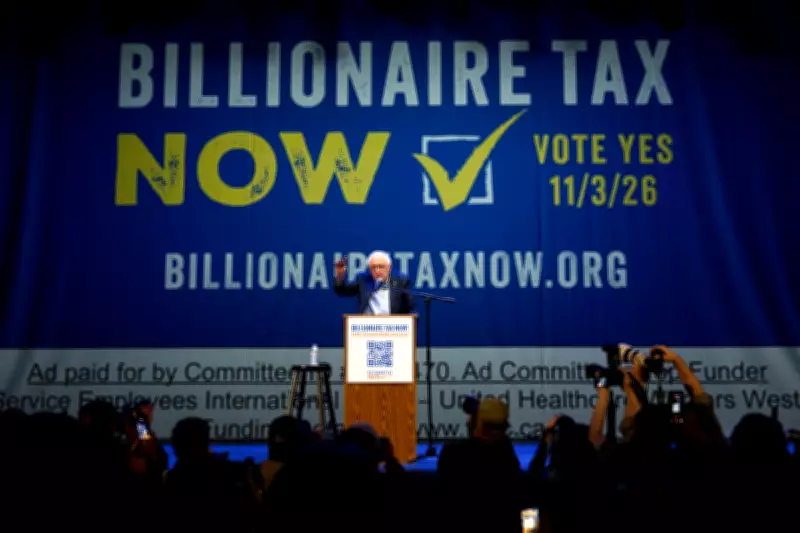
Senator Bernie Sanders and Representative Ro Khanna have unveiled a significant legislative proposal aimed at imposing a new wealth tax on America's wealthiest individuals. The bill, introduced on Monday, seeks to levy a 5% annual tax on billionaires in the United States.
The Make Billionaires Pay Their Fair Share Act
The proposed legislation, formally titled the Make Billionaires Pay Their Fair Share Act, would apply specifically to individuals with a net worth of $1 billion or more. According to estimates from Sanders's office, approximately 938 people in the country currently meet this financial threshold.
In a joint news release, Sanders, the independent senator from Vermont, and Khanna, the Democratic representative from California, outlined the ambitious scope of their plan. They cited an analysis by economists at the University of California, Berkeley, which projects that the wealth tax could generate an astonishing $4.4 trillion in revenue over the next ten years.

How the Revenue Would Be Utilised
The lawmakers have detailed specific plans for how this substantial revenue would be allocated to benefit American citizens. In its inaugural year, the bill would provide direct payments of $3,000 to every man, woman, and child in households earning $150,000 or less annually. This translates to $12,000 for a typical family of four.
Beyond these immediate payments, the legislation proposes using the estimated $4.4 trillion in revenue to address critical issues facing working families across the nation. Key initiatives include expanding Medicare coverage to include dental, vision, and hearing services for millions of senior citizens. Additionally, the plan aims to build, rehabilitate, and preserve over 7 million affordable housing units throughout the country.
Potential Impact on Prominent Billionaires
The news release from Sanders's office provided specific examples of how the wealth tax would affect some of America's most well-known billionaires. According to their calculations, Elon Musk would owe approximately $42 billion in taxes under this proposal, leaving him with an estimated net worth of $792 billion.
Similarly, Mark Zuckerberg, with an estimated worth of $220 billion, would face an $11 billion tax bill. Jeff Bezos, valued at $218 billion, would also owe around $11 billion under the proposed legislation.
Political Context and Challenges
Despite the ambitious nature of the proposal, political realities present significant obstacles to its passage. With Republicans currently controlling Congress, the legislation faces an uphill battle to become law. However, political analysts suggest the proposal could play a crucial role in shaping the Democratic party's platform for the 2028 presidential primary, potentially serving as a litmus test for candidates.
Parallel Developments in California
Meanwhile, in Khanna's home state of California, a separate wealth tax initiative is gaining momentum. A proposed ballot measure would impose a one-time tax equal to 5% of assets on California residents whose net worth exceeds $1.1 billion. The revenue generated would be directed toward healthcare, education, and food assistance programs within the state.
Supporters of this California measure must gather nearly 900,000 signatures to qualify it for the November ballot. Interestingly, Governor Gavin Newsom, widely considered a top Democratic contender for the 2028 presidential race, has expressed opposition to state-level wealth taxes. His spokesperson has indicated that Newsom believes such taxes could create competitive disadvantages between states.
Key Provisions and Considerations
Khanna, who has not ruled out a potential 2028 presidential bid himself, has advocated for specific provisions within the federal legislation. These include protections for startup founders whose stock is locked or whose companies are not yet profitable. The proposed provisions would allow such entrepreneurs to defer tax payments until a liquidity event occurs, without accruing interest, with adjustments based on valuation at the time of liquidity.

The introduction of this wealth tax legislation represents a significant development in ongoing debates about economic inequality and tax fairness in the United States. While its immediate prospects for passage appear limited, the proposal has already sparked important conversations about wealth distribution and government revenue priorities that are likely to continue influencing political discourse in the coming years.