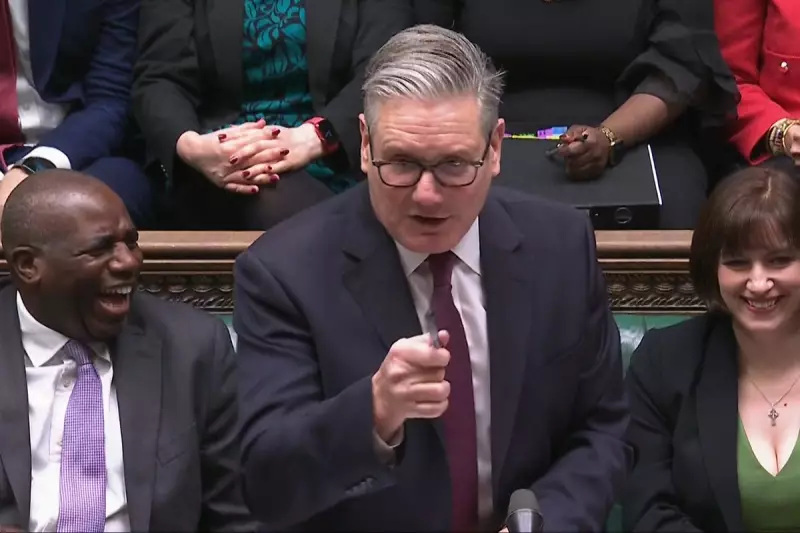
Prime Minister Sir Keir Starmer and Conservative leader Kemi Badenoch engaged in a spirited exchange of political barbs during Wednesday's Prime Minister's Questions, with defections and party discipline taking centre stage in the parliamentary debate.
Heated Exchange Over Party Loyalty
The session began with Commons Speaker Sir Lindsay Hoyle reprimanding MPs for excessive shouting while the Prime Minister was addressing the chamber. This intervention set the tone for what would become a particularly contentious question period focused on internal party politics and loyalty.
Starmer Targets Jenrick's Defection
Sir Keir Starmer immediately seized the opportunity to needle the Conservative leader about last week's high-profile defection of former shadow justice secretary Robert Jenrick to Reform UK. The Prime Minister delivered a pointed remark linking parliamentary behaviour to political allegiance.

"They shout on a Wednesday and they defect on a Thursday," Starmer declared. "The loudest shouter used to be former shadow justice secretary (Mr Jenrick). We should take a note of who is shouting most loudly this week."
Badenoch's Swift Retort
Kemi Badenoch responded with equal sharpness, contrasting her approach to party discipline with what she suggested was Starmer's more lenient stance toward dissent within his own ranks.
"When I had someone undermining my party, I sacked him," the Conservative leader asserted. "We all know that if he sacked everyone undermining his party, his frontbench would be empty."
Escalating Political Theatre
The Prime Minister fired back with a characteristically witty response, questioning the timing of Badenoch's disciplinary actions against Jenrick.
"She read the guy's defection letter, and then at that point decided to sack him," Starmer quipped. "What was she gonna do? Correct the typos and give it back to him? She should have sacked him when he made disgraceful comments about faces in Birmingham."
Starmer added a further barb, suggesting Badenoch's apparent satisfaction with having fewer Conservative MPs aligned with broader public sentiment. "She smiles, saying it's a good thing she's cleared out, a good thing there's fewer Tory MPs – the rest of the country agrees with her completely."
Parliamentary Discipline Enforced
The political theatre continued when Conservative shadow cabinet minister Richard Holden was ejected from the Commons chamber by Speaker Sir Lindsay Hoyle. The removal came after Holden repeatedly heckled the Prime Minister during a discussion about special educational needs and disabilities (SEND) funding in East Riding of Yorkshire.
According to local council figures, East Riding of Yorkshire receives approximately £18 million less in annual SEND funding compared to the average local authority. While Starmer acknowledged the government was applying the Conservative-derived funding formula, he noted ministers were "proposing reforms" to address such disparities.
Speaker's Humorous Intervention
As Holden's interruptions persisted, Sir Lindsay Hoyle employed both authority and humour to restore order. "Mr Holden, as shadow secretary of transport, you'll be getting the express train and you'll be out of here," the Speaker declared.
Starmer paused his response to the SEND funding question to gesture toward Reform UK MPs in the chamber, suggesting Holden's behaviour might indicate future defection prospects. "(Mr Holden) may be making himself the next candidate for the Thursday defection, or maybe it's someone else. Those that shout loudest end up over there."
When further disruptions continued, the Speaker issued a final directive: "Mr Holden, I think you need to leave." The shadow transport secretary subsequently rose from his seat, offered a bow in the Speaker's direction, and exited the parliamentary chamber.
Broader Political Context
This exchange highlights the ongoing tensions within British politics as parties navigate internal dissent and external challenges. The reference to Reform UK MPs in the chamber underscores the growing presence of alternative political movements and their potential to influence traditional party dynamics.

The incident also illustrates how parliamentary procedures and disciplinary measures intersect with substantive policy discussions, as demonstrated by the juxtaposition of the defection debate with questions about education funding allocations.