Starmer Issues Defiant Stance on Iran Amid Trump's Demands and Economic Warnings
Prime Minister Keir Starmer has delivered a resolute message regarding the escalating Iran conflict, asserting that the United Kingdom's economy possesses the necessary resilience to navigate the emerging storm. However, he confronts mounting calls to prepare for substantial intervention as a consequence of Donald Trump's military actions in the Middle East, a situation economists are dubbing 'Trumpflation'.
UK Resists Direct Military Commitment, Seeks Diplomatic Path
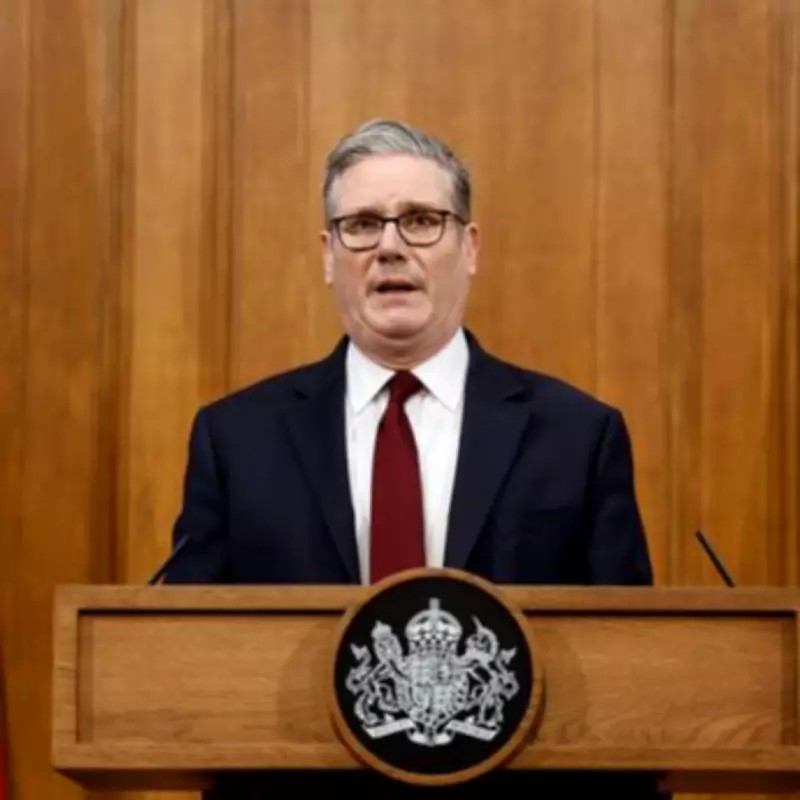
Speaking from Downing Street, Starmer firmly stated that Britain would not be drawn into a broader regional war, despite intense pressure from former US President Trump to deploy Royal Navy warships to protect the vital Strait of Hormuz. "While taking the necessary action to defend ourselves and our allies, we will not be drawn into the wider war," the Prime Minister declared. He emphasized the critical need for international consensus, revealing that the UK is collaborating with European and other allies to formulate a collective strategy aimed at swiftly reopening the crucial maritime chokepoint.
The Strait of Hormuz, a 104-mile passage linking the Persian Gulf and the Gulf of Oman, is a linchpin for global energy supplies, facilitating the transport of approximately one-fifth of the world's oil and gas. Recent missile and drone threats have severely disrupted traffic, sparking fears of a sharp spike in fuel prices that would ripple across the entire economy.
Economic Safeguards Announced as 'Trumpflation' Fears Mount
Acknowledging the widespread alarm caused by the crisis, which ignited following US and Israeli missile strikes on Iran in late February, Starmer unveiled a £53 million support package targeted at households reliant on oil for heating, which fall outside the standard energy price cap. This allocation includes £27 million for England, £17 million for Northern Ireland, £4.6 million for Scotland, and £3.8 million for Wales.
Furthermore, the Government has issued a legal directive compelling energy companies to pass on cost savings to consumers. "The British economy is in a better place than it otherwise would have been to weather the storm," Starmer asserted, citing post-2024 election efforts to bolster national resilience. These measures encompass the largest increase in defence spending since the Cold War and significant investment in domestic clean energy to reduce dependency on volatile fossil fuel markets.
Trump's Criticism and NATO Tensions Escalate
The Prime Minister's cautious approach has drawn fierce criticism from Donald Trump, who lamented the UK's initial reluctance to participate in the offensive against Iran. In remarks to the Financial Times, Trump implied potential repercussions for the NATO alliance, describing it as a "one-way street." He contrasted the UK's delayed offer of naval support with his demand for assistance prior to military action.
Trade Union Congress General Secretary Paul Nowak echoed concerns about the economic fallout, stating, "Working people are being hit with a Donald Trump-made cost of living crisis." He endorsed the Prime Minister's rapid support measures but warned that more intervention may be essential to shield households and businesses from the global shock, a phenomenon termed 'Trumpflation'.
Defence Secretary Details Regional Military Posture
In a parliamentary update, Defence Secretary John Healey provided details of the UK's defensive operations in the Middle East. He reported that the Royal Air Force has conducted over 550 hours of defensive sorties across five nations, with UK forces engaging drones on an almost daily basis. The region currently hosts more British fighter jets than at any point in the past fifteen years, underscoring the heightened military presence.
Starmer concluded by reiterating his commitment to de-escalation as the most effective strategy for economic stability. "My instinct is always to help working people in a situation like this," he said, while cautioning that the situation remains fluid and unpredictable in the coming months.