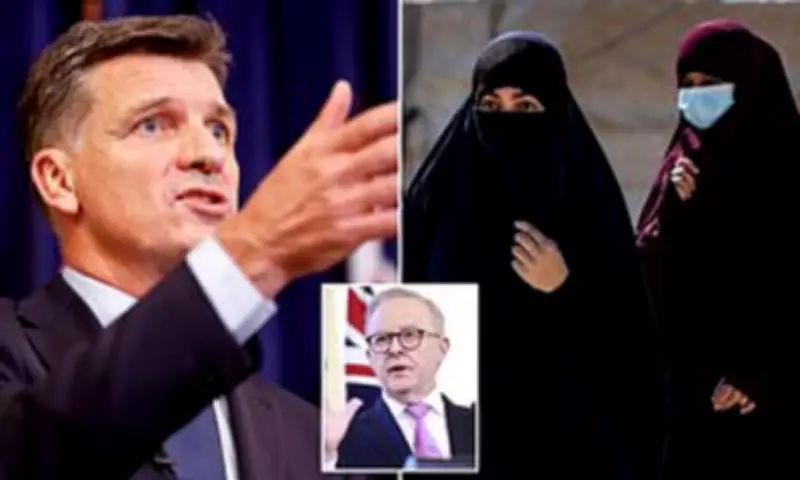
Opposition Leader Angus Taylor has launched a blistering verbal assault on Prime Minister Anthony Albanese, directly accusing him of lying about his government's role in facilitating the return of Australian ISIS brides and their children from Syria. In a dramatic escalation of political rhetoric, Taylor claimed the Labor administration has spent 'several years' covertly planning for the repatriation of these women and children from Syrian refugee camps.
Heated Exchange Over National Security
Taylor's extraordinary choice of language came during an interview with The Saturday Telegraph, where he stated: 'I'm calling bulls*** on the Prime Minister.' This inflammatory remark followed closely on the heels of Albanese himself using the same phrase earlier in the week during an appearance on The Karl Stefanovic Show, creating a remarkable tit-for-tat exchange between the nation's top political leaders.
Government's Official Position Challenged
The Opposition Leader specifically targeted Home Affairs Minister Tony Burke, alleging he has been 'up to his eyeballs in assisting the repatriation' despite official government statements to the contrary. Taylor vowed to continue 'forensically looking for the facts that Australians deserve to know,' suggesting a systematic investigation into the government's actions regarding this sensitive national security matter.

Prime Minister Albanese had previously used identical language to deny allegations that Burke had made any pre-election deals with refugee advocates regarding the repatriation. 'I call bulls***,' Albanese declared, explaining that his government had actually opposed a court case brought by non-government organisations demanding repatriation and had successfully defended their position.
Passport Issuance Fuels Controversy
The controversy intensified last week when Burke confirmed that 11 Australian ISIS brides had been issued Australian passports, while simultaneously maintaining that the government was not 'conducting repatriation' for them. This apparent contradiction has provided ammunition for Taylor's accusations of government duplicity.
Government officials revealed that a delegate had been sent to the Al Roj camp in northeastern Syria, where the families have been detained for seven years, to perform DNA tests and issue travel documents. The camp conditions have been widely described as 'inhuman,' adding humanitarian dimensions to the complex political debate.
Albanese's Compassionate Stance
Prime Minister Albanese has repeatedly emphasized his government's position, stating this week: 'We've said that we have compassion for the children involved, but that others who chose to travel to that area have made those decisions in life.' He reiterated that Australia was not 'providing repatriation' to the women and their children, drawing a distinction between administrative processes and active assistance with return.
The women in question travelled to Syria between 2014 and 2019 to live with, support, or marry members of the Islamic State terror group. Following the collapse of the IS caliphate, they and their children have been detained in Syrian refugee camps under difficult conditions.
Proposed Legislative Response
In response to the situation, Taylor has proposed tough new legislation that would make it virtually impossible for ISIS brides to return to Australia. His proposed bill would create criminal penalties for anyone assisting Australians with links to Islamic State in returning home, representing a significant hardening of Australia's approach to returning foreign fighters and their associates.
'We will take action and refuse to let people come here who abandoned Australia to support Islamic extremist terror overseas,' Taylor declared. 'We must shut the door to people who do not share our values – and these people rejected our values in favour of terror.' He described the legislation as designed to 'protect Australia's way of life' from those who had voluntarily aligned themselves with terrorist organizations.

Camp Director's Revelations
Adding complexity to the situation, Syrian camp director Hakamia Ibrahim has identified two of the Australian women as 'extremists' who are being held separately from the main group of 11 women and 23 children. These children have been pleading with the Australian government to facilitate their return to Australia, creating emotional pressure on policymakers.
'In the camp, they [the Australians] did not cause problems – except for two people, of course,' Ms Ibrahim told The Australian. 'They are still among the extremists, from the extremist women.' This distinction between different categories of detainees highlights the nuanced challenges facing Australian authorities as they navigate this politically charged issue.
The escalating conflict between government and opposition over this matter reflects deeper divisions about national security, immigration, and Australia's responsibilities toward its citizens who have made choices contrary to national interests. As both sides dig in their positions, the fate of the women and children in Syrian camps remains uncertain, caught between humanitarian concerns and security imperatives.