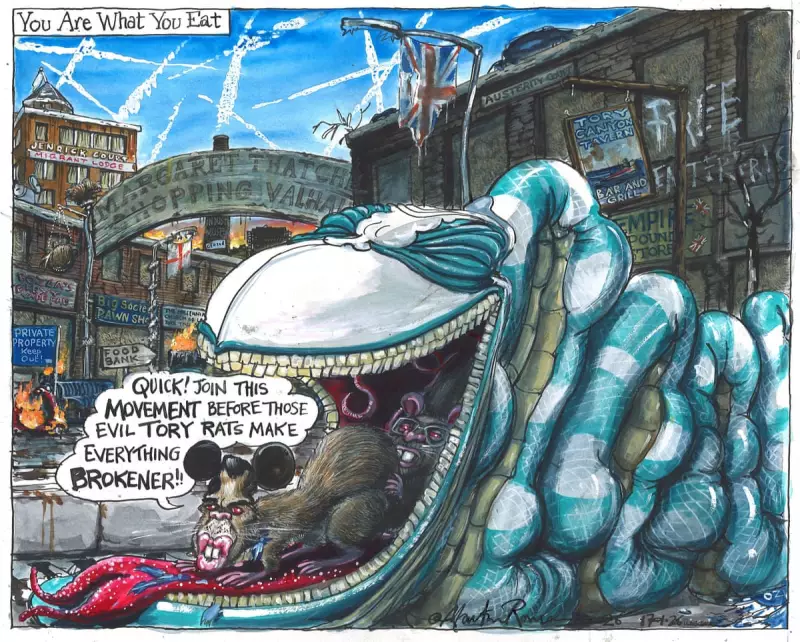
The British political landscape is undergoing a seismic shift, captured with characteristic bite by renowned cartoonist Martin Rowson. His latest work, published on 16th January 2026, visualises the growing crisis within the Conservative Party as MPs defect to the rival right-wing party, Reform UK.
The Satirical Lens on a Political Exodus
Martin Rowson, a veteran satirical artist for The Guardian, uses his pen to dissect the ongoing turmoil. The cartoon, a potent piece of political commentary, depicts the defection of Conservative members of parliament to Nigel Farage's Reform UK. This visual metaphor lays bare the fragmentation and internal strife plaguing the Tories, suggesting a haemorrhaging of support and a fundamental challenge to the party's unity and direction.
The artwork is not merely an observation but a sharp critique. It underscores a pivotal moment where longstanding party loyalties are being severed, driven by ideological disputes and electoral calculations. The date of publication, 16th January 2026, anchors this event in a specific political chronology, marking a significant point in the run-up to any future general election.

Analysing the Implications of the Defections
This exodus of MPs is more than just personnel change; it represents a profound realignment on the right of British politics. Each defection weakens the Conservative Party's parliamentary standing while simultaneously bolstering Reform UK's credibility as a serious political force. Rowson's cartoon likely amplifies the sense of chaos and decline within Tory ranks, a narrative that can be deeply damaging in the court of public opinion.
The move signals that for some on the right, the Conservative Party under its then-leadership has drifted too far from its core principles, particularly those associated with a hardline stance on issues like immigration and Brexit. Reform UK is positioned as the purer vessel for these beliefs. This splintering risks dividing the right-wing vote in future elections, which could have dramatic consequences for the electoral fortunes of both parties involved.
What Rowson's Art Tells Us About the Future
Satire often serves as a bellwether for deeper political currents. Rowson's depiction is a stark warning to the Conservative leadership about the perils of internal division. The cartoon suggests a party in existential crisis, struggling to define itself and hold its coalition together. For Reform UK, the imagery validates its strategy of poaching disaffected Tories, presenting itself as a dynamic and growing alternative.
The long-term consequences are multifaceted. For Westminster, it means a more fragmented and unpredictable political environment. For voters, it presents a more complex array of choices on the right. And for the Conservatives, it necessitates a urgent strategic response—whether that is a shift in policy to win back defectors, a more aggressive stance against Reform, or a fundamental internal reckoning.
In essence, Martin Rowson's cartoon of 16th January 2026 does more than elicit a chuckle; it provides a visual shorthand for a political earthquake. The defections to Reform UK are a symptom of a deeper malaise within British conservatism, and the satirical spotlight makes it impossible to ignore.