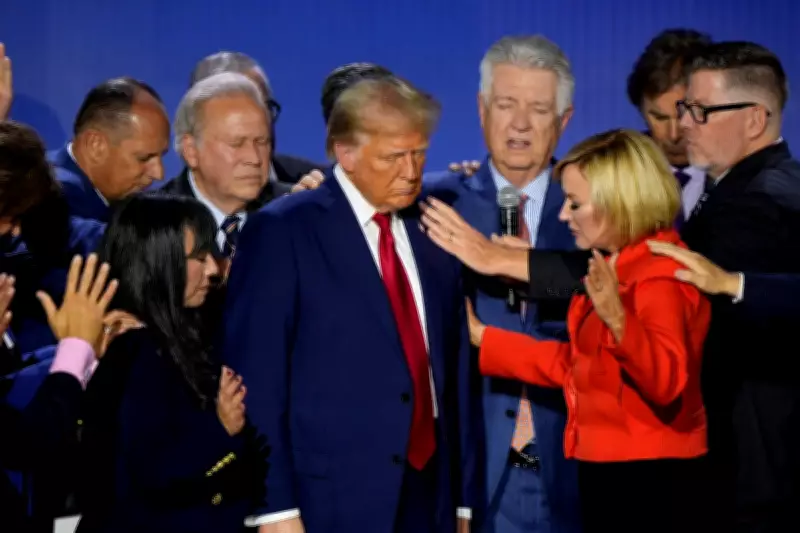
Donald Trump's personal spiritual advisor has ignited a fierce controversy after explicitly comparing the billionaire president's life and struggles to those of Jesus Christ during a White House Easter luncheon event. The televangelist Paula White-Cain, who has served as a key religious figure across both Trump presidencies, delivered a Wednesday address that drew direct parallels between the legal challenges and assassination attempts faced by Trump and the biblical trials endured by Christ.
Controversial Easter Address at the White House
Standing before an audience with President Trump positioned directly behind her, White-Cain turned to address him personally during her remarks. She stated that Jesus Christ demonstrated profound leadership and transformation through immense sacrifice, explicitly linking this to Trump's experiences. "Mr President, no one has paid the price like you have paid the price. It almost cost you your life," White-Cain declared, emphasizing the personal toll on the former president.
She further elaborated on this comparison, noting, "You were betrayed and arrested and falsely accused. It's a familiar pattern that our lord and savior showed us." White-Cain continued by asserting that just as Christ's story did not end with his trials, neither did Trump's, suggesting a divine plan for his resurgence. "Because he was victorious, you are victorious. And I believe that the Lord said to tell you this: because of his victory, you will be victorious in all you put your hands to," she concluded, receiving applause from attendees. President Trump responded to these remarks with a smile and a simple "thank you."

Immediate and Widespread Public Backlash
The comparison has provoked an immediate and intense backlash across social media platforms, with many users branding the statements as outright blasphemy and theological insanity. Catholic theologian Rich Raho expressed his dismay on social media, posting, "Blasphemous. It's stunning to see a US Bishop standing right there on the stage while Paula White compares Trump to Jesus Christ."
Other commentators echoed this sentiment, with Syed Zada criticizing the politicization of faith, stating, "If every leader who faced backlash started claiming a messianic arc, history would look like a Sunday school parody. Faith is sacred. Turning it into a campaign prop at a White House lunch isn't divine. It's theatrical." Additional social media users described the comments as deeply offensive and sacrilegious, with one noting, "As a Catholic, I find this woman completely sacrilegious and offensive on every possible level."
Political strategist Jeff Timmer offered a harsher assessment, labeling those involved as "freaks, liars, charlatans, grifters, criminals – anything but Christians. All of them." This reaction highlights the divisive nature of the remarks and their perceived crossing of religious boundaries for political endorsement.
Paula White-Cain's Role and Previous Controversies
Paula White-Cain was first officially appointed to a White House position in 2019, serving as a religious advisor within the Office of Public Liaison. However, her connection to Donald Trump reportedly dates back to 2002, when he contacted her after seeing her television broadcasts. She has since become a pivotal figure in the Trump administration's strategy to maintain and mobilize evangelical Christian voter support, even speaking at the president's inauguration in 2017.
Despite her influential role, White-Cain has frequently been at the centre of significant controversies. In 2020, she delivered a sermon calling upon Jesus Christ to "command all satanic pregnancies to miscarry," a statement that drew widespread criticism. She has also previously declared the White House to be "holy ground" and asserted that "to say no to President Trump would be saying no to God."
More recently, last month she urged her followers to donate "the first tenth of your gross income" to support her ministry and its causes, including funding projects in Israel. This history of provocative statements underscores her controversial approach to blending evangelical messaging with political support, further fueling the current outrage over her Easter comparison.

Broader Implications for Political and Religious Discourse
The incident raises serious questions about the intersection of faith and political leadership in contemporary American politics. By drawing a direct analogy between a sitting president and a central figure of Christianity, White-Cain's comments challenge traditional religious sensitivities and risk alienating segments of the faithful who view such comparisons as inappropriate or heretical.
This event also reflects the ongoing efforts within certain political circles to frame political struggles in overtly religious terms, potentially leveraging spiritual narratives for electoral advantage. The backlash serves as a reminder of the fine line between religious expression and political endorsement, particularly in a diverse society with varying theological perspectives.
As the controversy continues to unfold, it remains to be seen how this will impact the relationship between the Trump campaign and evangelical voters, a demographic crucial to his political base. The incident may prompt broader discussions about the appropriate role of religious rhetoric in political settings and the boundaries of acceptable spiritual comparisons in public discourse.