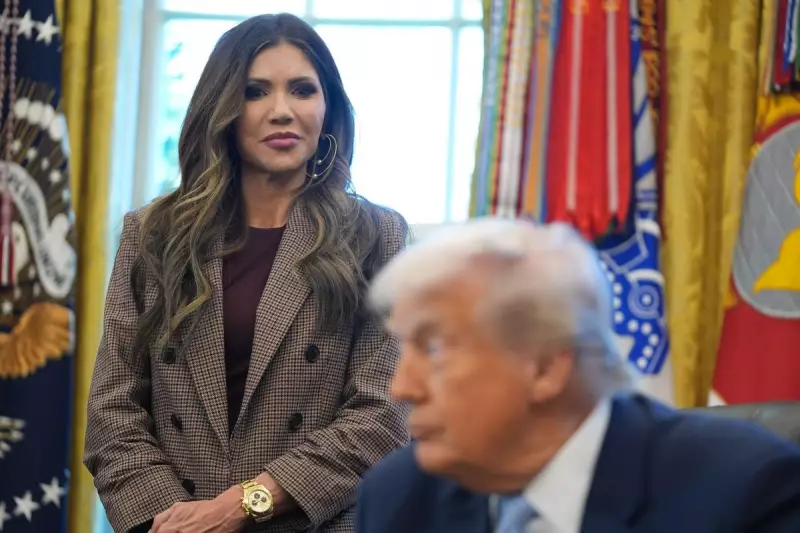
President Donald Trump has adopted an unusually cautious stance regarding the fatal shooting of a U.S. citizen by federal immigration agents in Minneapolis, declining to offer the robust defence of Homeland Security Secretary Kristi Noem that characterised his response to a similar incident earlier this month.
A Stark Contrast in Presidential Responses
The latest controversy centres on Alex Pretti, a 37-year-old intensive care nurse who was beaten and shot by Customs and Border Protection officers on Saturday. Pretti had been assisting a fellow protester demonstrating against the federal presence on Minneapolis streets when the violent encounter occurred.
This incident stands in marked contrast to the administration's handling of the killing of activist Renee Good by an ICE agent earlier in January. On that occasion, President Trump immediately endorsed the version of events presented by Secretary Noem and the Department of Homeland Security, who claimed Good was a "domestic terrorist" attempting to injure officials with her vehicle, despite contradictory video evidence.

Measured Words from the Oval Office
When questioned by The Wall Street Journal about Pretti's killing, for which Secretary Noem maintained was a "defensive" measure because the victim allegedly carried a 9mm semiautomatic handgun, Trump offered a notably restrained response.
"We're looking, we're reviewing everything and will come out with a determination," the president stated during a five-minute phone interview on Sunday. Pressed further on the matter, Trump elaborated: "I don't like any shooting. I don't like it. But I don't like it when somebody goes into a protest and he's got a very powerful, fully loaded gun with two magazines loaded up with bullets also. That doesn't play good either."
The president characterised the weapon Pretti allegedly carried as "very dangerous" and "unpredictable," claiming it was "a gun that goes off when people don't know it."
Political Pressure Mounts on Multiple Fronts
President Trump's tempered comments come as Secretary Noem faces mounting political pressure, including calls for her resignation and threats of impeachment from Democratic governors Kathy Hochul of New York and Gavin Newsom of California. This growing outrage stems from her management of the administration's intensified crackdown on undocumented migrants.
When questioned about the timeline for withdrawing approximately 3,000 federal forces from Minnesota, Trump responded: "At some point we will leave. We've done, they've done a phenomenal job... We'll leave a different group of people there for the financial fraud."
The president referenced a welfare-fraud scandal in Minnesota as justification for the immigration enforcement surge, describing it as "the biggest fraud anyone has seen" while suggesting California might experience "much bigger" issues.
Social Media Diversions and Architectural Ambitions
On his Truth Social platform Sunday, President Trump largely avoided substantive discussion of the Minneapolis shooting. Instead, he praised allies appearing on Fox News to address the tragedy and called on Minnesota Governor Tim Walz and Minneapolis Mayor Jacob Frey to "formally cooperate with the Trump Administration to enforce our Nation's Laws, rather than resist and stoke the flames of Division, Chaos, and Violence."
The president devoted more digital attention to complaining about changes to NFL broadcasting arrangements and issuing a lengthy post about his under-construction $400 million White House ballroom. This controversial project involved demolishing the East Wing and now faces legal challenges from the National Trust for Historic Preservation, which filed a lawsuit in December.
"Making such a large gift to the U.S.A. was thought to be, by almost everyone, 'A WONDERFUL THING TO DO' – But no, as usual, I got sued, this time by the Radical Left National (No!)Trust for Historic Preservation, a group that couldn't care less about our Country!" Trump complained in his characteristic style.
The president's divergent responses to these two similar incidents involving federal agents and civilian deaths reveal a shifting political calculus as pressure mounts on his administration's immigration enforcement policies and key cabinet members face unprecedented scrutiny.